

Hey there!
Welcome to Issue #139 of Better Bioeconomy, weekly insights on how tech is reshaping food and agriculture for better human and planetary health. Thanks for being here!
The Strait of Hormuz blockade, in place since March 2, has removed 43% of global seaborne urea from the market. Urea prices have jumped over 30% since. Northern Hemisphere planting decisions are weeks away.
Against that backdrop, this issue carries three different approaches to reducing dependence on conventional nitrogen supply chains. PlasmaLeap’s A$30 million raise produces nitrogen from air, water, and renewable electricity in modular on-farm units.
Crop Diagnostix, which launched commercially this month, takes a different angle: RNA sequencing of plant leaf samples to tell farmers precisely when they don’t need to apply nitrogen. In field trials that translated to a 38% reduction in nitrogen use alongside an 8% yield increase.
Vietnam’s low-emission rice programme shows what systematic reduction looks like at scale: 354,000 hectares reached two years ahead of target, a 38% reduction in nitrogen application per hectare, a 13.4% rise in farmer income.
The pattern also showed up outside this issue: Birufinery received investment this week for seaweed-microbe biostimulants claiming 30-50% fertiliser reduction in tropical plantation crops, and Rovensa Next launched a dual-microbial inoculant in Brazil targeting nitrogen fixation and phosphorus solubilisation across ten crops.
None of these is a complete answer to a supply crisis. PlasmaLeap is commissioning first-of-a-kind systems. Crop Diagnostix is launching in corn and potato only. Vietnam’s results came with guaranteed offtake that most markets won’t replicate. But the blockade has made the commercial case more convincing and urgent for all of them.
BIO BUZZ
Products, partnerships, and policies
🏭 Latam sugar giant Magdalena is building a 650,000-L precision fermentation facility in Guatemala, targeting high-value molecules
Founded in 1983 and still family-owned, Magdalena has long monetised sugarcane byproducts through molasses fermentation and bagasse-fired energy. Its new biochem unit goes further: a 650,000-L CMO facility breaking ground in May 2026, starting at 50,000 L with a 2,000-L pilot plant and scaling to full capacity by 2029.
The competitive case rests on three structural advantages: captive feedstock (sugar), existing bioprocessing infrastructure, and the acquisition of Biorbis, an R&D lab in Portugal previously owned by Amyris. Downstream kit will cover centrifugation, microfiltration, and spray drying, enabling industrial enzymes and dry protein formats.
In addition to the CMO play, Magdalena has launched Proteva, upgrading spent distillery yeast into functional feed and pet food ingredients via enzymatic hydrolysis. The longer-term ambition is to own proprietary molecules, focused on nature-identical compounds that are hard to scale conventionally.
Source: AgFunder News
Thoughts 🤔
Four decades of sugar cash flows, not venture capital, are funding this facility. That removes the liquidation timeline and growth mandate that push most fermentation startups toward premature scale. The feedstock is already integrated into core operations, so the marginal cost of fermentation inputs looks structurally different from a standalone build.
The CMO-first sequencing adds to this discipline. Contract manufacturing revenue from clients like Coca-Cola and Bacardi validates the process stack before Magdalena commits capital to proprietary molecule development. The Biorbis acquisition is worth noting here: Amyris’s Portugal R&D lab, picked up during bankruptcy in 2023, likely gives Magdalena strain development capability for that longer-term play. Amyris failed partly because it tried to own strain IP, manufacturing, and consumer brands simultaneously without the cash flows to sustain all three. Magdalena is taking the science without the overhead.
I think what determines whether the proprietary pipeline moves from ambition to funded R&D is how CMO margins hold up. If contract manufacturing stays profitable long enough to self-fund the next phase, the sequencing makes sense. If margins compress as more fermentation capacity comes online, Magdalena faces the same capital problem it was designed to avoid.
🍫 Puratos to launch the world’s first cell-based chocolate for commercial use by end of 2026
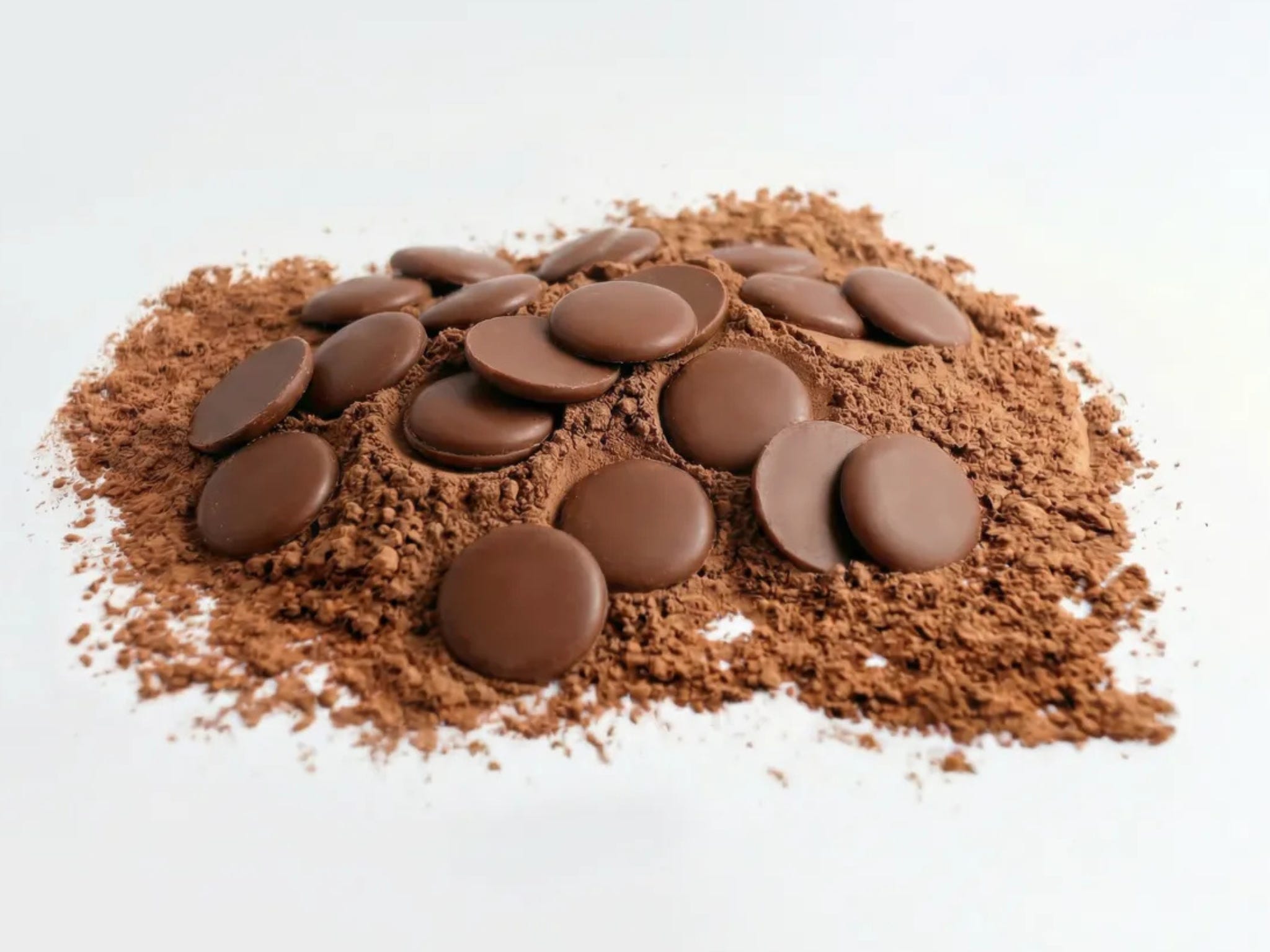
Belgian confectioner Puratos, which invested in California Cultured through its VC arm Sparkalis, will now bring a cell-based cocoa product to its US customer base by the end of the year.
Puratos frames cultured cocoa as a “climate-independent and sustainable complement” to conventional farming, citing more consistent quality and supply. It is drawing on its flavour development and sensory science expertise to ensure the ingredient meets food manufacturer expectations.
For chocolate makers, the appeal is a cocoa ingredient free from supply volatility. The commercial launch moves cultured cocoa from scientific proof to a dependable ingredient that manufacturers can plan around.
Source: Green Queen
Thoughts 🤔
Two major chocolate incumbents anchoring commercial products around the same startup, before FDA GRAS clearance is even secured, is interesting. Puratos is both investor via Sparkalis and first commercial channel for the US market. Meiji, Japan’s largest chocolate company, signed a 10-year supply agreement targeting both the US and Japanese markets. Together, that is a multi-anchor launch strategy that distributes commercial proof across geographies and buyer types before the product is fully approved.
That structure matters for plant cell culture broadly. The technology has been validated for niche cosmetic and supplement ingredients, but a high-volume food commodity like cocoa is a harder test. Flavour complexity, performance specs across bakery and confectionery, and procurement scrutiny from professional food manufacturers all set a higher bar.
If both launches perform on taste and batch consistency, California Cultured becomes the one of clearest proof-of-concept for plant cell culture moving from niche botanicals into commodity food ingredients. If either struggles at scale, the window narrows considerably, and the sector’s broader ambitions take longer to prove out.
🔁 California Cultured completes first commercial-scale run of plant cell-cultured cocoa using $3k reusable plastic bioreactors
Plant cell culture has historically relied on expensive stainless steel tanks. California Cultured’s proprietary rigid plastic bioreactors run at 2,000-L, can be reused thousands of times and cost ~$3k each. A comparable stainless steel tank could cost $500k to $1M.
Automated control software lets large numbers of reactors run with minimal labour, compressing both capital and operating costs. The scale-out model deploys many inexpensive modular units in retrofitted light industrial space, avoiding the centralised mega-plant economics that have made biomanufacturing difficult.
The first product, a cultured cocoa powder with zero lead and cadmium, is positioned as a flavanol-boosting health ingredient rather than a direct cocoa replacement.
Source: AgFunder News
Thoughts 🤔
Most biomanufacturing scales by building fewer, larger, more expensive units. California Cultured runs in the opposite direction: many small, cheap reactors in retrofitted light industrial space, with automated control software compressing the labour cost that usually scales with unit count. That is a scale-out model, and it appears in other technology cycles at the point where centralised infrastructure proves too capital-intensive to deploy quickly enough.
The CAPEX compression matters beyond cocoa. Stainless steel infrastructure costs have kept commodity food applications using plant cell culture structurally out of reach. If $3k reusable reactors hold at 2,000L and above, the cost game for plant cell culture across a wider range of crop inputs changes significantly.
But whether the architecture generalises is the open question. Reactors optimised for a single cocoa cell line are a specific case. Different plant species, growth parameters, and contamination profiles may each limit transferability. If those constraints are manageable, California Cultured may have built a manufacturing template as much as a product.
🛒 Nestlé launches Snack Vibes in Germany using Planet A Foods’ cocoa-free chocolate alternative
Snack Vibes goes on sale next month under Nestlé’s Choco Crossies brand in Germany, targeting Gen Z in three flavours: classic, hazelnut, and salted popcorn caramel. Each 100g pack retails at €2.79 and is made with Planet A Foods’ ChoViva instead of conventional chocolate.
ChoViva is produced by fermenting and roasting sunflower and grape seeds to replicate cocoa’s aroma, flavour, and texture, combined with plant-based fats and sugar. It functions as a 1:1 cocoa replacement in vegan, dark, milk, and white chocolate formats.
Planet A Foods has expanded its Pilsen production facility from 2,000 to 15,000 tonnes annually, and has entered into a commercial partnership with Barry Callebaut. ChoViva is already in over 120 products across 10 countries and more than 100,000 stores globally, with partners including Lindt, Aldi, Lidl, Rewe, and Kaufland.
Source: Green Queen
🐶 Magic Valley launches Australia’s first cultivated meat for dogs
Training Bites blend cultivated pork with oat flour, apples, sweet potatoes, and brewer’s yeast. Sold in limited drops at A$14.95 per 50g pack, they are the first cultivated meat product available for pets in Australia and Magic Valley’s first commercial proof point for its broader pork platform.
Pet food regulation in Australia sits under voluntary industry standards rather than government approval, giving the company a faster path to market than human cultivated meat requires. Magic Valley is using Rogue Pet to build real operating capability across production, fulfilment, and repeat purchase.
The first drop selling out in a week gives Magic Valley something rare in cultivated meat: real customer demand and early revenue. Future drops, expanded market reach, and B2B supply to other pet food brands are on the roadmap.
Source: Green Queen
🌾 Vietnam has nearly doubled its low‑emission rice target two years early by reducing adoption risk
The programme set out to cover 180,000 hectares of low-emission rice between 2024 and 2025. By the end of 2025, it had reached 354,000. The acceleration largely came from a single structural change: guaranteed offtake for every tonne produced, removing the market risk that typically stalls smallholder adoption.
Participating farmers adopted mechanised seeding and improved water management, cutting emissions by 3-4 tonnes of CO₂e per hectare against conventional growing. Average farmer income rose 13.4%. Vietnam also piloted its Measurement, Reporting and Verification (MRV) process across 11 model areas, with both staff and farmers able to run it independently.
The government plans to add 800,000 more hectares before 2030. Over 5,000 hectares are already certified under a "green rice" label, positioning the crop for market differentiation and climate-aligned trade premiums.
Source: AgTechNavigator
Thoughts 🤔
Smallholder adoption of known-good farming practices almost always stalls at the same point: who absorbs the market risk when the practice works but the price doesn’t.
What Vietnam assembled was a risk transfer architecture rather than a technology programme. Guaranteed offtake removed farmer downside. World Bank carbon payments added a revenue stream not contingent on commodity prices. A green export premium, with certified rice reaching $820 per tonne against $400-450 for conventional Vietnamese fragrant rice, layered a third incentive on top. The farming practices were already well-documented. The bottleneck was never agronomic.
That distinction is important if we want to replicate this across regions. The constraint being solved here is an institutional one. Other rice-growing countries in Southeast Asia face the same adoption stall on similar known practices. Can the multilateral financing and offtake commitments that made Vietnam’s architecture work can be assembled elsewhere without compressing the premium?
🌽 Crop Diagnostix uses RNA sequencing to flag crop disease up to four weeks early
The California-based startup borrowed a diagnostic approach from human medicine and applied it to crops. It reads which genes are active in plant tissue to detect nutrient deficiency, disease pressure, drought, and water stress before any visual sign appears. By the time symptoms show, the damage is already done.
Growers send weekly leaf-punch samples in vials and receive results within 48 hours across four indexes: yield response, nutrient status, pathogen stress, and water stress, trained on thousands of real-world RNA samples from corn and potato fields. In field trials, the system detected disease four weeks before visible symptoms.
Pilots in corn and potato showed an 8% yield increase and 23% reduction in inputs, including a 38% cut in nitrogen, translating to a claimed $720/acre net profit advantage. At $500-700 per field per season, the company is launching commercially in 2026 through agronomy partners including CHS and Wilbur-Ellis.
Source: AgFunder News
Thoughts 🤔
Current crop agronomy is typically organised around visible symptoms. You scout, you see something wrong, you respond. RNA diagnostics flip that sequencing: reading gene expression before any damage appears means the decision window shifts from damage control to prevention.
The four-week lead time is what makes this practically meaningful. Most fungicide and nitrogen timing decisions are already constrained by application windows and crop growth stages. A four-week signal opens up interventions that simply aren’t available when diagnosis happens at symptom onset.
The harder question, I think, is behavioural. Pre-symptomatic data asks growers and agronomists to act on an invisible signal. That’s a different decision-making posture, and the distribution channel here (retailer-affiliated agronomists at CHS and Wilbur-Ellis) inherits grower trust but still has to translate an RNA report into a management change.
If the platform performs consistently beyond the corn and potato pilots, the adoption constraint is likely less about the science and more about whether agronomists are trained and incentivised to use it that way.
BIO BUCKS
Funding, M&As, and grants
🍌 Tropic raised $105M Series C to scale gene-edited banana varieties and deploy TR4-resistant Cavendish from 2027
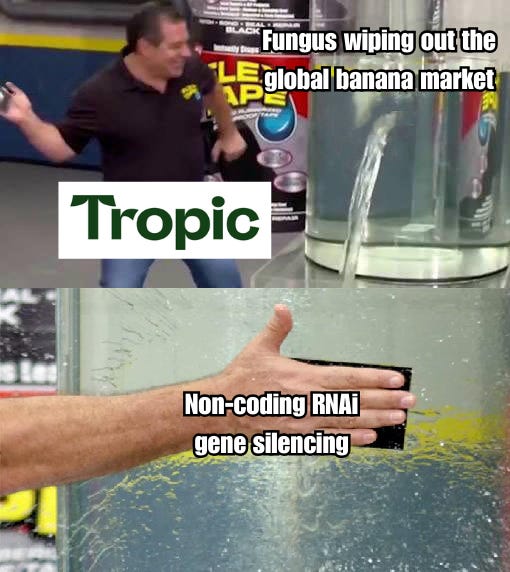
The UK-based company has regulatory approval for non-browning and extended shelf-life bananas in five markets. The non-browning variety knocks out the oxidation enzyme, unlocking cut fruit applications. The shelf-life product suppresses ethylene production, adding 10+ days to supply chain windows and cutting cold transport costs.
TR4 resistance is built on Tropic’s patented Gene Editing Induced Gene Silencing (GEiGS) platform, which edits non-coding genes. Instead of searching through 30,000+ candidate genes for a knockout target, GEiGS redirects the banana’s own RNAi machinery to attack a specific gene inside the fusarium fungus. The approach is tissue-specific, avoids GMO classification, and doesn’t require a full gene knockout.
TR4 threatens a $25bn industry across Southeast Asia, Africa, and Latin America. Tropic is establishing a mother plantation ahead of commercial deployment from 2027, with capital also funding Black Sigatoka resistance, rice, and new crops. GEiGS is already licensed to Corteva for corn and soybean, British Sugar for sugar beet, and Genus for livestock disease resistance, pointing to platform value well beyond bananas.
Investors: Forbion Bioeconomy Fund, Corteva, IQ Capital, Just Climate, ABN Amro, Invest International, Temasek, and more.
Source: AgFunder News
Thoughts 🤔
The banana supply chain cannot switch away from Cavendish at the pace TR4 is spreading. Variety standards, handling protocols, packaging, and retail contracts are all tuned to a single cultivar, and switching is not realistic even under an existential disease threat. That structural lock-in is what makes TR4 resistance a sale into a captive market. Whoever can fix Cavendish in situ is filling a gap with no substitute.
The oversubscribed round in a compressed funding environment makes more sense in that context, though the cap table suggests more than one thesis at work. It spans a commodity sugar trader (Sucden), development finance institutions (Invest International, ABN Amro), a climate fund (Just Climate), and a strategic ag company (Corteva), capital types that rarely share a syndicate. That breadth points to food security, supply chain resilience, and platform licensing all being priced in simultaneously.
GEiGS is also being deployed well beyond bananas. The platform is already licensed to Corteva for corn and soy, British Sugar for sugar beet, Genus for livestock genetics, and Syngenta Vegetable Seeds, four distinct applications across plant and animal species, before the banana product has reached commercial scale. The platform is accumulating proof of concept across a wider crop base than any banana franchise alone could justify.
But what determines whether GEiGS becomes primarily a licensing platform or a crop company with a licensing arm is whether the banana deployments generate the field-scale performance data that licensees in higher-volume crops need to double down on their commitments.
⚡ PlasmaLeap raised A$30M Series A to deploy zero-emissions, on-farm nitrogen fertiliser production from air, water, and renewable electricity
The University of Sydney spinout uses a patented plasma reactor to convert air, water, and renewable electricity into ammonia and nitric acid with no fossil fuel inputs. Its modular systems are designed to slot into existing fertiliser supply chains and can be deployed directly on farms or at local hubs.
Conventional nitrogen production relies on Haber-Bosch and long supply chains. Nitrogen fertiliser accounts for ~2.5% of global CO2e. In parts of sub-Saharan Africa, retail prices reach nearly double the world free-on-board price because of importation, logistics, and financing costs. Decentralised production addresses both problems at once.
Capital will fund first-of-a-kind hubs in New South Wales and Tasmania. The company expects carbon credits from its decarbonisation impact, with the platform producing synthetic hydrocarbons from biogas or syngas in the longer term.
Investors: Gates Foundation, Investible, Yara Growth Ventures, Twynam, GrainCorp Ventures, and more.
Source: PR Newswire
Thoughts 🤔
Nitrogen fertiliser in parts of sub-Saharan Africa retails at nearly double the world free-on-board price. That gap is not a production problem, it is logistics, importation financing, and supply chain intermediation. Decentralized plasma production does not need to beat Haber-Bosch on synthesis cost to win in those markets. It only needs to undercut the landed cost of imported product, which is a lower bar than the green ammonia narrative typically frames it.
That distinction could reshape the commercialization sequence. In markets where nitrogen deficit directly constrains yields, and where the premium over production cost is absorbed entirely by the supply chain rather than growers, proximity to the farm is itself the value proposition. The technology does not need carbon credit revenue or a green premium to be viable.
The Gates Foundation anchoring this round alongside Yara and GrainCorp suggests the investor syndicate is pricing in both development market deployment and existing agricultural supply chain integration simultaneously. Those are different go-to-market paths with different procurement rails, timelines, and success conditions.
🥛 Verley raised €32M Series A to scale its precision-fermented whey proteins and launch in the US by year-end
The French startup’s near-term commercial focus is on protein shots, where its purified beta-lactoglobulin delivers high protein concentration while keeping clarity, solubility, and stability intact. First products featuring FermWhey are expected to hit the US market by the end of 2026.
Verley is operating as a B2B ingredient supplier, targeting food manufacturers and brands that can apply their own formulation expertise and market infrastructure. To scale, it is using a hybrid model combining its own pilot facility with industrial manufacturing partners in Europe and North America, before transitioning to large-scale facilities capable of multi-thousand-tonne annual volumes.
Following its US launch, the company is advancing regulatory pathways in Europe and the Middle East. The oversubscribed round was won on execution: FDA clearance, validated industrial performance, a growing IP portfolio, and commercial demand that already exceeds current production capacity.
Investors: Alven, Blast, Bpifrance, Sofinnova, Sparkfood, Captech, and Founders Future.
Source: Green Queen
🍼 Guoke Xinglian raised $14.6M Series A+ to scale up precision-fermented human lactoferrin with human-identical glycosylation
Lactoferrin is the most abundant immune glycoprotein in breast milk, revered for gut health and iron transport, but present in cow’s milk at concentrations 10x lower than in human milk. Beijing’s Guoke Xinglian uses precision fermentation to produce a bioidentical version, more effectively absorbed and gentler than its bovine counterpart.
The key challenge is glycosylation, attaching sugar molecules to the right positions on the protein, which affects its folding, stability, antigenicity, and resistance to breakdown. The company claims to be the only firm to express human milk glycoproteins via food-grade yeast, using a Kluyveromyces martensii chassis with glycosylation editing.
Human lactoferrin has entered trial production, with Guoke Xinglian targeting both domestic and overseas B2B supply to infant formula, women’s wellness, health supplement, and functional nutrition brands. The fresh capital will fund AI-driven platform scale-up and global market expansion.
Investors: Shanghai Zhuiguang Julian, Lenovo Capital, Changjin Holdings
Source: Green Queen
🎯 AgZen raised $10M Series B to scale real-time spray monitoring that cuts chemical inputs by up to 50% without yield loss
The MIT spinout’s RealCoverage system bolts onto any sprayer and uses high-speed cameras to track droplet coverage across the leaf at speeds up to 18mph, detecting droplets as small as 150 microns. It shifts spray management from gallons-per-acre rules to micro-ounces per square millimetre of leaf surface.
The AI layer processes live coverage data against variables including nozzle type, pressure, boom height, canopy structure, and wind speed, then issues specific real-time adjustments to the operator. A second product, EnhanceCoverage, due commercially in 2027, wraps droplets in adjuvants at the nozzle rather than in the tank, enabling further input reductions.
The system covered one million acres in 2025 and has commitments for over two million acres across the US, Australia, and Argentina in 2026. The company also announced a strategic partnership and investment from Syngenta Group Ventures, signalling that agchem sees real-time droplet intelligence as infrastructure.
Investors: DCVC Bio, Material Impact, Astanor, and Syngenta Group Ventures.
Source: AgFunder News
Thoughts 🤔
Spray management in commercial agriculture has been governed by gallons per acre for decades. RealCoverage shifts the unit to micro-ounces per square millimetre of leaf surface, and that difference matters for more than farm efficiency.
When coverage is measurable, what growers are buying changes. Volume procurement becomes performance procurement. That creates conditions for premium pricing on high-efficacy formulations. The competitive axis shifts from price per litre to ROI per leaf.
The agchem response to this is visible in the cap table. Syngenta sees RealCoverage as infrastructure for how crop protection products are “tested, sold, and eventually formulated.” What that means in practice is a product development dataset that does not otherwise exist: 150-micron droplet coverage mapped against canopy structure, product, and outcome across millions of acres. Corteva also signed a partnership in October 2025. Two competing majors on the same platform is a strong infrastructure signal.
🧫 baCta raised €7M seed to produce astaxanthin via AI-optimised yeast fermentation for cosmetics and nutraceutical markets
Astaxanthin is a crimson antioxidant used in dietary supplements, cosmetics, and animal feed, but today’s supply is mainly split between petrochemical synthesis and algae cultivation. The Paris-based startup uses generative AI and liquid-handling robotics to rapidly engineer yeast strains that produce astaxanthin in fermentation tanks, iterating continuously on yield and efficiency.
baCta claims that yeast reaches over 100g/L biomass density in a bioreactor, compared to under 5g/L for algae in photobioreactors. Combined with a proprietary downstream process that avoids supercritical CO2 extraction, baCta’s cost target is in line with synthetic producers. Its astaxanthin is also claimed to be in the free, non-esterified form, making it more bioavailable than the algae version.
The company targets cosmetics and nutraceuticals, positioning astaxanthin as an underexploited longevity ingredient. Fresh capital will fund scale-up validation and platform expansion to additional high-value ingredients. Regulatory filings are planned through GRAS in the US and the novel food pathway in the EU.
Investors: LocalGlobe, Daphni, and OVNI Capital
Source: AgFunder News
🌱 Amatera raised €6M to accelerate climate-smart crop breeding by screening at the cell culture stage
Conventional breeding of perennial crops like coffee or wine grapes can take over 20 years and cost millions. Amatera induces spontaneous genetic variation at the cell culture stage using physical and chemical approaches, generating large libraries of non-GMO cell lines that can be sequenced and screened before any plant is grown.
Standard practice regenerates all cells into plants before genotyping. Amatera inverts this: it isolates individual cell lines, sequences them in culture, and only regenerates the promising candidates into whole plants. That removes the screening bottleneck and cuts time and cost significantly.
For perennials, the company develops varieties in-house and licenses them. For annual row and vegetable crops, it offers the platform directly to seed companies. Current candidates in nursery trials include a Robustica coffee combining Robusta disease resilience with Arabica taste, a caffeine-free Arabica, and wine grape varieties resistant to downy mildew and black rot.
Investors: Demea Sustainable Investment, Oyster Bay, PINC, Mudcake, Exceptional Ventures
Source: AgFunder News
🧬 Bindbridge raised $3.8M to design molecular glue herbicides that turn weeds’ own protein recycling machinery against them
The UK-based startup uses molecular glues, which are single small molecules that hijack a cell’s protein degradation system, forcing weeds to destroy their own essential proteins. Unlike PROTACs (Proteolysis-Targeting Chimeras), which are large two-part molecules that are hard to optimise, molecular glues are closer in scale to conventional herbicides and easier to formulate for field conditions.
The company’s BRIDGE platform uses AI-driven structural modelling to discover and design these molecules, predicting which compounds can bring two target proteins together to trigger degradation. The platform also filters for agronomic properties like molecular size, charge, and hydrophobicity, ensuring designs translate to the field.
The funding will support co-development partnerships with ag chem companies and the first round of lab testing. Bindbridge’s initial focus is a broad-spectrum glyphosate replacement, with a longer runway into insecticides, fungicides, and sprayable plant traits for drought tolerance and nutrient use efficiency.
Investors: Nucleus Capital, Speedinvest
Source: AgFunder News
Thoughts 🤔
The new herbicide mode of action pipeline is sparse. Bayer’s Icafolin, announced in mid-2025 as the first new herbicide mode of action in over 30 years, won’t launch commercially until 2028 at the earliest. That context matters for Bindbridge because, from my understanding, induced protein degradation would be mechanistically distinct from what is being used commercially, not enzyme inhibition, not membrane disruption, but forcing target proteins to self-destruct via the cell’s own recycling machinery.
The big question is whether the BRIDGE platform can deliver it. Rational molecular glue design has advanced significantly in pharma, with multiple clinical-stage programs and dedicated computational platforms. But that progress is concentrated around well-characterised human E3 ligases with decades of structural data behind them. Plant protein targets don’t yet have that foundation. Whether AI-driven structural modelling can bridge that gap for agricultural biology, where the structural data is thinner, is the assumption the thesis rests on.
But that assumption will be tested relatively quickly. The first co-development partnerships and lab validation data will be the earliest signal either way.
🤖 Living Models raised $7M to build AI foundation models for plant genomics and compress the seed development cycle
The French startup applies the transformer architecture that powers large language models to plant DNA sequences, treating nucleotides as a language instead of relying on computer vision or phenotype-based analysis. Its BOTANIC series spans models from 100M to 1B parameters trained on 43 phylogenetically diverse plant species, with open-weight models available on Hugging Face.
Conventional trait discovery requires growing plants and working backwards from phenotypes. In-silico DNA experiments allow researchers to identify stress tolerance and yield stability traits before a plant is grown, targeting a development cycle that currently takes up to 8 years.
Fresh capital will fund model and platform development. CEO Cyril Véran has framed the plant genomics focus as a deliberate starting point, indicating that BOTANIC is a beachhead for a broader life sciences foundation model strategy.
Investors: Asterion Ventures, The Galion Project, Kima Ventures, STATION F, University of California Berkeley, and more.
Source: iGrow News
🍫 Cellva Ingredients raised $3.8M pre-Series A to scale its cocoa-free chocolate ingredient made from coffee production waste
The Brazilian startup extracts bioactive compounds from two coffee by-products (parchment and silver skin), microencapsulates them for stability, and supplies the result as a drop-in ingredient replacing up to 70% of cocoa in bakery, confectionery, beverage, and nutrition applications.
Instead of sourcing virgin agricultural inputs, the startup partners directly with coffee producers in Bahia’s regulated growing regions, building full traceability from farm to finished ingredient. The company’s ingredient, CoffeeCoa, carries a naturally sweet profile and is rich in antioxidants and fibre.
From gram-scale batches in 2024, the company projects processing around 2,000 tonnes of raw material this year. It is already supplying industrial bakery manufacturers and chocolate processors in Brazil, and is advancing commercial discussions with clients in Europe, Asia, and the US.
Investors: DigiBoard, Air Capital, Rubens Pereira
Source: Green Queen
🌍Join HackSummit 2026, get 15% off your pass using my code

HackSummit returns to Lausanne, Switzerland on April 22-23, 2026 for its 5th anniversary.
Over two days, founders, investors, and operators will explore how industrial capacity and food sovereignty are becoming foundational systems in a climate-constrained world.
Day 1 focuses on unlocking infrastructure, manufacturing, energy, and hard-tech systems that underpin resilience.
Day 2 dives into Food Sovereignty by scaling stable, regenerative, and secure food systems amid climate volatility and supply risk.
Join the builders shaping the next decade of industrial and biological resilience including Altrove, Paebbl, MicroHarvest, Hades Mining, AtomoCooling and Voltrac. As well as Partners and Managing Directors of Visionaries Tomorrow, Voltfang, Space Forge, FORWARD.one, Slate VC, Contrarian Ventures and Unruly Capital.
💰 Use my code 'BetterBio15' for 15% off your pass.
If you found value in this newsletter, consider sharing it with a friend who might benefit! Or, if someone forwarded this to you, consider subscribing.
Thank you, and have a great day!
Disclaimer: The views and opinions expressed in this newsletter are my own and do not necessarily reflect those of my employer, affiliates, or any organisations I am associated with.