

Hey folks!
Thanks for being here. In Issue #138 of Better Bioeconomy, I want to share something that has shifted in how I think about failure in agrifood.
For a long time, my working theory when a technology stalled was some version of: wrong market timing, wrong team, wrong capital structure. They were usually a company-level explanation. And often, those explanations are right.
But I kept noticing the same failure pattern across companies with different technologies, different founders, different geographies, and even different capital structures. Company-specific problems explain individual failures. They do not explain why the pattern repeats so consistently across companies that share almost nothing except the system they entered.
The Food and Agriculture Organisation (FAO)’s ‘Transforming food and agriculture through a systems approach’ report gave me the language for what I was noticing. The failure was not always a company-level problem. It was a system-level one: technologies trying to enter systems that were not designed to receive them.
Agrifood systems are not just supply chains
Before the interesting part, some grounding on what we are talking about.
When FAO uses the phrase “agrifood system,” it means something bigger than the farm-to-fork supply chain most people picture. It captures the full journey of food from production through processing, distribution, retail, and consumption, including all the waste that comes out the other end.
But it also includes the people, institutions, incentives, and policies that govern how food moves through that chain, and the relationships between the food system and everything else it touches: health systems, environmental systems, energy systems, water systems, and economic systems.
This interconnectedness is the central fact that makes food system problems so persistent.
Interventions in one part propagate through the system’s connections to every other part, often in ways that were not anticipated. Subsidise fertiliser to boost yields, and you can inadvertently degrade the waterways downstream that farmers depend on. Design food aid to address acute hunger, and you can simultaneously undermine the local markets that would have provided more durable food security. These outcomes do not require bad intentions. They emerge from the structure of the system itself.
This is also why the same intervention can succeed in one context and fail in another with almost identical surface conditions. The difference is rarely the technology. It is which part of the system the intervention enters, and what the downstream effects of that entry are. Most post-mortems on failed agrifood technologies do not ask this question.
Food governance was built to optimise within sectors, not across them
Fragmented food policy is not a coordination failure that could be fixed with better communication between ministries. It is the output of how food system governance was built.
Agricultural ministries optimise for yields and farm incomes. Nutrition departments optimise for dietary outcomes. Environmental regulators optimise for emissions and biodiversity. Trade departments optimise for export earnings.
Each of these actors is doing what their mandate requires, subject to budget cycles, performance metrics, and political accountability structures that reward progress on their specific objective. But they are not rewarded for thinking about what happens when all of these optimisation functions run simultaneously on the same underlying system.
A recent paper in Frontiers in Sustainable Food Systems identifies four overlapping governance challenges that explain why this pattern is so durable. One of them is what the authors call cross-temporal mismatch: the daily demands of keeping food supply moving pull institutions toward short-term decisions, while the structural changes needed to make food systems resilient play out over decades. The actors most responsible for managing the system’s immediate functioning are structurally the least positioned to redesign it.
Compound that with the difficulty of coordinating across distant value chain nodes, the absence of solutions that satisfy stakeholders with compatible priorities, and the complexity of integrating knowledge across communities that rarely talk to each other, and fragmented governance looks less like a political failure than an architectural one.
The result is a consistent pattern of unintended consequences. Productivity programs that increase yields while degrading the soils and water systems that underpin long-term productivity. Nutrition initiatives that ignore the food environments, retailer incentives, and processing economics that determine what people actually eat. Environmental policies that reduce emissions in one part of the system by pushing costs onto smallholder farmers in another.
FAO’s own policy analysis makes the distinction precise. The majority of food policies it surveyed acknowledged that cross-sector involvement was necessary to implement them successfully. Very few had built any institutional structure to carry that involvement out. The acknowledgement and the architecture are two different things, and the gap between them is where unintended consequences accumulate.
I see this dynamic in agrifood startups. A company might have a genuine technology: a biological input that demonstrably improves soil carbon, a digital tool that measurably reduces water use, a novel protein that cuts the emissions intensity of a diet. The science works, and the pilot results are real. But still, the technology stalls somewhere between proof of concept and at-scale adoption because the surrounding system was not designed to absorb it.
Rob Ward’s “Minimum Viable Ecosystem” concept put a useful framing on what I was observing in a guest piece for AgFunder News. He distinguishes between “challengers,” startups that compete against existing systems in isolation, and “disruptors,” who reconfigure the value chain so that all participants benefit from the change. Most agrifood startups launch as challengers and wonder why the system pushes back. The surrounding value chain has no reason to accommodate them and economic reasons to resist.
Most agrifood due diligence asks whether customers will buy the product. But perhaps the more predictive question is whether the value chain surrounding that customer has any incentive to accommodate the technology/product. A challenger can pass every customer discovery test and still stall, because the distributors, retailers, or institutional buyers adjacent to that customer have economic reasons to resist. The failure mode is ecosystem mismatch.
The system rewards the actors and decisions that siloed mandates reward. Technologies that require the system to behave differently face headwinds that often have nothing to do with their technical merit. When one of those technologies eventually stalls, the post-mortem focuses on the company: the capital strategy, the go-to-market, the founding team. But we should also ask if the system was ever designed to receive it.
Coordination architecture determines which technologies get to scale
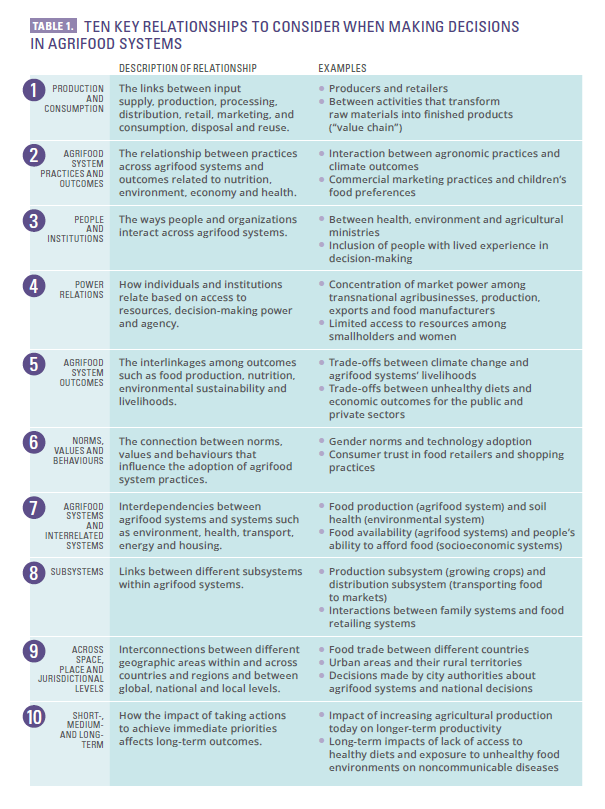
Rather than focusing on individual technologies, actors, or even sectors, the FAO report focuses on relationships. It identifies ten key relationships within agrifood systems, from production-consumption dynamics to the institutional structures that shape decision-making power, and argues that these relationships are where the real leverage sits. A change at the right relationship node can cascade across the system in ways that a targeted point intervention cannot.
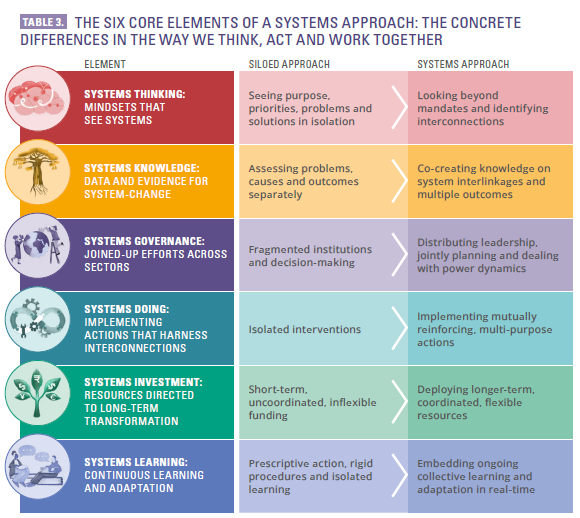
The report then proposes six elements it considers necessary for food system transformation: systems thinking, systems knowledge, systems governance, systems doing, systems investment, and systems learning. All six elements are about how the system is organised: how it generates and shares knowledge, how it coordinates across sectoral mandates, how it designs and funds interventions, and how it adapts when outcomes diverge from plans.
Some of the examples the report draws on illustrate what this looks like in practice. New York City’s public procurement reform simultaneously shifted nutrition outcomes, reduced the climate footprint of the city’s food purchasing, improved equity in food access, and created new market signals for suppliers across a complex supply chain.
Ethiopia developed an integrated national food systems vision that brought together nutrition, climate resilience, food safety, and farmer livelihoods into a single framework, then used it as the organising logic for investment decisions.
Indonesia built economic models to explicitly map the trade-offs between food security, biodiversity, and economic development, creating the knowledge infrastructure needed for cross-system decisions rather than single-sector ones.
A study in Philosophical Transactions of the Royal Society B, led by FAO researchers drawing on food system implementations across Morocco, Costa Rica, Rwanda, and the Pacific Islands, found the same sequencing in each case. Transformation required two things working in tandem: formal governance structures like coordinating bodies and revised policy frameworks, and something harder to fund, the shifts in relationships, trust, and institutional thinking that allow different mandates to align. Neither was sufficient without the other. And in the case examined, the technologies and investment decisions came after that combination existed, not before.
Each created a mechanism that made the system’s trade-offs visible across sectors before decisions were made, and positioned one actor to coordinate above the siloed mandates rather than within them. That sequencing matters more than any of the specific interventions that followed. The technology and investment decisions in each case came after that coordinating mechanism existed. Most agrifood innovation runs the sequence in reverse: the technology arrives first, and waits for the institutional conditions to catch up.
The forces that built the broken architecture are the same ones that protect it
The system is not failing to change because people lack good ideas about what needs to change. It is failing to change because the same structural features that produced the broken architecture, short political time horizons, fragmented authority, and uncertainty about what will work, are also the features that make redesigning it so difficult. Three overlapping forces explain the bind.
1. Time
Building coordination across institutions, ministries, and sectors takes years. Political cycles, by design, reward visible progress on short timescales, which means the interventions most likely to produce durable food system change are the ones that take the longest to show results.
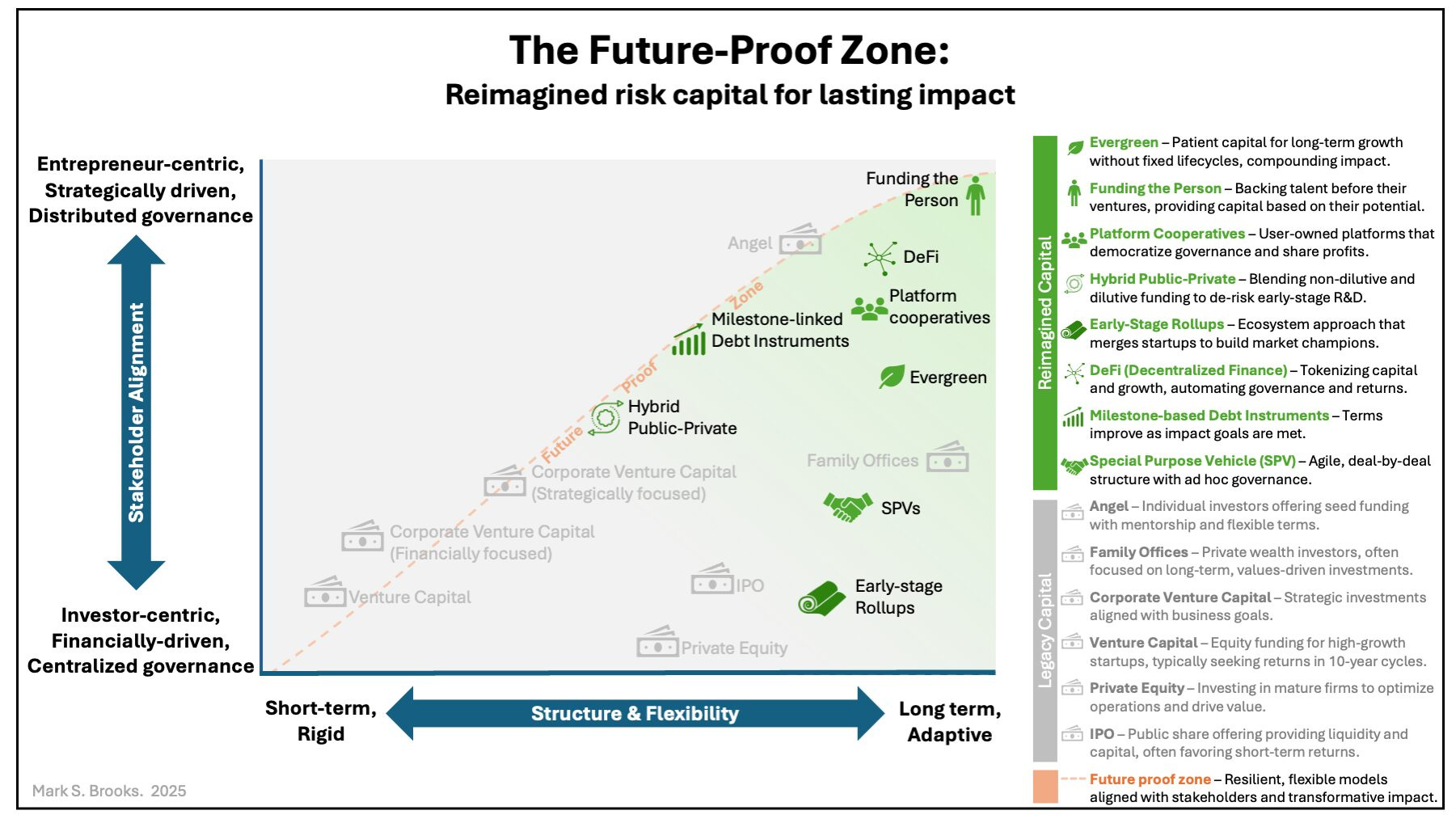
I see the same mismatch runs through capital markets. Meaningful agricultural innovation may take 10-15 years to mature, against a 7-10 year (sometimes even shorter) VC fund horizon. A fund operating on that clock will rationally favour technologies that can show commercial traction within that window, which means the technologies most likely to produce systems-level change are systematically deprioritised. The capital structure is doing what it was designed to do, but the problem is that it was designed for a different job.
2. Leadership
Systems transformation requires someone, or some institution, with both the authority and the knowledge to coordinate across competing interests and power structures. In practice, those two things rarely sit in the same place.
The actor with political authority to coordinate tends to lack the technical understanding to do it well, the actor with deep technical knowledge rarely has the mandate to impose coordination across ministries or value chain actors. Ethiopia’s food systems vision worked in part because it was deliberately co-convened by two ministries, which gave it both the cross-sector legitimacy and the technical depth that single-ministry leadership could not provide. That kind of deliberate coordination architecture is lacking.
3. Uncertainty
Complex systems do not respond predictably to interventions. A procurement reform that works in New York City may produce different effects in Nairobi. This unpredictability changes what the right institutional response looks like.
Transforming a system under uncertainty requires the capacity to run pilots, embed real-time evaluation, and adjust course before scaling, which is a learning infrastructure that most project cycles and private funding milestone structures are not designed to support.
Three implications that are harder to ignore once you accept the diagnosis
The report’s framework is a policy document, not a startup playbook, so I want to be careful not to overextend its implications. But reading it as someone who spends time with agrifood founders and investors, the direction of the implications feels consistent.
1. Agrifood does not have an innovation shortage, it has an infrastructure shortage for deploying the innovations it already has
The conversation in agrifood tends to centre on what needs to be invented: a more resilient crop, a lower-emissions input, a more efficient supply chain. The FAO framework points in a different direction. The six elements it says food systems need to transform are all about coordination, transparency, and institutional design.
Governance tools that help ministries make decisions across sectoral lines. Knowledge systems that make system-level trade-offs visible before policies are committed. Procurement architecture that closes the gap between a corporation’s sustainability pledge and what its buying team actually does. None of these are biological or digital innovations in the conventional sense, but the framework suggests they may be the infrastructure or ecosystem orchestration tools that determine whether everything else gets to scale.
Agrifood is lacking the integration layer that would allow it to function as a system rather than a collection of point solutions. My understanding of what this implies is still evolving, but the conversations I find most interesting in agrifood right now are not about a new crop or a new molecule. They are about how to change the rules of the game that determine whether any crop or molecule gets adopted at all.
2. One of the biggest risks in agrifood is launching into a system that was not designed to absorb you
The adoption curves for precision agriculture, agricultural biologicals, and climate-smart farming practices all follow a similar pattern. The science often precedes broad adoption by years, sometimes decades. What eventually changes is the incentive structure around it: regulatory clarity, supply chain economics, procurement rules, and subsidy design all shift, and suddenly a technology that was technically proven but commercially stalled finds its moment.
One of the things I find underweighted in agrifood investment narratives is who actually bears the cost of being early. The system benefits when adoption accelerates, but the downside of moving first falls almost entirely on the individual producer: the financial risk, the operational disruption, the reputational exposure if the technology underperforms. Ali Morpeth, co-founder of Planeatry Alliance, put this well in AgFunder News: even producers who understand which direction change needs to go are often paralysed because “the downside risks of moving first remain disproportionately high.”
A farmer’s decision to adopt a new technology is a cash-flow decision made within the tight economics of a single growing season, not an investment decision in the VC sense. A technology that delivers ROI over three seasons requires the farmer to absorb risk for three seasons before knowing if it works. The costs of being early fall entirely on the farmer, the benefits are diffuse and slow to arrive.
Most agrifood due diligence runs in one direction: does the technology work, and will customers buy it. But it needs to run in both. Before asking whether customers will buy, ask whether the value chain surrounding that customer has any economic incentive to accommodate the technology.
A few diagnostic questions to ask: Does regulatory clarity already exist, or does the company have to create it? Do the distributors or institutional buyers adjacent to your target customer benefit from your adoption, or does it threaten their margins? Is there at least one actor in the ecosystem with an explicit mandate to coordinate across the value chain? If the answers to those questions are no, you are not launching into an ecosystem, you are trying to build one while simultaneously selling into it. That is a different company, with a different capital structure and a different timeline, than what most early-stage pitch decks describe.
3. The capital model that built ‘agrifood tech’ is structurally mismatched to the transformation timelines the sector needs
A startup can have product-market fit within a segment while being structurally incompatible with the broader system it is trying to change. A soil health technology can work on farms where incentives reward soil health investment. It will not scale in systems where commodity price dynamics, subsidy structures, and land tenure arrangements mean farmers cannot capture the value it creates.
Part of what has shifted in how I think about agrifood investment is the recognition that the standard VC model is structurally mismatched to the sector’s transformation timelines. As Michael Dean of AgFunder said in a piece for AgTech Navigator: “Going to investors and saying we can deliver 3x returns within 10 years is proving super tough.” The consensus points toward patient capital, government involvement, and strategic corporate partnerships as the funding mix the sector actually needs.
Ward’s Minimum Viable Ecosystem concept is one practical response at the startup level: before asking whether a startup can find customers, ask whether it has identified the smallest viable set of partners, incentives, and institutional conditions that would make adoption rational across the value chain.
This is a problem with a known set of partial solutions. Development finance institutions, blended finance vehicles, and strategic corporate ventures with long horizons exist and are funding meaningful work. Patient capital is not theoretically impossible to construct.
The gap is that the infrastructure for connecting agrifood founders to the right capital structure at the right stage is underdeveloped relative to the volume of companies trying to raise money. Most founders encounter the VC model first because it is the most visible, and discover after two or three rounds that the clock was set for a different kind of problem.
The practical implication: knowing which type of capital is right for the problem you are solving is as important as finding capital generally. A company trying to change a system over fifteen years, funded by investors expecting an exit in six, is in tension with its own strategy. The capital structure should match the transformation timeline, not the other way around.
Food systems were designed for a different job
Food systems were not designed to deliver multiple outcomes simultaneously. They evolved to prioritise one thing above others, usually yield, volume, or cost, and to do so within institutional structures that reward that prioritisation. The expectation that they now deliver food security, climate resilience, nutritional quality, economic fairness, and environmental health at the same time is not unreasonable. But meeting it requires redesigning the system.
The FAO report is one of the more honest assessments I have read of what that redesign requires. The barriers it identifies, misaligned time horizons, leadership gaps, and institutional inertia, are features of the same system producing the outcomes we are trying to change.
If that diagnosis is right, the implication is that the agrifood innovation ecosystem needs to make a larger bet on institutional architecture alongside product development. The field has spent a decade asking what technologies can do. The more important question is what systems need to become before technologies can do it.
The technologies that are currently proven but stalled will not stick around. Without the institutional infrastructure to absorb them, they quietly fade away: the startup runs out of runway, the founding team disperses, the IP gets shelved or absorbed into something adjacent. Founders and investors absorb the cost first, visibly, through failed fundraises and written-off positions. But the quieter cost falls on the farmers and food businesses that never got access to something that worked, and on the next generation of founders who will spend time and capital rediscovering the same dead ends.
If you found value in this newsletter, consider sharing it with a friend who might benefit from it! Or, if someone forwarded this to you, consider subscribing.
Disclaimer: The views and opinions expressed in this newsletter are my own and do not necessarily reflect those of my employer, affiliates, or any organisations I am associated with.
Eshan, your focus on system architecture in agrifood mirrors what I see working with founders—progress depends on more than just strong technology. The teams that gain real adoption are those who manage to communicate value across every level of the chain, from off-grid producers to institutional buyers.
Translating complex realities into a message that resonates with both partners and investors is often what moves innovation beyond the pilot stage. When the story reflects both the solution and the environment it needs to thrive, you open doors for real momentum.