

Hey folks!
Thanks for being here. For Issue #130 of Better Bioeconomy, I sat down with Oscar Ramos, Managing General Partner at Orbit Ventures, an emerging-markets venture platform that backs breakthrough companies and helps them scale across Asia, Africa, the Middle East, and Latin America.
Orbit doesn’t operate like a typical venture fund. It invests, but it also acts as a hands-on growth platform, helping companies navigate scaling in markets where infrastructure is uneven, buyers are fragmented, and execution matters far more than narrative.
Oscar is open about not being a food or ag specialist investor, which is precisely why I wanted his perspective. It sits outside the usual industry echo chamber. What he brings instead is pattern recognition from working across sectors and geographies where productivity gains, not sustainability slogans, determine whether a business survives.
Before Orbit, he worked across R&D and telecom at companies like Ericsson and Telefónica, then went on to build and launch several startups before moving into venture capital at SOSV, where he remains a Venture Partner. That background places him at the intersection of operators, investors, and founders building under real constraints.
In our chat, we spoke about why logistics and first-mile coordination are often the highest-leverage starting points in agrifood, and why adoption in emerging markets follows immediate economics rather than ideals. We also discussed how the same bottlenecks repeat across continents, what founders can reuse as a result, why localisation determines whether solutions stick, and why the unwritten rule in climate tech in emerging markets is still “don’t talk about climate.”
Let’s jump in!

Productivity is the fastest path to both growth and decarbonization
For Orbit, productivity is a key mandate. Climate sits inside it, not alongside it. When Oscar looks at agriculture and food systems in emerging markets, he is not starting from emissions targets or sustainability frameworks. He starts with a more straightforward question: where is value being lost today, and how quickly can it be recovered?
The thread running through his perspective is inefficiency. The systems around farmers, such as transport, storage, aggregation, and distribution, still run as they did decades ago. Fresh produce often deteriorates before it reaches buyers because basic first-mile transport is inefficient. Weak coordination, empty backhauls, and layers of unnecessary intermediaries add friction at every step, generating more waste and a larger carbon footprint.
The first leg of the journey becomes a kind of operational black hole: loose communication between farmers, traders, and transporters, inconsistent handling, long delays, and avoidable losses. As a result, supply chains burn time, fuel, and product before anyone captures real value.
Oscar sees that waste as the low-hanging fruit. He shared the example of Ridelink, an Ugandan company, backed by Orbit, that coordinates informal trucking networks in rural areas. Instead of building new infrastructure from scratch, the platform makes the existing system legible. It aggregates information on which vehicles have capacity moving in and out of villages, then matches that capacity to farmers and distributors who need it.
The immediate effect is fewer dead-head trips. Drivers earn more because they are not returning empty. Farmers pay less because loads are consolidated. Ag-input distributors reach more customers with the same fleet. The same products move faster and more cheaply, and less fuel is burned along the way.
He sees a similar pattern in seed and input supply. In many markets, farmers still travel long distances to buy inputs from fragmented, informal retailers. If a startup can aggregate demand and coordinate deliveries, those trips collapse. Farmers get hours back, not just money. Distributors expand reach without expanding assets.
What looks mundane on the surface starts to compound. Better routing lowers the cost per trip by cutting unnecessary kilometres, which reduces fuel use and vehicle wear. Vehicles are used more efficiently because they move fully in both directions. Inputs arrive sooner and in better condition, so less is wasted before it is even applied.
Crucially, these gains show up immediately. And that timing is what determines whether a solution is adopted at all.
Drive adoption by showing immediate value
Adoption follows economics. In more mature markets, it is easier to talk about sustainability and long-term gains. In emerging markets, as Oscar put it, “in very traditional links you need to prove your value quickly.” This matters most when solutions are sold to the smallest players in the value chain: smallholder farmers, truck drivers, and rural traders who operate week to week rather than quarter to quarter. A product that promises higher yields in three years will struggle against one that drops operating costs today.
For founders, this means designing offerings around immediate incentives. In the Ridelink example in Uganda, the platform delivered value to all participants quickly: drivers earned more, farmers paid less, and distributors sold more inputs. That quick feedback loop accelerates adoption and builds the trust needed for longer‑term changes, such as adopting improved seeds or on‑farm technologies.
Oscar also emphasised that quick wins don’t preclude long‑term impact. Reducing waste and moving goods more efficiently also reduces emissions. In many supply chains, first-mile leakage is a meaningful emissions driver. In emerging markets, where there is little room for purely altruistic climate initiatives, climate solutions have to hitch themselves to cost savings to gain traction.
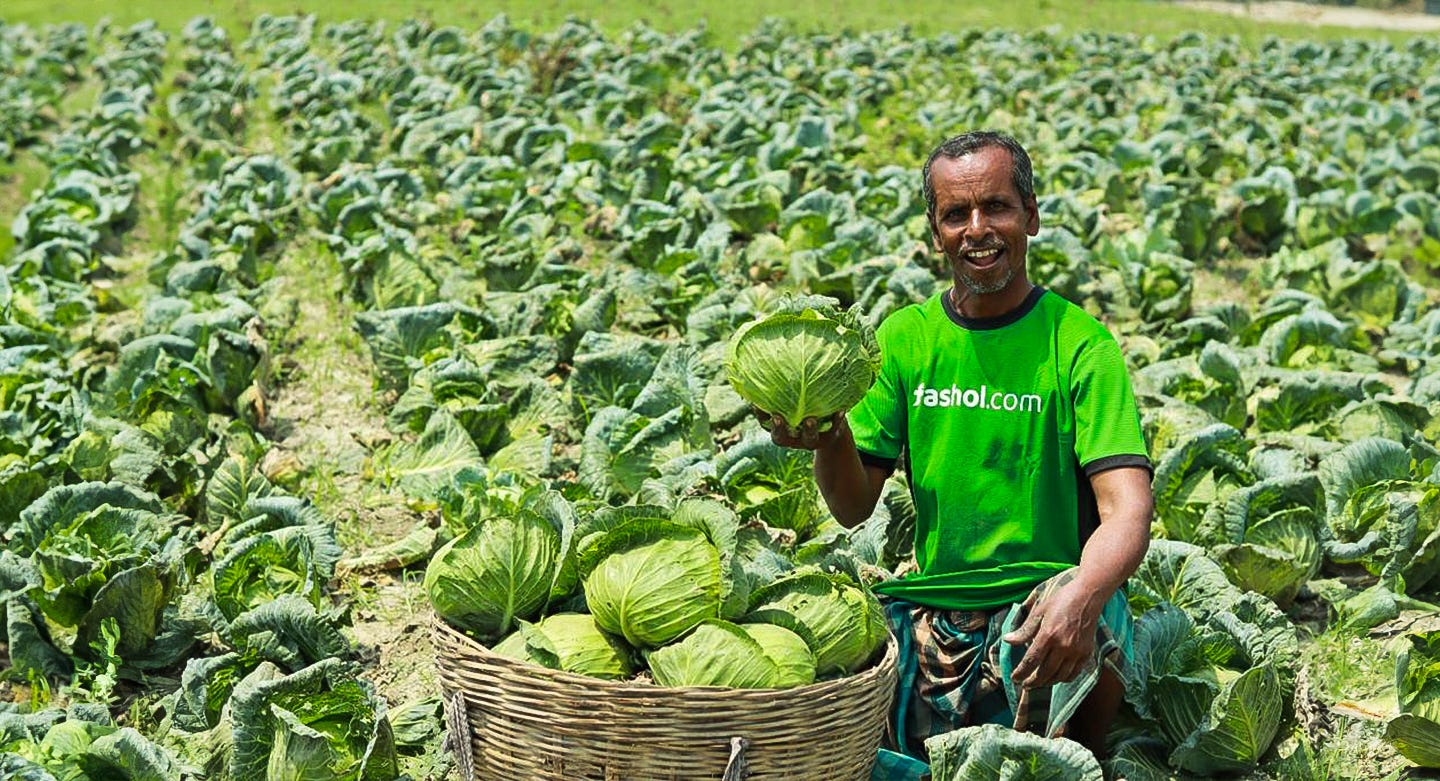
He pointed to similar dynamics in Bangladesh. Orbit-backed Fashol has reportedly reduced farm-to-distribution waste from around 50% to under 5% by tightening coordination across the chain. The details vary by market, but the principle is consistent: when a solution quickly turns leakage into cash, adoption follows.
Most continents share the same bottlenecks, even if the surface looks different
If you are not on the ground, working across Africa, Asia, and Latin America, the differences may seem daunting. Languages, cultures, regulatory frameworks, and infrastructure levels vary widely. Yet Oscar argued that there are more similarities than founders realise.
He recalled two Latin American founders from an Orbit-backed company who had previously helped scale an online marketplace for fresh produce across Brazil and Mexico, and brought those hard-earned lessons into their next venture.
When they compared notes with Orbit’s Nigerian portfolio company, Pricepally, which is working on farm-to-table distribution, the overlap was striking. Pricepally’s team has also learned from Frubana's experience in Latin America (Orbit did not invest in Frubana but has backed former employees building new ventures), which helped sharpen what to replicate and what to avoid. They began to share lessons from their own failed experiments, including which pricing models resonated and what mistakes to avoid when entering new regions.
Similarly, one of Orbit’s Colombian investment team members recently joined the evaluation of a prospective investment in Egypt. The team was surprised by how many of its Colombian playbook elements, such as the need for working capital solutions for informal traders and the importance of transparent pricing in commodity markets, applied directly.
This cross‑market pattern recognition is valuable because it reduces the “reinvention cost.” If you know that first‑mile aggregation is a bottleneck in multiple continents, you can draw on proven solutions rather than starting from scratch.
By cultivating a community where founders share experiences across borders, Oscar believes investors can accelerate learning across markets. For investors, this pattern recognition also reshapes risk. Lessons learned in Nigeria can inform decisions in Bangladesh or Peru, allowing teams to move faster with more confidence.
Localisation is what makes solutions stick

The flip side of these similarities is the risk of copy-and-paste. Not every solution travels seamlessly, and local execution remains crucial. Despite the shared bottlenecks, Oscar warned against assuming that data and logic alone can override centuries of tradition.
Agriculture is deeply cultural. Practices such as harvesting rituals, planting schedules, or animal rearing methods are often tied to identity and pride. In some cases, those traditions persist even when alternative approaches are demonstrably more efficient. This has direct commercial implications. Oscar recounted instances where startups tried to introduce new storage systems or cropping patterns only to face resistance because the methods clashed with cultural norms.
Even when the science proved the innovation would reduce losses or increase yields, adoption lagged until the solution was reframed to respect local identity. Sometimes that meant allowing a traditional practice to coexist alongside a new technique. Sometimes it meant adapting the product so it complemented, rather than replaced, the status quo.
This balancing act echoes a broader tension between efficiency and identity. Many emerging‑market agricultural practices evolved for sound historical reasons: certain crops are planted at specific times to avoid pests, and grains are dried in particular ways to suit local cuisines.
While modern techniques may appear ‘more efficient’ on paper, they must be introduced with humility. In Oscar’s words, “Even if it’s not the most efficient way, it’s part of the identity of the people.” As founders designing technology for agrifood, it is essential to remember that emotional and cultural considerations matter as much as unit economics.
Navigating exits: ‘The unwritten rule of climate tech in emerging markets: don’t talk about climate.’
Finally, we turned to exits. A topic top‑of‑mind for investors as IPO windows remain shuttered and M&A appetite wavers. Oscar was candid: in emerging markets, there are very few clean tech or climate exits. The pool of venture capital is small, and the subset focused on climate is even smaller. That scarcity shapes how companies position themselves. “I have a joke,” he said. “The unwritten rule of climate tech in emerging markets is: we don’t talk about climate.”
This is about pragmatism. In many markets, climate‑aligned products are perceived as expensive, unreliable or time‑consuming relative to conventional alternatives. Meanwhile, investors outside climate circles are sceptical of the revenue potential and timelines of climate businesses.
Founders reframe their solutions as logistics or mobility plays, not as climate. A startup that reduces fertiliser waste by optimising application is positioned as a precision agriculture company that improves productivity rather than as an emissions‑reduction tool. A firm building cold‑chain infrastructure is pitched as a supply‑chain efficiency company. The climate benefits are real, but they are not the headline.
This positioning makes sense given the current market. Global data show that climate‑tech funding has cooled: investment in the sector continues to decline. Exits are largely happening via bargain‑hunting acquisitions rather than blockbuster IPOs.
For companies operating in emerging markets, where the buyer universe is smaller and macro risks loom larger, the more realistic path is to build a real business with strong unit economics (surprise!) and position it as a valuable asset for a strategic buyer, rather than optimising for a public listing.
This pragmatic stance shapes how founders should design their companies from the outset. Businesses that can be read through multiple lenses tend to have more exit optionality. A supply-chain optimisation platform might appeal to logistics operators, commodity traders, or even government agencies. A digital marketplace could be relevant to regional retailers or telecom groups. Keeping the business model flexible widens the pool of potential acquirers.
It also puts pressure on the fundamentals. Strategic buyers will ultimately look past the climate narrative and focus on margins, customer retention, and the ability to scale. If those elements are weak, climate credentials alone are unlikely to carry a deal over the line.
Finally, capital structure matters. As dedicated climate tech capital pools tighten, equity alone is often insufficient, especially for businesses with infrastructure or asset-heavy components. Debt, revenue-sharing arrangements, and blended finance are increasingly part of the picture. Designing a capital stack that matches the realities of the business is becoming just as important as designing the product itself.
Takeaways from my conversation
Solve for inefficiency first. Supply chains in emerging markets leak value through poor first‑mile logistics, lack of cold storage and fragmented distribution. Start by coordinating transport, aggregating demand and reducing waste. These are immediate levers for productivity, profitability and emissions reduction.
Value drives adoption. Farmers and drivers adopt new tools when they see a quick, tangible benefit. Design solutions that cut costs or raise incomes in the first week, not the first year. Climate benefits are a bonus, not a primary selling point.
Look for patterns across markets. Nigeria, Colombia, Vietnam and Egypt share more agricultural bottlenecks than you’d expect. Founders who learn from peers in other regions avoid re‑inventing the wheel. Investors can accelerate innovation by fostering cross‑border knowledge networks.
Respect local identity. Efficiency isn’t everything. Traditions and cultural practices shape how agriculture is done and how new technologies are adopted. Innovations must be adapted to local contexts and introduced with empathy.
Frame your business beyond climate. In emerging markets, climate funding and exits are scarce. Position your company as solving logistics, distribution or productivity problems. Ensure unit economics are strong so that strategic buyers will pay attention, and be prepared for M&A rather than IPOs.
If you found value in this newsletter, consider sharing it with a friend who might benefit from it! Or, if someone forwarded this to you, consider subscribing.
Happy holidays Eshan! Thank you for excellent issue #130! Oscar's Orbit interview is eye opening. Thank you for letting us know more about what's brewing in the space. I'm optimistic that we will continue to see rapid progress in the alt protein and alt agriculture space. May you have a very happy holiday season and may only good things come to you in 2026 👍❤️