

Hey there!
Welcome to Issue #136 of Better Bioeconomy, weekly insights on how tech is reshaping food and agriculture for better human and planetary health. Thanks for being here!
BIO BUZZ
Products, partnerships, and regulations
🇺🇸 USDA and Department of War signed an MoU to elevate agriculture into the national security framework
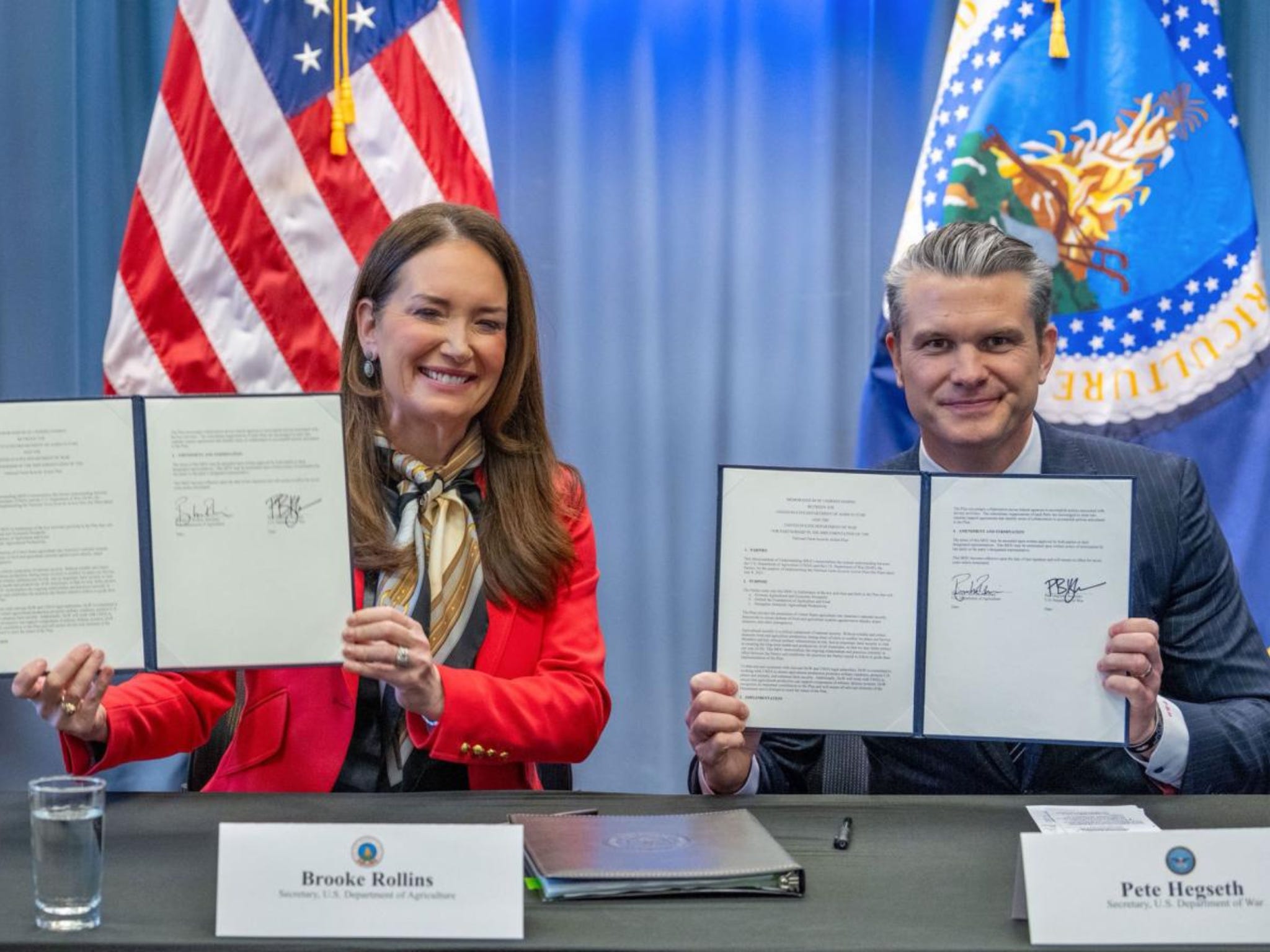
The agreement builds on the National Farm Security Action Plan announced in July, which targets agrifood research security, supply chain gaps, and domestic productivity. A new research partnership between DARPA and the USDA’s Office of the Chief Scientist has been formed, alongside a new Office of Research, Economic, and Science Security under the USDA.
The MoU gives USDA agencies access to DARPA to accelerate the adoption of novel technologies. Its focus areas include biotech and biomanufacturing, American-made research, and building a “21st-century agro-defence workforce” through higher education programmes.
The two departments will share intelligence on food system threats, technological requirements, and economic trends. USDA testbeds may be used to fast-track testing, validation, and deployment of agricultural biosecurity technologies through an “expedited but bounded pathway” that maintains safety and oversight.
Source: Green Queen
💰 Cellular agriculture infrastructure company IntegriCulture reaches profitability through a multi-sector strategy
The Japanese company posted a net profit of JPY40M ($255k) for FY Oct 2024-Sept 2025. It funded itself through cosmetics and other non-food uses while continuing to supply cellular agriculture startups and run CRO (Contract Research Organisation) work.
The company is transitioning from a supplier-CRO model to a CRDMO (Contract Research, Development & Manufacturing Organisation) while building full-stack infrastructure for cellular agriculture, including cell culture media, scaffolds, and low-cost hardware. Management says each segment is already profitable on a unit basis, with further growth expected in FY25 (Oct 2025-Sept 2026).
Instead of relying on large, expensive stir-tank bioreactors, IntegriCulture focuses on compact packed-bed and adherent systems to reduce costs and risk. Its scale-up work is supported by Japan’s SBIR program, while scale-out development includes collaboration with Sumitomo Riko on low-cost, oxygen-infusion-free bioreactors.
Source: AgFunder
Thoughts 🤔:
IntegriCulture turning profitable is a useful reality check for cell ag. One of the first businesses to show durable economics is not a cultivated meat brand, but an enabler selling infrastructure, with cosmetics acting as the near-term profit pool rather than food.
Three signals stand out to me. First, “picks & shovels” are proving bankable before the headline products, echoing how CDMOs and toolmakers in biopharma captured value well ahead of many novel therapeutics. Second, diversification into non-food verticals is becoming the default de-risking pattern while food-grade regulation, CAPEX, and cost curves catch up. Third, their pivot away from massive stirred tanks toward modular, adherent and packed-bed systems hints that cell ag scale may look more like distributed solar than a few giga-factories.
This suggests that, at least in the near-term, the most resilient opportunities in cellular agriculture will sit in infrastructure, services, and adjacent ingredients rather than pure-play cultivated meat brands.
🌾 Syngenta becomes first to bring a commercially scalable hybrid wheat to market in Europe
X-Terra hybrid wheat has received regulatory approval in France, with the first two varieties, SY Sphynx and SY Xanthis, available to farmers for the 2026 sowing season. The milestone is the result of more than 15 years of work cracking wheat’s genome, which is nearly six times larger than the human genome.
The varieties are engineered for climate resilience, offering improved tolerance to septoria (one of Europe’s most economically damaging wheat diseases) and integration with Syngenta’s Cropwise digital platform for early disease-pressure alerts. The approach positions X-Terra as a system-level innovation rather than a standalone seed product.
Syngenta plans to extend the platform to the UK and Germany following the French approval, framing hybrid wheat as a cornerstone of Europe’s next generation of climate-resilient cereals. For a crop that supplies nearly one-fifth of global calories, the shift to hybrid performance carries major food security implications.
Source: AgTechNavigator
Thoughts 🤔:
Wheat might be is starting to follow maize and barley toward a world where hybrids become the performance benchmark. That can change who captures value, because more of the category shifts from farm‑saved seed to annual repurchase tied to proprietary genetics and playbooks.
Bundling X Terra with Cropwise and integrated agronomy reframes “seed choice” into “system choice.” Once your yield risk, disease alerts, and input protocols are tuned around a specific hybrid and data stack, switching becomes costly.
The question is whether the economics clear the bar for European growers after the seed premium and tighter management recipes. If the hybrid‑plus‑digital package can reliably buy a few points of margin and more predictable yields under climate volatility, this looks like the start of a cereals platform shift.
🔎 Carbon Robotics unveils its Large Plant Model, the ‘most advanced AI model’ for plant detection and identification
The Large Plant Model (LPM) is trained on years of plant images across varying soil types, climates, and growth stages. It can identify a new weed immediately, including how it will look from different angles and as it matures, without sending data back to a data centre for retraining. Farmers with Carbon Robotics’ existing LaserWeeder machines can access it via a software update.
The new PlantProfiles feature lets farmers use the Carbon Robotics iPad Operator App to select photos of their specific crops and weeds. The system then automatically adjusts to the parameters of that field, cutting setup time and making the tech usable without deep technical knowledge.
LPM moves away from the traditional computer vision architecture used in earlier LaserWeeder models, which could not adapt to new plants in real time. CEO Paul Mikesell says parts of the AI architecture are now more advanced than those used in self-driving cars, and positions LPM as bringing that frontier AI capability to a part of agriculture that has largely missed out on recent advances.
Source: AgFunder
Thoughts 🤔:
This is showing up as three constraints tighten at once: herbicide resistance keeps rising, input economics remain volatile, and seasonal labor windows are still unforgiving.
Cloud-centric ag AI also hits practical ceilings in the field, since connectivity is uneven and in-row decisions cannot wait on round trips to a data center. Carbon’s bet is edge inference plus a fleet data flywheel, turning deployed machine-hours (and a very large labeled plant dataset) into compounding model advantage.
The playbook rhymes with AV autonomy and precision equipment: ship useful hardware, harvest messy edge cases at scale, then shift value capture toward the perception and decision layer. The question is whether the software stack becomes the thing growers renew and competitors struggle to replicate.
If Carbon can keep performance strong across crops and regions, this shifts the advantage toward whoever has the most machines working in real fields.
🍄🐄 Joyn Foods earned K-12 approval in South Carolina, allowing it to sell its mycelium-enhanced blended meat to schools across the state
The US startup (formerly Mush Foods) secured statewide purchasing access through the South Carolina Purchasing Alliance (SCPA). This approval is important because school bids require strict compliance with USDA standards, competitive pricing validation, and proven student acceptance through pilot tastings.
Its 50Cut blend mixes beef, mushrooms, and mycelium. By partially replacing conventional beef, the blended protein reduces environmental impact while improving nutrition without asking school kitchens to change how they operate.
In tastings, students gave the meatballs a 96% approval rating and the burgers 92%. Even K-2 students responded well, with 84% positive feedback. With the National School Lunch Program serving nearly 30 million meals a day, even small formulation changes in ground beef can impact millions of meals annually.
Source: Green Queen
Thoughts 🤔:
One thing I keep coming back to in “alt protein adjacent” stories is that the real bottleneck is rarely the ingredient science. It’s distribution through procurement systems and kitchen reality.
In the near term, scale tends to flow to products that fit existing institutional rails. Bid lists, meal pattern compliance, and predictable pricing matter more than consumer branding when the buyer is a school district, hospital, or university. If something can drop into the same recipes, equipment, and prep flow, it meaningfully lowers the adoption cost.
Blended formats also feel like a pragmatic cultural layer. They can improve nutrition and reduce footprint without asking customers to opt into an identity statement. In a polarized food narrative, that “balanced protein” positioning might end up being a feature. This is especially true in public and contract catering, where quiet reformulation can move faster than consumer sentiment.
🍼 Tech breakthrough lets PFerrinX tune iron loading in its precision-fermented lactoferrin by application
The startup has developed a process to precisely control iron saturation in its NanoFerrin ingredient, producing three distinct profiles: apo-lactoferrin (0% iron) for immunity and cosmetics, native lactoferrin (~10%) for infant nutrition, and holo-lactoferrin (100%) as a gentle iron supplement.
Most precision-fermented lactoferrins, the company claims, default to high iron saturation (75%+), which limits their utility in applications like infant formula, where lower levels are preferred.
PFerrinX has secured manufacturing capacity of 200 metric tons across sites in the EU and Asia, with room to scale to 400 tons based on demand. The company says it can currently produce at cost parity with dairy and plans to undercut dairy’s $300/kg production cost within 24 months, with multiple regulatory filings underway.
Source: AgFunder
Thoughts 🤔:
The first wave of animal-free lactoferrin was a pure supply story: can we make the same molecule, at scale, without cows. The PFerrinX news points to a next phase: spec-defined ingredients where attributes like iron saturation are tuned, validated, and sold as the product itself rather than left as a back-end QC detail.
That could shift the competitive moat in precision fermentation downstream. Strain IP and stainless steel still matter, but differentiation starts to look like finishing, QA, and the ability to guarantee a functional state batch after batch, and eventually across sites. It’s a more “formulator-first” world where customers brief against performance tolerances, claims defensibility, and risk profiles.
Once buyers have options, procurement behavior tends to reward suppliers who can industrialize reliability: tighter variance, better comparability packages, clearer spec sheets, fewer surprises during scale-up.
🍫 Cargill has partnered with Kokomodo to validate commercial cell-based chocolate solutions, with support from EIT Food
The partnership builds on EIT Food’s €20,000 investment in Kokomodo in late 2024 and its selection as one of 16 startups in the 2025 RisingFoodStars cohort. These programmes are designed to help promising agrifood startups validate, scale, and commercialise transformative tech more rapidly.
Cargill and Kokomodo will run trials in industrial settings, testing how cell-based cocoa performs in beverages, dairy, and confectionery. They’ll assess functionality, taste, and whether it can be produced at scale. Initial functional test results are expected in the coming months.
Kokomodo’s tech uses cocoa cells sourced from premium Central and South American beans to create sustainable, future-proof cacao ingredients. Cargill says the project fits its “portfolio mindset,” giving product developers another route for cocoa formulations while reducing pressure on traditional supply.
Source: Green Queen
BIO BUCKS
Funding, M&As, and grants
🧬 Resurrect Bio raised $8.1M Series A led by Corteva to advance its AI-powered platform for restoring crops’ innate disease resistance
UK-based startup has developed a three-part platform, anchored by its FloraFold AI tool, that maps the molecular interactions between pathogen effector proteins and plant NLR immune proteins. By identifying precisely where pathogens bind to suppress a plant’s immune response, it can pinpoint the exact gene edits needed to block that interaction and restore full resistance to fungal disease, oomycetes, and nematodes.
Rather than performing gene edits itself, Resurrect Bio delivers validated editing targets to seed company partners who apply techniques like CRISPR to their own germplasms. The approach is crop-agnostic and pathogen-broad, with current focus on soy, corn, wheat, rice, cotton, and brassicas. Some resistance changes require as little as a single amino acid substitution.
The company is targeting 18 disease resistance traits across its blockbuster crops in the next three years, alongside improvements to FloraFold’s predictive accuracy. Several joint development agreements with leading seed companies are expected to be announced shortly. Revenue will come from milestone payments, success fees, and profit-sharing on licensed seed traits.
Investors: Corteva Catalyst, Calculus Capital, Pymwymic, UKI2S, SynBioVen, and AgFunder
Source: AgFunder
Thoughts 🤔:
The few signals I’m watching in the Resurrect Bio news are about where trait discovery is trying to go next. First, the industry seems to be testing a shift from bespoke, single-trait programs toward horizontal platforms that can repeatedly identify edit targets across crops and pathogens. The moat moves from “we have one great trait” to “we have the fastest, most reliable discovery-to-deployment loop with seed partners.”
Second, the emphasis on minimal edits, looks like a deliberate regulatory and adoption strategy. It’s a way to fit through the narrowest NGT‑style gates and keep optionality in tough markets like the EU and UK, while also making the edits easier to explain to downstream buyers.
Third, Corteva leading via Catalyst reads like pre‑bought option value ahead of its planned seed and crop protection separation in the second half of 2026. In a split, each entity needs its own pipeline narrative. External trait platforms can support the seed side’s cadence and give the crop protection side a path into more durable, lower‑scrutiny resistance “products” as chemical pressure builds.
🤖 Upside Robotics raised a $7.5M seed round to cut fertiliser use and waste in corn crops
The Canadian startup builds lightweight, solar-powered robots that apply fertiliser only when plants need it. The company says the approach can cut fertiliser use by 70% and save farmers about $150 per acre per season. It uses its proprietary algorithms with soil and weather data to optimise nutrient delivery
The startup has shown rapid traction, expanding from 70 acres in 2024 to 1,200 acres in 2025, with projections to exceed 3,000 acres in 2026 while keeping 100% customer retention.
Only 30% of traditionally applied fertiliser is absorbed by crops, leaving 70% wasted. Upside targets this inefficiency, starting with corn, one of the most fertiliser-intensive crops. With more than 200 farms on its waitlist, Upside plans to use the funding for R&D, to scale operations, and to expand into the US corn belt.
Investors: Plural, Garage Capital and the founders of Clearpath Robotics
Source: TechCrunch
🎯 Kilter raised €6.5M pre-Series B led by Kubota to scale its autonomous spot-spraying robot for high-value crops
The Norwegian startup’s AX-1 spraying robot identifies individual weeds using AI and applies only a few droplets of crop protection product to a 6×6 mm target area. The system avoids damage to surrounding crops while significantly cutting input volumes. It currently supports more than 15 crop types.
Alongside the investment, a distribution partnership with Kubota will make the AX-1 available through dealer networks in Germany and the Netherlands from 2026. The arrangement pairs Kilter’s precision nozzle tech and AI capabilities with established machinery expertise and commercial infrastructure across key European markets.
The robot is positioned for growers facing herbicide resistance and tightening regulatory frameworks in Europe, where effective active ingredients are becoming increasingly scarce. The new funding will support international expansion, further tech development, and pilots across additional crops and markets.
Investors: Kubota, SBG Invest AS, Pymwymic, and Nufarm
Source: Future Farming
Thoughts 🤔:
Kubota leading Kilter’s round looks like an OEM testing a new role: platform orchestrator in crop care. The interesting delta is the pairing of capital with a Smart‑Farming‑branded, dealer‑led rollout in markets like Germany and the Netherlands. That effectively turns distribution, servicing, financing, and uptime into the core product.
If that model works in specialty crops, it could become the fastest path for robotics to clear adoption friction, because growers buy reliability and support as much as they buy capability.
The other interesting shift is how “precision” is being reframed. Ultra‑targeted spot spraying is increasingly regulatory and operational de‑risking, not just an input‑saving feature. In Europe, where crop protection constraints tighten, how product was applied could become a compliance edge and a buyer requirement.
🐝 Polybee raised $4.3M seed round to scale its drone-based pollination and AI yield forecasting tech
The Singapore-based startup uses small drones that launch and recharge on their own. Fitted with cameras, they track crop health, ripeness, and variability throughout the season. That stream of images feeds models that tell growers where and when to harvest to improve yield and margin.
Customers report up to 3x higher profits from better harvest timing and earlier detection of crop stress. In greenhouses, autonomous pollination has delivered up to 15% yield gains. These benefits are especially valuable during shoulder seasons when market prices are highest.
The new funding will help Polybee scale quickly, aiming for a five-fold jump to more than 4,000 acres by 2026. The company sells an end-to-end subscription (fixed fee per hectare, no upfront drone purchase) that cuts labour, improves consistency, and reduces the risk of pollination versus bumblebees or manual work.
Investors: Paspalis Capital, elev8 VC, SEEDS Capital, and strategic angel investors, including Blue River Technology founder Jorge Heraud
Source: AgFunder
Thoughts 🤔:
The interesting signal in Polybee’s approach is the reframing of pollination as an operational risk line item that can be engineered and monitored. Bees and manual stimulation work, but they introduce labor exposure and biosecurity complexity. If controlled airflow can deliver consistent fruit set with lower variance, pollination starts to look like fertigation or climate control: a managed input with tuning knobs, logs, and accountability.
Another interesting signal is the move from maximizing yield to maximizing timing. “Right-time yield” is basically revenue management for produce. If you can predict ripeness and variability continuously, you can make better harvest decisions, hit contract specs more reliably, and capture shoulder-season pricing without guessing.
This could be a real step toward algorithmic biology in high-value crops if unit economics and reliability hold across sites. Otherwise it stays a premium tool for labor-constrained, biosecurity-sensitive growers.
❄️ CryoBio raised $1.3M in pre-seed funding to cut frost-related crop losses with a biologic crop protectant
Frost damage drives an estimated $30B in global food waste, enough food to feed 200 million people. The New York-based startup was created to fill a market gap in frost-specific crop protection solutions. Frost damage has doubled over the past decade and is expected to double again as climate change and earlier planting push growers into riskier windows.
The company’s lead product is an anti-freeze molecule made through precision fermentation. It can protect crops from frost for several days up to two weeks, depending on the crop. CryoBio is also working on a seed-treatment version designed to run through farmers’ existing equipment.
Aiming for a 2028 launch, CryoBio is running five-acre field trials with nearly 30 growers across New York, Maryland, and Washington. The next round will fund biomanufacturing scale-up from grams to kilograms and expand trials to larger acreage.
Investors: Marble, Ag Ventures Alliance, NY Ventures, Launch NY, FuzeHub, and impact angels.
Source: AgTechNavigator
Thoughts 🤔:
Frost is becoming first-class climate risk category with its own solution stack. We now have credible estimates that spring frosts destroy food equivalent to feeding hundreds of millions of people each year, and a new wave of biological tools is targeting that loss. That reframing is important because once a risk is quantified and repeatedly priced into losses, it competes for the same mental and budget real estate as drought, heat, and disease.
The big question is whether performance holds across messy field conditions, not just in the best case. Biological and bio based claims often compress when you add region, variety, and microclimate variance. If multi-site data shows consistent ROI, frost could become a budget line item rather than an emergency response.
🦠 MicroHarvest secured a €5.5M German government grant to build an industrial-scale microbial protein plant in Leuna
The plant will produce 15,000 tonnes of protein annually for pet food, human food, and aquaculture. Production is expected to begin within two years, with molasses as its primary feedstock through an already-secured regional supply chain.
The Hamburg-based startup’s biomass fermentation process runs in just 24 hours and produces protein with over 60% raw content, a complete amino acid profile, high digestibility, and an umami flavour that improves palatability. Its MPX Care pet food ingredient has already appeared in The Pack’s Gut Bites and Vegdog’s dog and cat treats, while MPX Boost and Hilix target the aquaculture market.
The company reviewed 40 European sites before selecting Leuna for its feedstock proximity, industrial infrastructure, and surrounding agri-processing network. MicroHarvest will work with Industriepark Leuna as its park operator and utilities provider, with local and federal stakeholders supporting the project through permitting and investment incentives.
Source: Green Queen
🐄 Ruminant BioTech launched CAD$7.6M program to validate its slow-release methane-reduction bolus for pasture-raised cattle
The New Zealand startup’s slow-release bolus sits in the animal’s stomach and steadily delivers bromoform, a methane-inhibiting compound. Unlike feed additives suited to intensive farming, this approach works in grazing systems where daily controlled feeding is not practical. Animal trials suggest that one dose delivers a 75% reduction in methane for over 100 days, with the team targeting 6 months.
The three-year, on-farm program is designed to secure Canadian registration for beef cattle and generate data needed for future expansion into the US, Brazil, and the EU. It is backed by a CAD$2.8M Alberta government grant, CAD$3.4M from two industry partners, and CAD$1.4M from Ruminant BioTech’s own funds.
The company’s business model leans on carbon insetting and offsetting to cover costs where there is no direct productivity payback for farmers, pointing to carbon markets now worth over $1T and covering 25% of global emissions. CEO cited Brazilian meat giant Marfrig’s methane targets as evidence that major food companies are seeking solutions.
Source: AgFunder
BIO READS
Thought-provoking opinions
🇮🇳 India will see IPOs in agritech before America or Europe
Omnivore’s Mark Kahn argues that Indian agritech is structurally different from Western markets and could see IPO exits earlier, given more accessible public markets and strong domestic investor appetite.
Mark traces India’s agritech boom to the post-2016 shift from consumer e-commerce to B2B marketplaces and farm-to-consumer brands. Fragmented smallholder supply chains have been reorganised through service-based and asset-light models.
He also points to growing opportunities in biomanufacturing, full-stack CDMOs, robotics, and climate-aligned companies. And he rejects the idea that smallholder agriculture is charity-driven rather than a scalable, tech-enabled business opportunity.
Source: Mark Kahn
🧩 Antifragile agriculture: How to stop playing the old game
Christine Gould, founder of GIGA Futures, argues that agrifood innovation is structurally fragile because incumbents, investors, and policymakers continue to optimise for protecting the existing model rather than building new growth engines.
Drawing on examples from sectors such as defence, tech, and consumer goods, she introduces the concept of “antifragile agriculture.” In this approach, volatility is treated as a catalyst for capability-building through portfolio thinking, scaling infrastructure, and circular innovation systems.
The piece is both a critique of risk-averse capital and corporate behaviour, including signals like the shutdown of FMC Ventures, and a call for deliberate architectural shifts that would allow agriculture to generate its own AWS- or ZX-style breakout platforms.
Source: Christine Gould
🤔 The ag input industry is entering its most active restructuring cycle since the 2010s consolidation wave
The global crop input industry is undergoing a structural reset driven by patent expiries, generic competition, regulatory pressure, and higher capital costs.
After a decade of consolidation in the 2010s, large incumbents such as FMC, Syngenta, BASF, Corteva, Bayer, UPL, and Nufarm are now reassessing their portfolio composition, capital structures, and organisational designs.
Jorge argues that what we are seeing is not isolated corporate events, but a broad cycle of unbundling and strategic repositioning that could reshape competitive dynamics across seeds, crop protection, and biologicals over the next several years.
Source: Jorge Fernández Vidal
🏆 The FoodTech World Cup is officially underway for 2026!
Applications are now open for Founders pushing the boundaries of biotech in food.
FoodHack and Nestlé Research are ready to uncover fresh talent and spotlight the most promising solutions.
How it works: 15 top teams will advance through to the virtual Semi-Final before the 5 brightest go head-to-head at the HackSummit’s Grand Final in Lausanne on 23rd April.
Already confirmed on the Jury are Bodil Sidén (Kost Capital), Celine Schiff-Deb (Mista / Givaudan), Gil Horsky (Flora Ventures), Eugenia Barcos (Nestlé Research), Steve Molino (Synthesis Capital).
Enter your startup today!
If you found value in this newsletter, consider sharing it with a friend who might benefit! Or, if someone forwarded this to you, consider subscribing.
Thank you, and have a great day!
Disclaimer: The views and opinions expressed in this newsletter are my own and do not necessarily reflect those of my employer, affiliates, or any organisations I am associated with.