

Hey, it’s Eshan. Welcome to Issue #155 of Better Bioeconomy, insights on companies and capital using biology to shape how we eat, grow food, and nourish ourselves. Thanks for being here!
The conversation in human health has been shifting from lifespan extension to healthspan. I have spent the last few weeks working out who in the food and nutraceutical space is capturing that shift and how.
The two words describe different things. Lifespan is how long you live. Healthspan is how long you live in good health, before chronic disease and functional decline take hold.
Put simply, healthspan extension is not about adding years to your life. It’s about adding life to your years. That to me is a much more compelling proposition than being promised you will see 120.
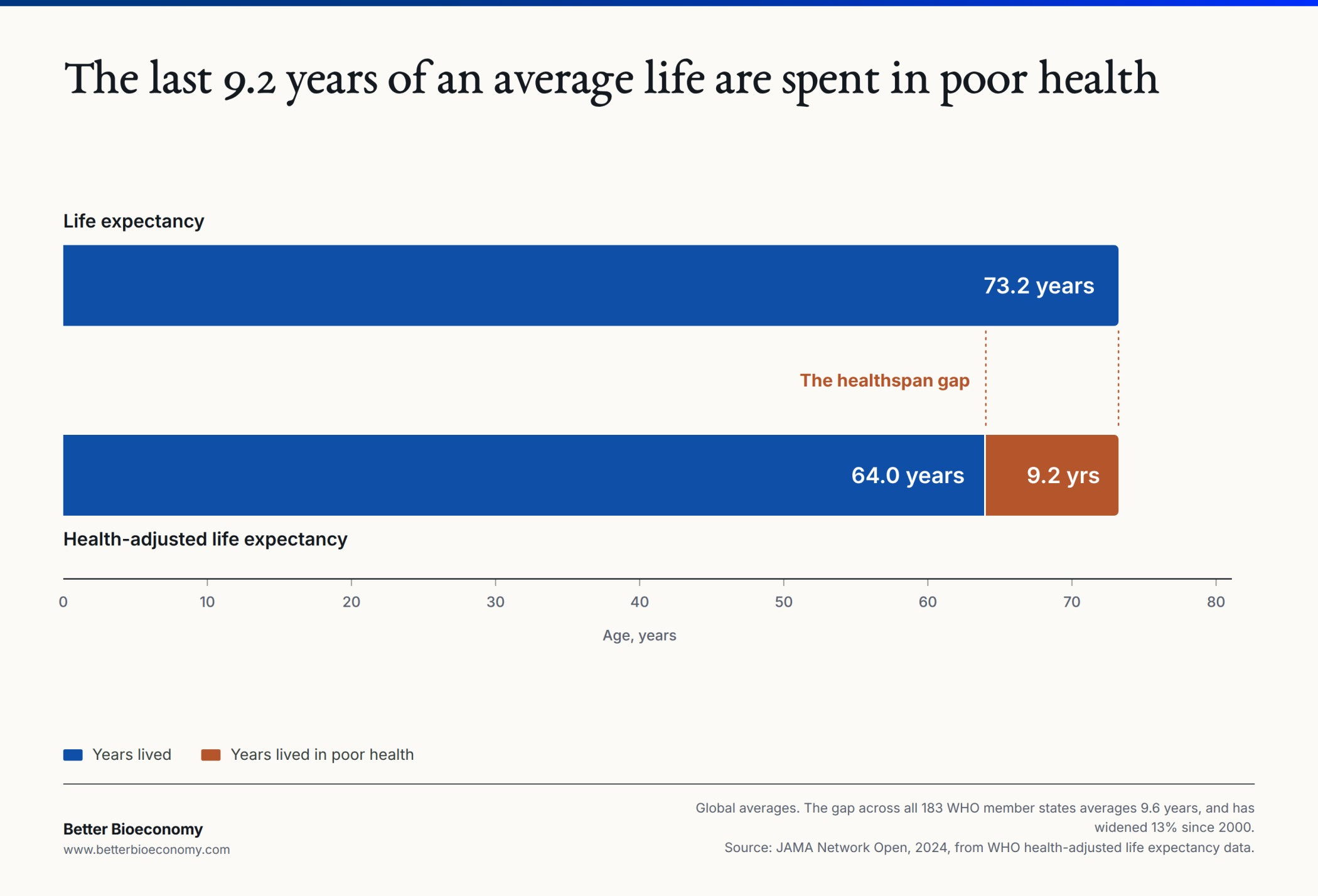
A 2024 analysis in JAMA Network Open covering all 183 WHO member states put the average gap between them at almost 10 years, and found it had widened by 13% since 2000. Most of us can expect to spend roughly a decade at the end of life unwell, and that decade is what the industry has started selling against.
What follows is a map. I want to lay out the distinct positions companies are taking, which ones look defensible, what the incumbents are doing about it, and what this shift does to the rest of food and nutraceuticals.
Let’s dig in!
The demand shifted from clean labels to clinical proof
The demand is not in doubt. McKinsey’s latest wellness research, previewed in June, has 84% of consumers ranking wellness a top priority, with more than half saying they prioritise it more than they did a year ago. Longevity is one of the growth pockets it names, and cognitive health is one of the gaps, with consumers reporting they could not find products to help them maintain it.
What the supplement aisle converts is narrower. Lumina Intelligence finds 57% of consumers recognise the term healthspan, 63% believe anti-ageing supplements can extend it, and 77% say they are interested in products supporting cellular repair. Only around 20% buy an anti-ageing supplement in a given year. Interest runs three to four times ahead of purchase, which is the gap every company in this article is trying to close.
What changed is what people want proved before they buy. McKinsey describes consumer preference moving from clean and natural ingredients toward clinically proven efficacy, and finds the shift sharpest in supplements and over-the-counter products. Doctor recommendations are regaining ground as a trusted source at the same time. Both of those are requests for somebody else to have checked the work first, and they are the demand-side reason the rest of this article looks the way it does.
There is an awkward gap underneath all of it. Healthspan has no agreed measure. At the population level there is one, the health-adjusted life expectancy figure the WHO uses, which is where that 9.6-year gap comes from.
At the level of a person or a product, there is nothing settled. A systematic review published last September screened over 14,000 papers and found 113 primary definitions still in circulation, concluding that the absence of a standard is now hampering comparison between studies.
So people are measuring more about themselves than ever, and none of it is a validated measure of the thing they are trying to improve. Blood panels, continuous glucose monitors and epigenetic clocks like GrimAge and DunedinPACE all produce numbers.
None of those numbers has an agreed relationship to how many healthy years you get. That is the situation in which “clinically proven” becomes the shortcut consumers reach for, and in which a clinician’s recommendation regains value.
GLP-1 drugs are what turned all of this from a preference into an expectation. Around 18% of American adults now use one, up from roughly 14% a year earlier. Users eat less, so every bite has to carry more, which has turned nutrient density into a formulation requirement and pushed protein, fibre and portion-controlled formats across the industry.
Muscle preservation has become a named target rather than a later worry. The larger effect is that millions of people have taken something and watched a measurable change happen in their own body over a few months. That resets the bar for everything else they consume.
Demographics sit behind all of it. The WHO projects that one in six people worldwide will be 60 or over by 2030, that the over-60 population reaches 2.1 billion by 2050, and that the over-80 group triples to 426 million over the same period.
That combination changes the design constraints. A food company optimising for taste, convenience and cost now has to think about clinically meaningful dosing, daily compliance, ingredient provenance and long-term safety. Precision fermentation earns its place here on consistency, because it produces a defined molecule at the same concentration every batch, which is what you need when the dose is the claim.
Which brings me to the problem. Euromonitor, via senior global insight manager Nick Stene, finds that half of all newly launched dietary supplement SKUs since July 2024 carry at least one healthspan claim. NAD+ messaging alone appears on just under 6%. When a claim appears on half of everything new, it stops helping anyone sort.
The seven positions companies are taking
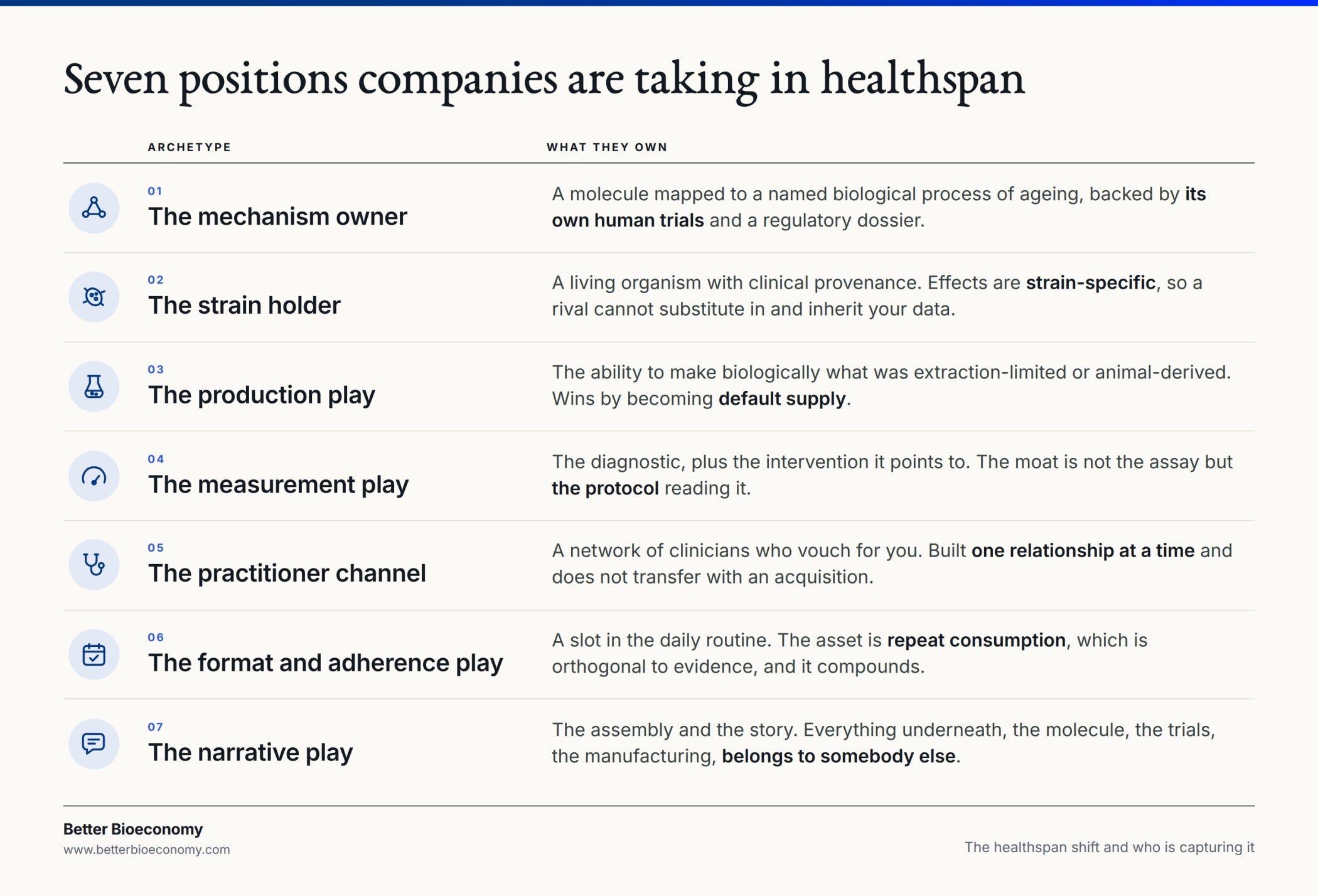
Underneath the marketing, I count seven different positions. They differ in what the company owns and how easily someone else could come to own it, too.
The mechanism owner
They hold a molecule mapped to a named biological process of ageing, backed by its own human trials. Timeline is one example. Niagen Bioscience, formerly ChromaDex, is probably the purest one, with nicotinamide riboside tied to NAD+ decline, more than 35 published human trials and EU novel food authorisation. Its eight-week study in 132 overweight adults showed a 51% rise in whole-blood NAD+ at 300mg a day.
The proof burden is the heaviest in the category: randomised human trials on your ingredient at your dose, plus a safety dossier clearing novel food or new dietary ingredient review. The molecule itself is copyable. The trial record and the regulatory file are the durable part.
The strain holder
They own a living organism with clinical provenance. Pasteurised Akkermansia muciniphila is the cleanest case, characterised by Willem de Vos and Patrice Cani, given a positive EFSA safety opinion in 2021 and authorised in the EU in 2022 as a food supplement at up to 5 × 10¹⁰ cells a day.
Probiotic and postbiotic effects are strain-specific, so a competitor cannot substitute a related organism and inherit your data. The moat is the patent estate, the proprietary trial record and the manufacturing know-how, since deposits in public collections can often be obtained by third parties.
The production play
They make biologically what was previously extraction-limited, animal-derived or prohibitively expensive, and increasingly compete on delivery as well as supply. Helaina’s precision-fermented human lactoferrin sits here, alongside fermentation-derived ergothioneine, mycoprotein platforms, and the bioavailability work around liposomal and phytosome formats.
The proof burden rests on equivalence, safety and a cost curve. These companies win by becoming default supply, which holds only as long as nobody makes the same molecule more cheaply.
The measurement and personalisation play
They own the diagnostic and sell the intervention. Bioniq formulates from blood biomarkers, Viome from microbiome and gene expression, Elo Health from panels combined with wearable data.
The defensible layer sits underneath the assay, since competitors can run the same markers. It is the protocol that decides who gets flagged, what they are told to change, what gets rechecked and when.
The caveat is that no biomarker of ageing has been clinically validated, and there is no agreement yet on how one should be, so the scoreboard everyone is being judged against is not itself settled science.
The commercial logic still points one way. In April, Infinite Epigenetics, TruDiagnostic’s parent, acquired Tally Health and moved into supplements, so the company running the biological age scoreboard now sells products the scoreboard rates.
The practitioner channel play
They sell through gatekeepers who require evidence before they will recommend anything. Thorne, Pure Encapsulations, Designs for Health and Xymogen all operate here, alongside the dispensary platform Fullscript. The proof burden is different, weighted toward third-party certification through USP or NSF, clinical dosing, GMP compliance and practitioner education.
The channel is 9.2% of US supplement sales and growing over 7% a year. A network of clinicians who vouch for you takes years to assemble, which makes it one of the harder positions to attack. Worth noting that Thorne is not a pure channel play, since it serves 47,000 practitioners and more than five million direct customers. The channel moat reaches a large outcome when it sits underneath a consumer business.
The format and adherence play
They own a slot in the daily routine. Complete-meal and routine-based products like yfood, Huel, Grüns and Nestlé Vital sit here. The asset is repeat consumption, tapping into consumers’ habits. A greens powder somebody drinks every morning outperforms a validated ingredient they forget in a drawer.
Habit is durable while it lasts and it compounds, and it is the one position here a company with no scientific programme at all can build from scratch.
The narrative play
They assemble third-party-validated ingredients into a story. Avea and SRW Labs are examples. As far as public records show, these companies market on ingredient-level literature rather than published trials of their own finished formulations. IM8 is kind of in between this and the format play, and I would put it in both.
Incumbents are buying capability at different price points
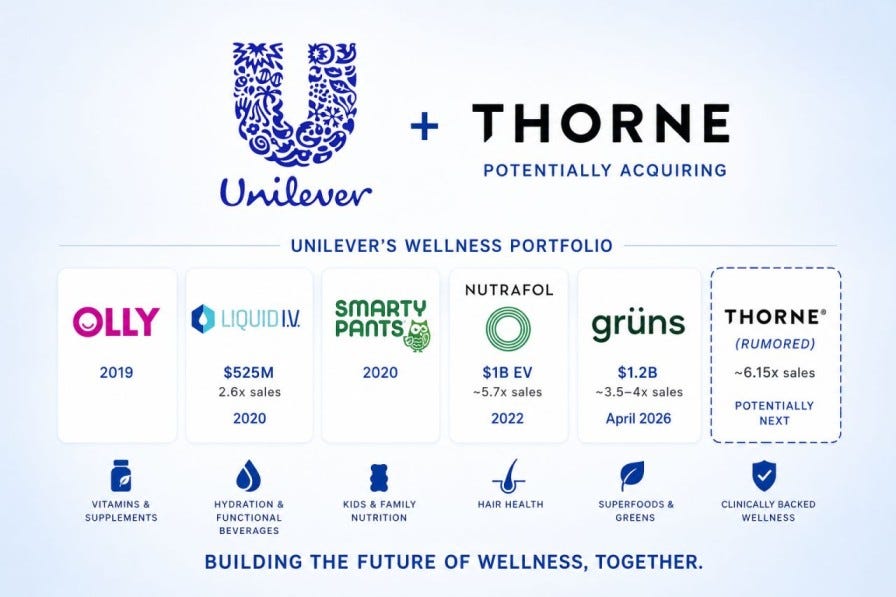
The acquisition record is the most legible thing in this category. It splits by what is being bought, and in one case by what is being sold.
Brands and habits command the largest cheques
Nestlé paid $5.75B for The Bountiful Company's core brands in 2021, covering Nature's Bounty, Solgar, Osteo Bi-Flex and Puritan's Pride, at 3.1 times the acquired brands' trailing sales. In June, it completed its purchase of the remaining 51% of yfood Labs at a reported $523M valuation against €150M of 2025 sales.
Danone agreed in March to buy Huel for around €1B, a deal still working through UK competition review, and Unilever bought Grüns at a reported $1.2B in April, roughly thirteen months after a Series B valued it at $500M and about thirty months after launch.
All three targets are formats people consume on a schedule. Grüns joins Unilever's Wellbeing Collective alongside Liquid I.V., Nutrafol, SmartyPants, Onnit, Olly, Equilibra and Welly, a group whose combined sales already top $1.1B against a stated ambition past $3B. Unilever has spent four years assembling that portfolio.
Science assets trade quietly and considerably cheaper
dsm-firmenich bought the postbiotics producer Adare Biome at a €275M enterprise value, bringing in Lactéol and the postbiotic Lactobacillus LB. Danone acquired The Akkermansia Company in 2025 for an undisclosed sum, buying a strain with a decade of academic work behind it.
Nestlé's original stake in Amazentis was never reported. The one deal here with a public number sits an order of magnitude below the brand cheques, which is suggestive rather than conclusive. Undisclosed does not mean small, and acquirers leave bolt-on values unstated regardless of size. That said, Nestlé, Danone and dsm-firmenich are all listed companies with disclosure thresholds, so a large purchase would likely have had to surface.
The clearest example of what changes hands in these deals is Ingredion’s June acquisition of Benicaros from NutriLeads, an upcycled carrot pomace extract that works at a 300mg daily serving. The asset deal transferred the intellectual property, the trademarks, the human clinical trials and the manufacturing know-how.
The practitioner channel is being repriced
L Catterton took Thorne private in 2023 at $680M. The Financial Times reported in June that Unilever is exploring a bid valuing it at up to $4B, with Haleon also among interested parties, though no deal has been struck.
Thorne serves 47,000 healthcare practitioners alongside more than five million customers. An asset that changed hands at $680M three years ago is now being discussed at roughly six times that.
The portfolios are being repositioned toward consumer nutrition
dsm-firmenich is exiting Animal Nutrition and Health to CVC at a €2.2B enterprise value, which the company describes as the final strategic step in becoming a fully focused consumer company in nutrition, health and beauty.
IFF is selling Food Ingredients, its largest division, to CVC for $4.3B, and its Pharma Solutions business to Roquette for $2.85B, sharpening its focus on flavours, fragrances and health. Both are moving out of tonnage and into function.
Unilever has probably gone furthest. On 31 March it signed a $44.8B combination of its entire food business with McCormick, taking $15.7B in cash and $29.1B in shares and leaving itself with 9.9% of the combined company. Just over a week later, it announced the Grüns acquisition. A company that spent a century building Knorr and Hellmann’s handed them to a spice business and bought a greens gummy for a reported $1.2B in the same fortnight.
What incumbents build for themselves is worth reading alongside what they buy and sell. Nestlé Vital, launched in February for adults in midlife, runs its Morning Routine formulation on taurine, magnesium and B vitamins in a daily-routine format. dsm-firmenich is reframing its innovation story from lifespan to cellspan around four modifiable hallmarks of ageing, with its Humiome Post LB postbiotic at preclinical data and ongoing human trials. Distribution now, expensive science later, and a story broad enough to cover both.
So what does this mean?
The second-order effects reach well past the companies making the claims. I can think of seven consequences that follow from all of this, and they land unevenly across food and nutraceuticals.
Small producers get priced out of their own claims
A properly powered randomised trial with functional endpoints runs from the high hundreds of thousands into the low millions, before the regulatory dossier. Regional ingredient companies cannot self-fund that.
Their options narrow to licensing material into somebody else’s clinical programme, selling into a private-label or commodity position, or keeping the ingredient and dropping the claim.
Consolidation follows, and it consolidates around whoever can afford the evidence rather than whoever has the better ingredient. That is a different selection pressure from the one this industry ran on before.
A market forms for evidence itself
PLT Health Solutions partnered this year with the Alethios decentralised clinical trial platform, specifically to give ingredient customers faster and cheaper substantiation. Once trials become a purchasable service, the barrier drops for everyone building a dossier from here.
The businesses selling substantiation capture the upside of the shift and carry none of the claim risk, which makes them a structurally comfortable place to sit. Biomarker panels, manufacturing quality systems and regulatory consultancies are being pulled into a category that did not previously need them at this volume.
Value moves upstream to whoever holds the dossier
When the evidence sits with the ingredient supplier rather than the brand, the supplier holds the asset that survives a brand rotation. A finished-goods company that licenses its actives is renting its differentiation.
FrieslandCampina Ingredients frames the same shift as protein becoming the baseline rather than the headline, which is a supplier-side way of saying the value is migrating into the formulation and away from the label.
Mainstream food reformulates, and commodity nutrition gets re-rated
Protein and fibre are now the leading claim in categories that never used them, increasingly formulated together for satiety and nutrient density, and healthy ageing is showing up across snacks, bakery, dairy and frozen.
The GLP-1 numbers underwrite it. Body composition substudies put lean mass somewhere between a quarter and 40% of total weight lost, and the drug-by-drug ordering is still being argued over in 2026 data. Lean mass includes water, organs, and connective tissue, so it is not the same as muscle, and these proportions are broadly typical of rapid weight loss of any kind.
The commercial effect is that protein, fibre and leucine-rich formats picked up a clinical rationale they did not have five years ago, and companies sitting on decades of ordinary nutrition science suddenly hold relevant evidence.
The channel mix shifts toward both ends and hollows out the middle
Direct-to-consumer is now 29% of supplement sales, up from 16% in 2020, while the practitioner channel reaches around $6B this year on roughly 6% growth. Those are the two places where a proof story can be told at all, either by a clinician who reads the data or in a direct relationship long enough to explain it.
An undifferentiated retail shelf is the hard place to sell a claim nobody has time to evaluate. The boundary between the two ends is also blurring, with practitioner brands moving into direct and retail channels alongside the clinics.
Jurisdiction decides what a product is
In the EU, almost none of the marquee longevity ingredients carry an authorised health claim, even where the ingredient itself is an authorised novel food. In the US, the FTC’s finalised order against TruHeight this year specifies randomised, double-blind, placebo-controlled testing on the product itself or an essentially equivalent product.
The same formulation can be a compliant product in one market and an enforcement target in another, which means the claim strategy has to be built market by market.
The word gets used up
At half of all new launches, healthspan has already stopped sorting anything for a shopper, a retail buyer or an investor. Consumers are moving in the same direction, with NielsenIQ describing a self-directed, results-driven consumer who checks claims for themselves.
Natural and clean label went through the same arc and came out as table stakes that nobody can charge for. When it happens here, the companies holding real dossiers inherit a category that nobody else is allowed to describe.
Closing thoughts
Consumers have started asking for proof, and the thing they want proved has no single measure. Consumers continue to buy healthy ageing products, and they increasingly want clinical evidence behind it.
Healthspan turns out to be several things: mobility, sleep, cognition, metabolic control, the muscle you keep. The review that found 113 definitions was pointing at a missing standard, since plenty of people define healthspan and nobody has agreed which definition counts. So each company claims a piece of it, and none of them can claim the whole.
Reading back across the seven, the question that separates them is what a competitor would have to build rather than buy. On that test, the practitioner channel is, in my view, the hardest to attack, because a network of clinicians accumulates one relationship at a time and does not transfer with an acquisition.
The strain holder is close behind. The production play holds default supply only until somebody makes the same molecule more cheaply, and the narrative play owns the assembly and nothing underneath it.
That ranking sits against where the money has gone, and working out why changed my mind about it. Replication difficulty sets defensibility. What sets the price is scarcity in the buyer's own hands. Unilever can fund a trial and license a strain, and it has built its Wellbeing Collective to $1.1B in combined sales across seven brands. It still paid a reported $1.2B for thirty months of Grüns. That tells you what habit at that velocity is worth to a company that already knows how to build brands.
There is a ceiling problem too. A dossier sold into other people’s formulations is capped by what formulators will pay, and it is sold to ingredient houses that know what building the same file would cost. dsm-firmenich bought Adare Biome while building Humiome in-house, which tells you what a company with its own research organisation thinks a dossier is worth. The most defensible positions in this category have the smallest buyer set and the best-informed buyers.
The money is going to habit, and it makes a lot of sense. A product somebody takes every morning for three years is worth more than one with a good trial and no repeat purchase. Strains and dossiers change hands quietly while formats change hands loudly, and Thorne is an early real sign of the market repricing one of those positions.
As always, my understanding keeps evolving here, and this is a category where the science and the commercial reality are moving at different speeds. If you spot something I have missed or got wrong, let me know.
And if you are someone investing in this space, I would love to connect. Thanks for reading!

Don’t miss your chance to attend the Asia-Pacific Agri-Food Innovation Summit and get 10% OFF with my network code. Use my exclusive partner code for 10% OFF your pass: BETTERBIO10
Learn more
If you found value in this newsletter, consider sharing it with a friend who might benefit from it!
Or, if someone forwarded this to you, consider subscribing.
Disclaimer: The views and opinions expressed in this newsletter are my own and do not reflect those of my employer, affiliates, or any organisations I am associated with.
On the money Eshan. Great summary.