

Hey, it’s Eshan. Welcome to Issue #158 of Better Bioeconomy. Insights on the companies and capital shaping how we produce food, nourish ourselves, and improve our health. Thanks for being here!
A phone can now show you last night’s sleep stages, this morning’s readiness score, your glucose curve after lunch, and a panel of blood markers from a commercial lab. Every one of those readings is real, but they are not equally well understood. Still, they show up on the same screen looking as though they are.
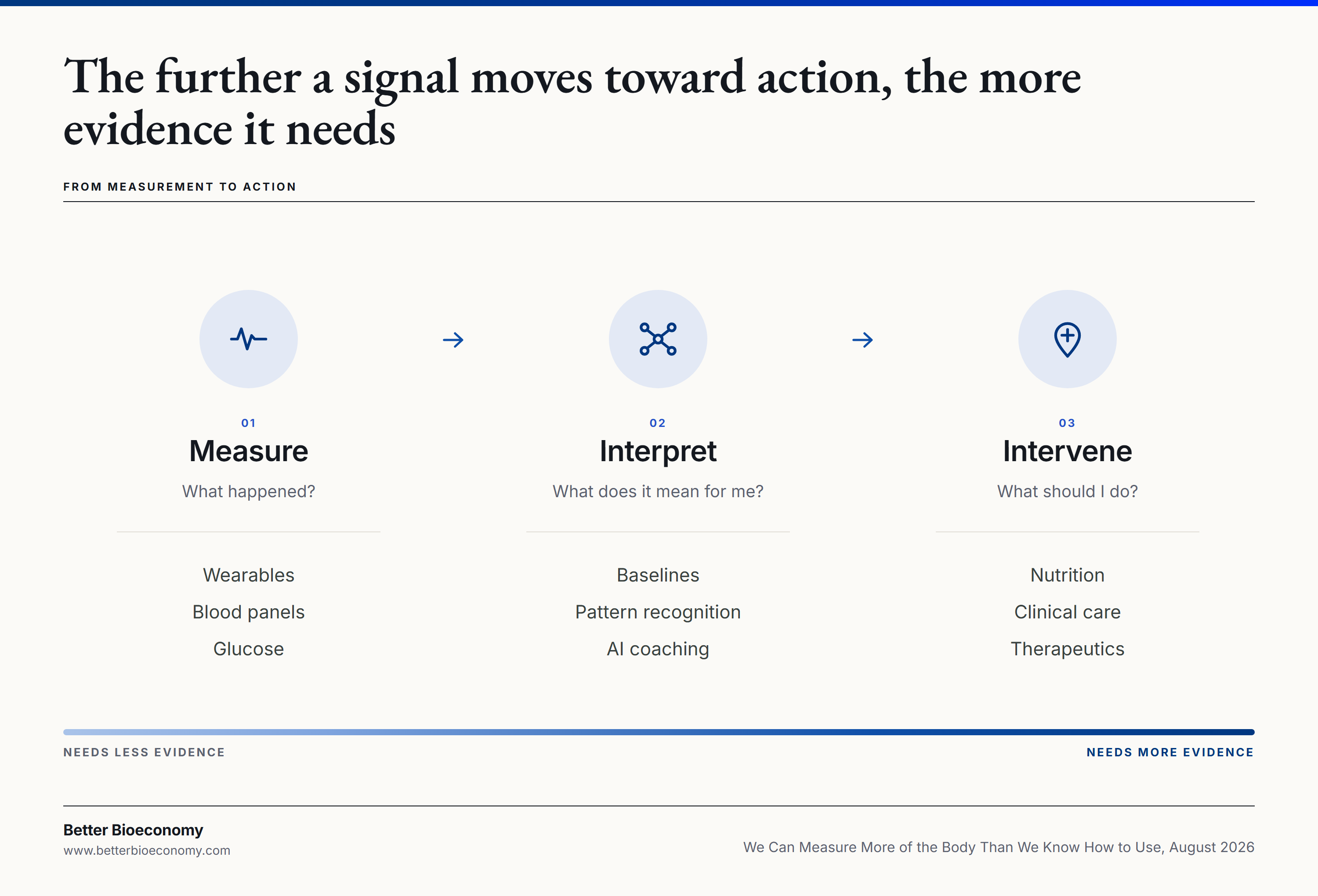
Whether we can measure more of our biology is clear. But what any one of those numbers is telling you is less clear, because a single reading can be answering three different questions at once:
What happened? Your glucose rose after lunch.
What does it mean for me? Whether that rise is unusual for you, or sits inside your own normal range.
What should I do? Change the meal, change the timing, or do nothing.
My reading is that consumer health is moving fastest into the question it can answer least well. Measuring what happened is getting easier. Knowing what one reading means for one person is harder. Knowing what to do about it is where these products are heading, and where the evidence runs out first.
Oura, WHOOP, Google and Dexcom are all adding data they did not collect
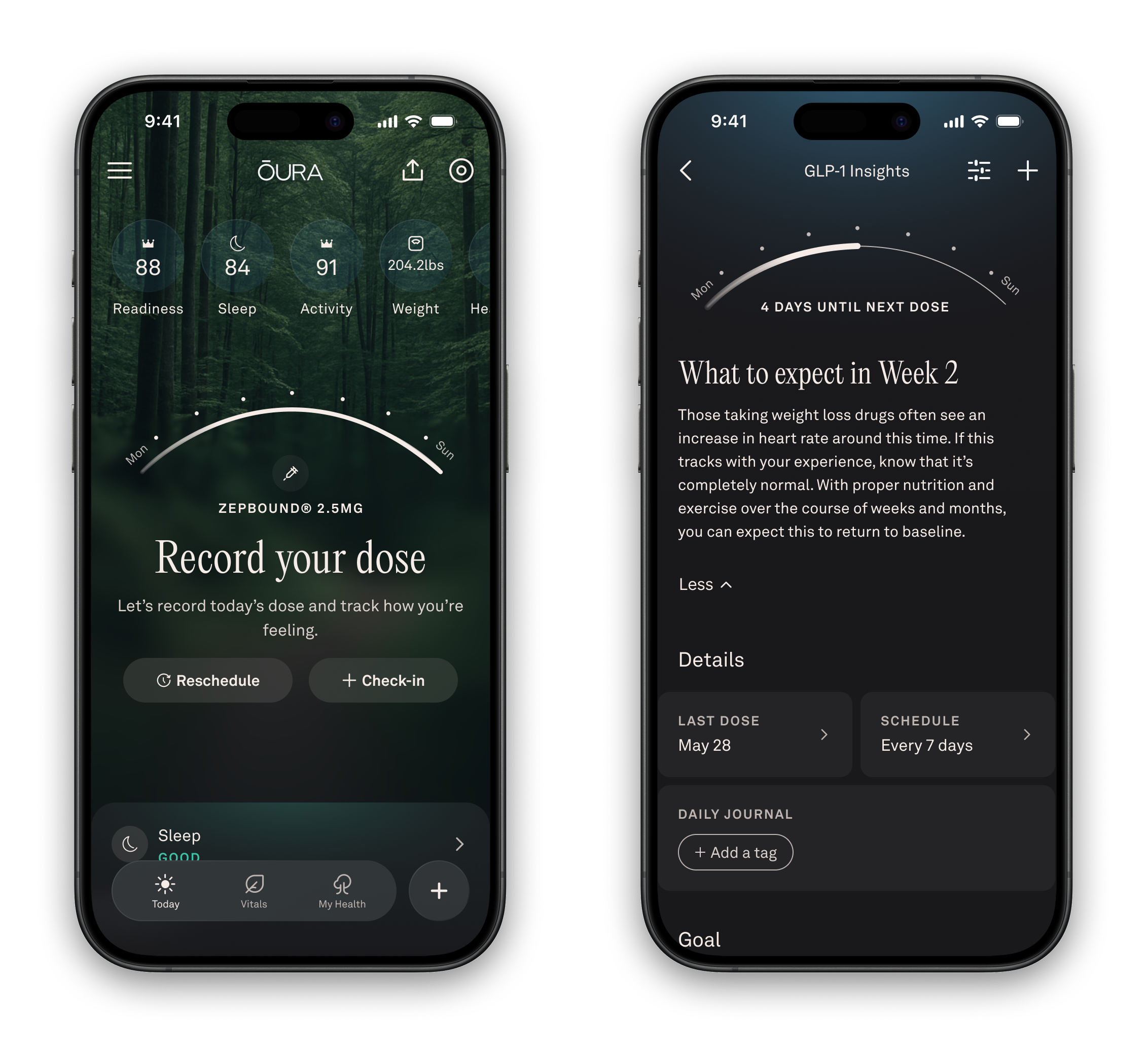
The leading consumer health platforms all shipped the same feature this year: an import button.
Oura sells Health Panels with Quest Diagnostics: book a blood test in the ring’s app and fifty results come back into it, and you can now upload a PDF of a test taken anywhere else.
WHOOP made the same move earlier, also with Quest, with 65 biomarkers reviewed by a licensed clinician and free uploads of old bloodwork.
Google went further and took the medical record itself: its Fitbit health coach connects lab results, medications, visit history and records from your own doctors, and its worked example is a food question, asking how that slice of pizza affected your glucose.
Dexcom has gone the other way, adding interpretation to a single signal, with a redesigned Stelo app doing pattern recognition, AI coaching and photo meal logging.
Two competing wearable companies went to the same laboratory business, and the headline feature on both accepts data the device never measured. So the wearable is turning into the place you keep everything else as well.
Thirty people ate the same meal twice and got two different readings
Start with the first question: What happened after this meal? Glucose is the fair test here, because it is the signal with the most evidence behind it.
At the US National Institute of Diabetes and Digestive and Kidney Diseases, Kevin Hall’s laboratory ran two inpatient feeding studies in which thirty adults without diabetes were served the same meals twice, about a week apart. The results came out in the American Journal of Clinical Nutrition in January 2025.
A research kitchen prepared and presented every plate. Continuous glucose monitors captured 1,189 responses to those duplicate meals, using sensors from both Abbott and Dexcom.
The question was how closely one person’s two responses to an identical meal match. Not very closely, apparently. Researchers score this on a scale from 0 to 1, where 1 means a measurement repeats itself perfectly. Hall’s team got 0.28 for the Abbott sensor and 0.17 for the Dexcom.
Eating the same breakfast twice generated about as much variation as eating two different breakfasts. They concluded that dietary advice based on these readings needs many measurements before a person’s response can be estimated reliably.
And this was inpatient, with every plate weighed and served by a research kitchen, which is about as controlled as this gets. In our day-to-day life, more things are moving that could change a single meal’s result.
Hall struggled to reproduce the response to a single meal. That is also what consumer glucose products put on the screen. Stelo shows the curve after a meal and now offers to photograph the plate first. Oura’s Meals feature does the same. The sensor is accurate, and the reading is real. But it is describing one meal, and one meal moves around a lot.
That said, it is thirty people, and the variability is not all biology. The two sensors did not agree with each other either, at 0.28 and 0.17 on the same meals. One post-meal response is not repeatable enough to base personal dietary advice on, which is what the study set out to test.
Averaging many meals finds the signal that one meal loses
The second question is the one people want answered: What does this mean for me?
Later that year, the same journal published a study that gets closer to answering it. At Westlake University in Hangzhou, a team working with José Ordovás and Ju-Sheng Zheng ran a study of 176 healthy Chinese adults, treating each person as their own experiment and feeding them standard meals under a glucose monitor.
Individual meals still varied. But when they combined many meals into a single score for how strongly a person's blood sugar responds to food in general, that score held steady. It came out at 0.73 on the same reliability measure that gave the single meal 0.17, and it was still recognisably the same person two years later. It is one cohort of healthy Chinese adults eating standardised meals, so whether the same score holds in other populations, or outside a research kitchen, is not established.
Hall asked whether one meal predicts itself. Westlake asked whether a person has a general tendency that shows up across many meals. The second team did what the first said was needed, and found something that held for two years. But the app puts the individual meal in front of you, because that is the thing that happened today.
That choice comes up everywhere, not only with food. A single meal, a single night’s sleep and a person’s average over months are different kinds of information. Some signals hold up one night or one meal at a time. Others only mean something once they have been averaged.
Glucose monitoring worked best where a diagnosis, a target and a treatment already existed
That leaves the third question: Does acting on the information help?
In June, Dexcom presented the CONNECT trial at the American Diabetes Association’s annual meeting. It randomised 283 adults with type 2 diabetes who were not on insulin at 22 US primary care practices, and ran for 26 weeks against routine care with finger-prick testing.
Everyone started with an HbA1c of about 8.8%. HbA1c is a blood test that reflects average blood sugar over roughly the previous three months, and it is one of the main measures clinicians use to judge how well diabetes is controlled.
The monitored group’s HbA1c fell 1.6 points against 0.7 in the control group. This is Dexcom’s own trial. The company sponsored it, several authors report consulting or research support from it, and the results have been presented at a conference but not yet published as a peer-reviewed paper. None of that undoes a randomised trial that hit the outcome it set out to test.
HbA1c at 26 weeks is itself an average of about three months of blood sugar, so what CONNECT tested was an aggregate outcome in a diagnosed population with an established target. It never rested on any single reading. Hall’s duplicate meals said one reading is not stable enough to rest on, and CONNECT did not ask it to.
Two months later, JAMA Internal Medicine published a review concluding that for people without diabetes, there is no good evidence that continuous glucose monitoring improves health or prevents diabetes.
The authors add that the meaning of glucose fluctuations in that group is uncertain, and that chasing spikes may lead people to cut out healthy foods such as fresh fruit.
What I think separates them is that in diagnosed type 2 diabetes, doctors already knew what was wrong, which number they were trying to bring down, and what to do about it, long before any sensor arrived.
A healthy person watching a curve rise after lunch has none of that, and no treatment that has been shown to help with the rise itself. The same pattern shows up elsewhere: wearable signals shifted up to seven weeks before an inflammatory bowel disease flare in 309 people, again in a group that already had a diagnosis.
The companies mark this boundary themselves. Dexcom’s Stelo site sells an AI Coach and promises to show how food, exercise, stress and sleep affect your glucose, and states that the user is not intended to take medical action on the device output without consulting a clinician. Those disclaimers draw a line between an insight a company can generate and a decision it will stand behind.
Products have to turn measurements into something people can act on
A consumer health product does more than show a number.
Stelo draws the curve, attaches it to the meal you photographed, and offers up to three suggestions off the previous day. Oura compresses a night of physiology into a readiness score. WHOOP returns a recovery percentage. An AI coach takes whichever of those is on the screen and writes a recommendation from it.
Each of those steps turns a measurement into something a person can act on. And each one needs a choice about what to show: the meal, the night, the day, or the three-month average.
The industry already knows baselines matter. Oura takes about two weeks to learn your averages and WHOOP about thirty days, and both use that history to judge whether today is unusual for you. That is a baseline for reading today's number, and it is a different thing from knowing how you respond to a particular food.
Glucose products do aggregate, but over time rather than over meals. Stelo reports daily and weekly summaries, and CONNECT's HbA1c is three months of blood sugar averaged. Both of those average the clock. Westlake averaged the meals, which is the score that would answer the food question. What the app shows you is still the meal.
The screen gives both the same weight. A glucose curve after lunch shows up looking as definitive as a three-month average.
The numbers are still useful. A review of 39 systematic reviews found that wrist-worn trackers reliably increase physical activity, even where their effects on cardiometabolic markers stay inconsistent. Prompting attention is a real function. But it is a different function from telling someone what to do.
How the industry could get better at this
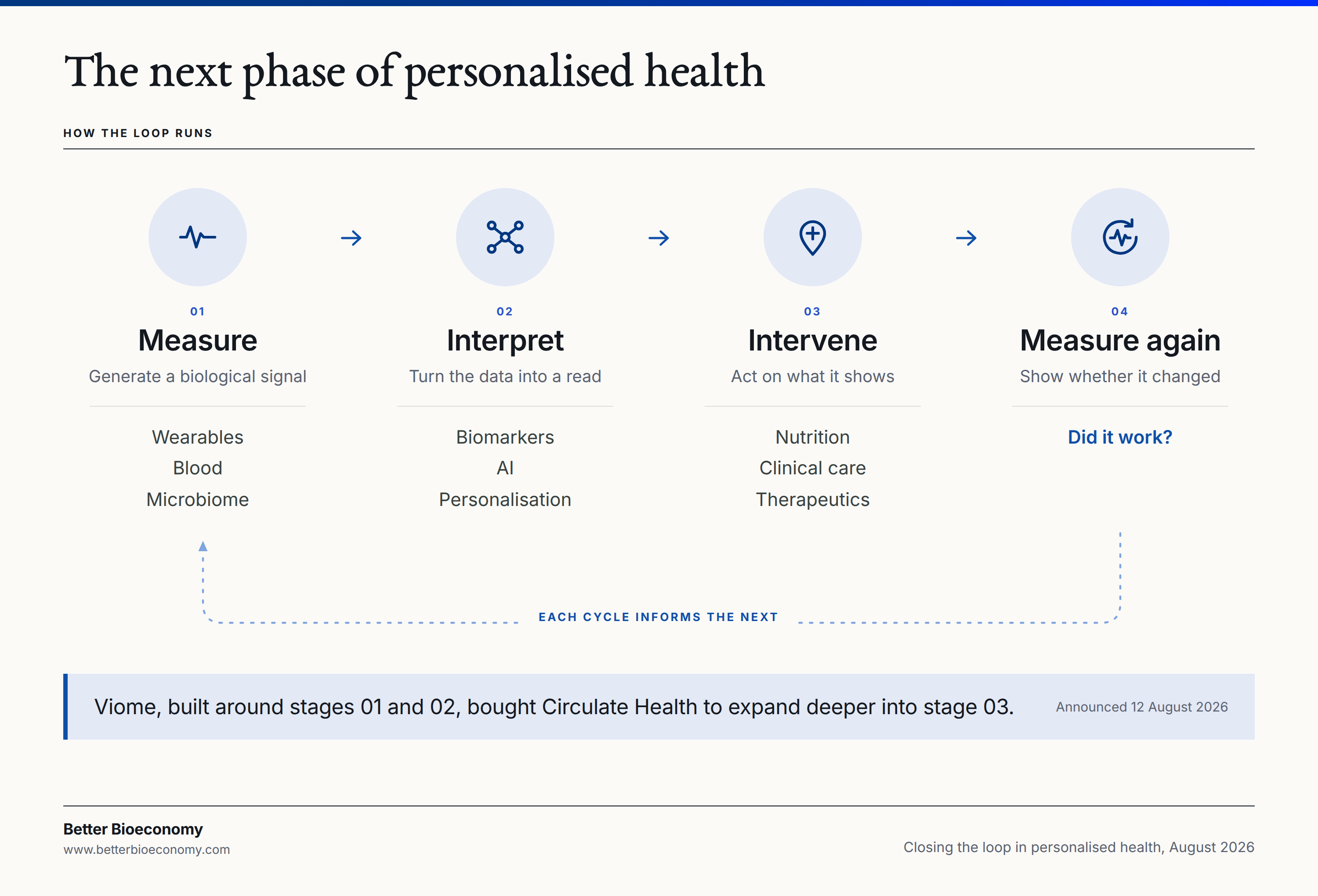
Four of these strengthen the path from a measurement to an action. The last one is about what to do where it cannot be strengthened yet.
Run the trial
Elevance Health and the University of California, Irvine, worked with Apple on a twelve-month randomised trial in 901 adults with asthma across 41 states. It ran against usual care, and the result is in JAMA Network Open.
Among those whose asthma was uncontrolled at the start, symptom control improved 4.6 points against 1.8. It is the same shape as CONNECT: a consumer device pointed at a diagnosed group with an established target and a known action.
Pay for the outcome
The US Food and Drug Administration has selected Dexcom’s Glucose Health Program as the first participant in its TEMPO pilot. The pilot is tied to the Centers for Medicare and Medicaid Services’ ACCESS Model, which pays on demonstrated improvement in patient health instead of on services delivered.
WHOOP has entered the same pathway. An institution that pays for outcomes has to say what counts as one, and it will not be a glucose curve after lunch.
Aggregate before you personalise
The Westlake score is stable across two years in a research setting, and a product could compute something like it. Whether anyone would value a number that is dull to look at and updates slowly is less clear.
A product that shows a steady, person-level number instead of today’s fluctuation is telling you which of the two it thinks matters.
Add a human, or the intervention itself
In June, Dexcom agreed to acquire Nutrisense, which pairs continuous glucose data with registered dietitians. Viome went further recently, buying Circulate Health and its plasma exchange clinics, which I wrote about here.
One adds human interpretation. The other adds the ability to act on the measurement inside the same company.
Know where to stop the claim
In January, the FDA reissued its general wellness guidance, and the line it draws is not about the sensor.
Some non-invasive wearables can estimate blood pressure, heart rate or glucose and stay outside device regulation. The measurements have to be validated, and the product cannot use them to guide a specific clinical action. It may tell you to see a doctor. It may not tell you what for. That is what the disclaimers above are made of.
Closing thoughts
Nutrition is where this gets difficult. Food touches glucose, sleep, energy, appetite and mood. We control it directly, and we get feedback within hours. That combination makes it tempting to act on a single reading, even though the evidence does not support firm conclusions from one meal.
What would matter is deciding when not to turn a measurement into an insight. Adding another signal is an engineering problem, and the industry has become good at it. Deciding what to do with each signal is a different problem. Some deserve a score, some deserve an explanation, and some should stay a measurement with no recommendation attached. It asks a product to put the evidence ahead of the interface.
The useful question about a consumer health product is no longer how many readings it carries. It is which readings it is prepared to leave off the screen, and what evidence it has for the ones that stay.
I’m Eshan. An operator-turned investor, backing companies in food, agri, nutrition, and health.
I’ve been writing Better Bioeconomy since 2023, as a way to share my learnings and to connect with cool people like you. Thanks for reading!
Unlock Asia’s trillion-dollar opportunity

Don’t miss your chance to attend the Asia-Pacific Agri-Food Innovation Summit and get 10% OFF with my network code. Use my exclusive partner code for 10% OFF your pass: BETTERBIO10. See you there!
If you found value in this newsletter, consider sharing it with a friend who might benefit from it!
Or, if someone forwarded this to you, consider subscribing.
Disclaimer: The views and opinions expressed in this newsletter are my own and do not reflect those of my employer, affiliates, or any organisations I am associated with.
"They show up on the same screen looking as though they are equally well understood" is the whole problem in one line. The sleep score is the sharpest case: a lab-validated stage estimate and an unpublished composite sit side by side in the same app, rendered identically, and only one of them can be checked against anything. Presenting a signal with its evidence attached is a design decision, and almost nobody makes it. I build a desktop app for Oura data that shows the parts rather than one verdict number, for exactly this reason: https://vitrahealth.app/?utm_source=betterbioeconomy&utm_medium=comment&utm_campaign=signal-evidence