

Hey, it’s Eshan. Welcome to Issue #159 of Better Bioeconomy. Insights on the companies and capital shaping how we produce food, nourish ourselves, and improve our health. Thanks for being here!
I have been increasingly curious about what the rise of metabolic health means for food and nutrition companies. GLP-1s have pulled a lot of attention toward blood sugar, appetite, weight management and muscle health.
But I wanted to work out where the food and nutrition opportunity extends beyond the drugs themselves. Tate & Lyle published one this month called Future-Proofing Nutrition: Designing Products for Lifelong Metabolic Wellness, and it is the latest in a run of consumer research on the subject since the start of 2025. ADM, Kerry, Cargill, dsm-firmenich, Ingredion, Herbalife and OPTAVIA have all published in the same window.
So I read across them to see where their thinking overlaps. Four themes kept coming up that I think say something useful about where metabolic health nutrition is heading.
Every source here is a company with something to sell, and these documents are marketing as much as they are research. I will just say that up front and move on, because the useful part is watching where companies with different products end up agreeing.
Consumers want metabolic health outcomes without asking for a “metabolic health” product
Metabolic health is a cluster of readings. The international criteria agreed in 2009 by the International Diabetes Federation, the American Heart Association and the World Heart Federation, among others, cover five of them:
Waist circumference
Blood pressure
Fasting glucose
Triglycerides
HDL cholesterol
Three out of range is metabolic syndrome. Being clear on all five without medication is what a 2019 analysis of US survey data called optimal metabolic health. Clinicians and researchers have those definitions. But shoppers do not, and several of these reports say so directly.
Emma Cahill, global marketing director for sweeteners, fibres and GLP-1 at Tate & Lyle, told: “I have yet to see a brand position boldly around metabolic health in consumer-friendly language.” OPTAVIA’s December 2025 survey puts a number on it from the other side. Fewer than half of Americans, 43%, have heard the term at all.
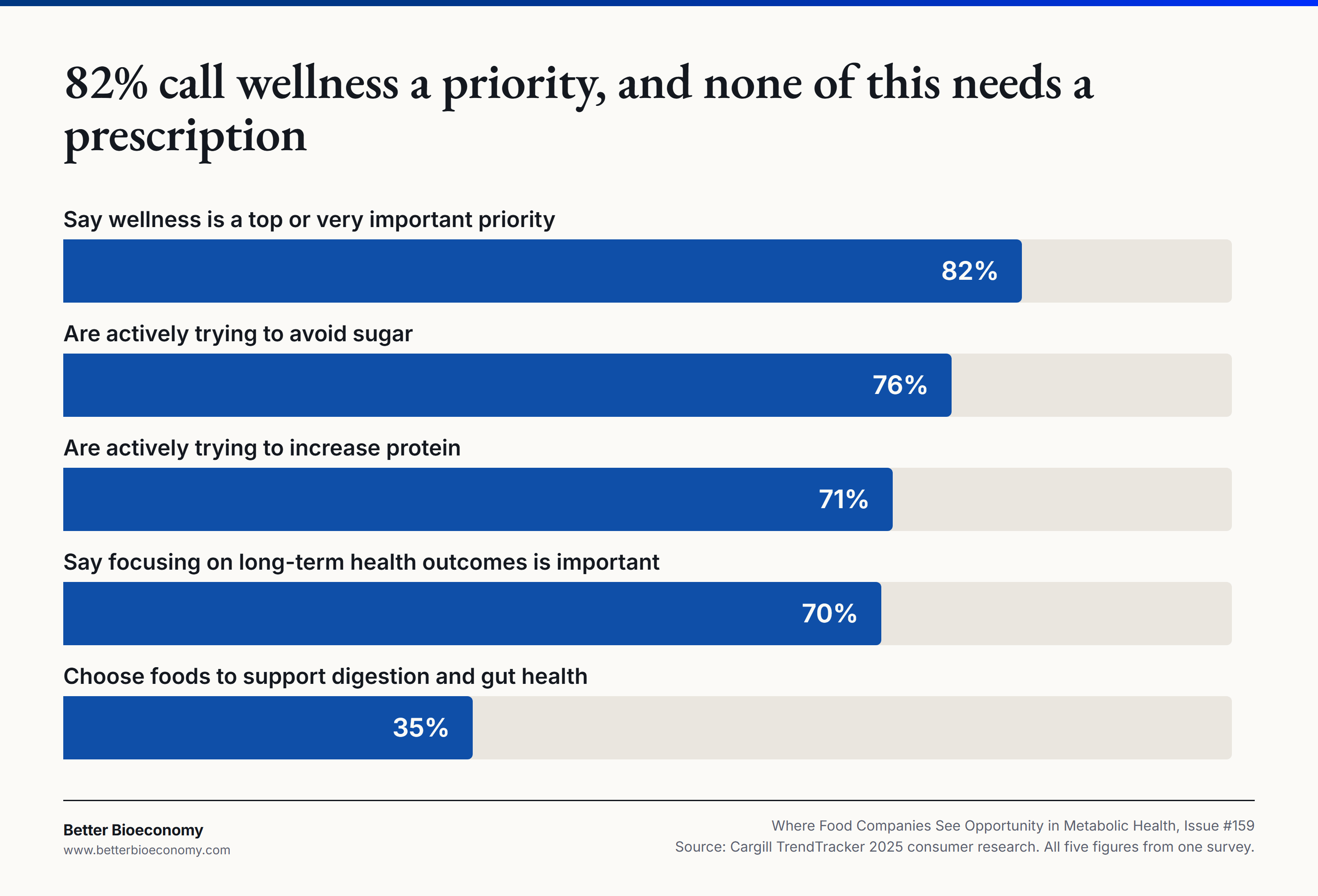
The behaviour is running well ahead of the vocabulary. Cargill’s TrendTracker research found:
76% actively trying to avoid sugar
71% actively trying to increase protein
35% choosing foods specifically to support digestion and gut health
Those overlap with what metabolic health products are trying to influence. None of them requires the shopper to have heard the phrase.
Herbalife’s May 2026 survey of >10,000 people across 11 Asia Pacific markets asked what people most want to improve. The top answers were:
Sleep quality: 44%
Mental wellbeing and stress: 38%
Nutrition quality: 31%
Weight management: 30%
Metabolic health was not among the options, so the survey cannot tell us whether people would use the phrase. What it does show is that the priorities people pick out are familiar: sleep, stress, nutrition and weight.
So the problem these reports keep circling is a naming problem sitting on top of behaviours that are already there. That is a better commercial position than the reverse, and it explains why these documents are all partly language exercises.
Cahill’s practical answer is that shoppers have flipped the order in which they read a label, checking the positives like fibre and protein before they check the negatives like sugar and calories. That is a small observation with a lot of formulation consequences.
The opportunity may not be to convince consumers to care about “metabolic health.” They already care about the things underneath it. For food companies, the better use of the term may be behind the scenes, as a way to decide what to formulate for, while the pack talks about outcomes people already understand.
The plate got smaller, and that changed the recipe and the format
For years, nutrient density was a positioning claim. You could put it on a pack. GLP-1 medications turned it into a constraint. ADM found that 74% of medication users feel full more quickly, and once that happens, every gram has to carry more.
Tate & Lyle’s earlier study, fielded among 500 active and former GLP-1 users in North America in May 2025, found users reading labels harder than before, looking for high protein, added fibre and less sugar.
Cargill’s numbers show the same behaviour as a coping strategy. Among GLP-1 users experiencing side effects:
25% increased fibre
24% increased protein
21% moved to smaller and more frequent meals
Nestlé is spending against that shift at scale, with Vital Pursuit built around portion-aligned meals and a Nestlé Health Science platform built around preserving lean muscle mass, gut health, micronutrient intake, hydration and weight rebound control.
On the ingredient side, Arla Foods Ingredients is selling into lean muscle preservation and gastrointestinal tolerance.
The most common answer is protein and fibre. The question is how much of that convergence comes from the biology, and how much comes from what these companies already sell.
Some of it is physiology. Less food means protein matters more for holding lean mass, and fibre matters more for satiety and for the glycaemic response of whatever is left on the plate. But a dairy protein supplier and a chicory fibre supplier arriving at compatible conclusions from different starting points is worth something.
The rest of it is that Cargill, Tate & Lyle, Arla, FrieslandCampina, Beneo and Roquette all sell protein or fibre, and Ingredion’s metabolic health paper names fibre, protein and sugar reduction as the three formulation tools, which is a description of Ingredion. ADM’s report is the clearest case, because it closes with a page mapping each finding onto an ADM ingredient:
Soy, pea and wheat protein for muscle
Biotics for digestive discomfort
Prebiotic fibre for satiety
Every one of these companies has found the white space, and all of them have found it shaped like the ingredient they already sell. Both things are true at the same time, and the convergence worth trusting is the one that crosses portfolios.
The language slips in the same way. “Slows gastric emptying” and “triggers GLP-1 release” are mechanistic claims. “Supports metabolic health” implies a clinical one. Across the reports I read, I did not find a clinical endpoint, and the documents move between those two registers without marking the change.
The smaller plate is changing the format as well as the recipe, and that gets less attention than the ingredients do. ADM’s own conclusion is that what these consumers want is enjoyable, convenient and portion-controlled functional products.
For food companies, the opportunity is bigger than reformulation. If appetite shrinks, what has to change is the portion, the format and the occasion, as much as the protein and the fibre content.
76% of people who stopped taking GLP-1s regained some of the weight
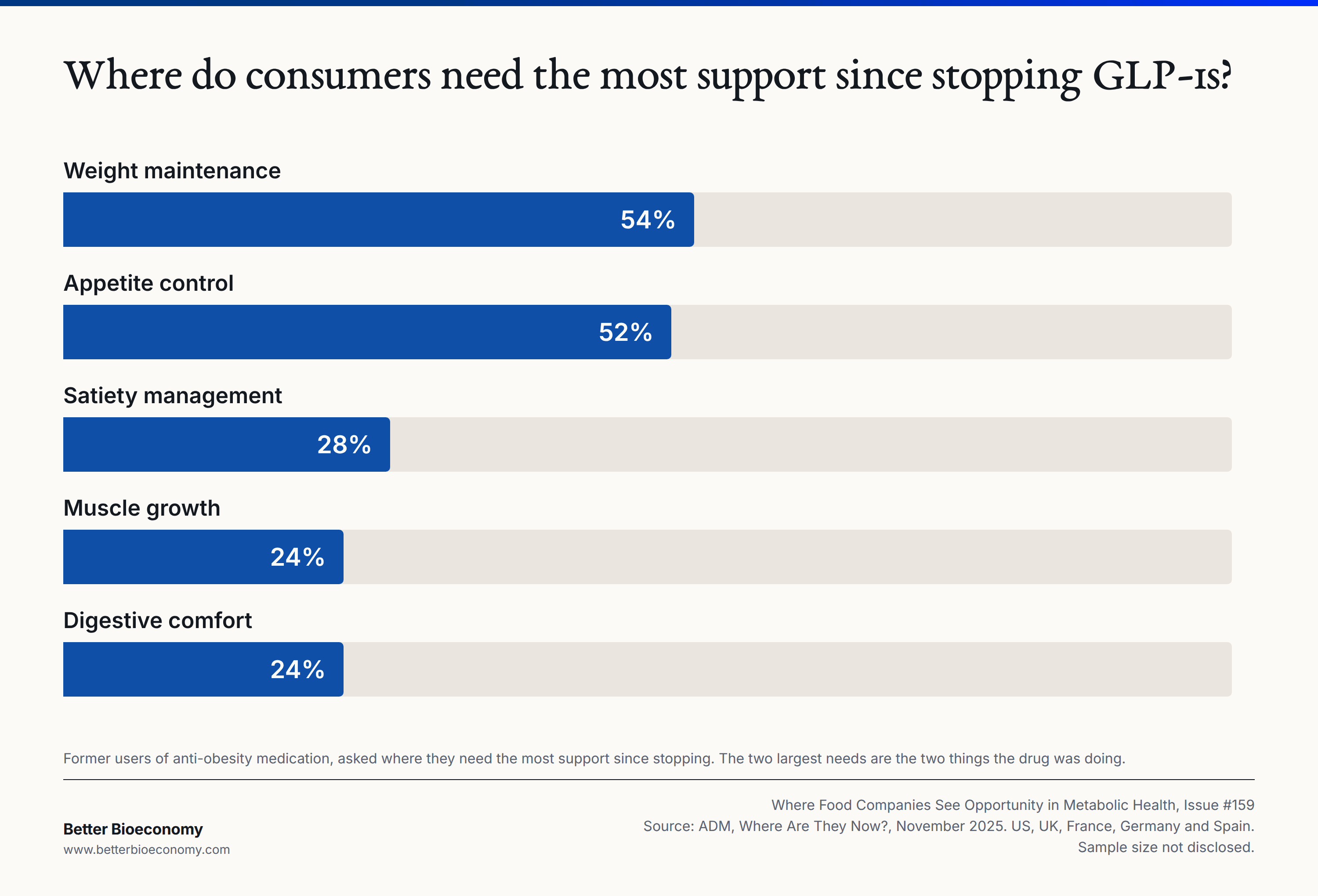
ADM published Where Are They Now? in November 2025, surveying people across the US, UK, France, Germany and Spain who are on anti-obesity medication and people who have stopped. It is the one report here that measures what happened to people after they came off.
Among former users, 60% say food noise has come back. 76% have regained at least some of the weight. Many also report keeping the habits they picked up on treatment:
54% still eating more fruit and vegetables
49% still holding better portion control
47% still cooking more at home
ADM reads the regain as happening despite those habits. The survey reports both and does not show they are the same people. It is also self-reported, and it counts how many people regained something. It does not say how much.
A Cleveland Clinic analysis followed 7,938 patients who stopped semaglutide or tirzepatide. Those treated for obesity had lost 8.4% of their body weight before stopping, and regained 0.5% a year later. That is well under what randomised trials had shown, largely because a quarter switched to another drug and a fifth restarted the original.
Both findings can be true at the same time. And what limited the regain in the Cleveland Clinic cohort was mostly other prescriptions.
Intention data tells a messier story. Kerry’s survey of more than 2,600 US adults, published in February 2025 on earlier fieldwork, found 6% of users planning to stay on the medication for life.
ADM asked a similar question later, across five countries, and found 35% planning to continue long-term. The two questions are not identical, so this is not a flat contradiction. But 6% and 35% point in opposite directions, and both are asking people to forecast their own future behaviour. I would be cautious about building a market thesis on either number.
What people actually did is more useful than what they predicted they would do. Among those who do come off, appetite returns and weight regain is common.
Tate & Lyle describes the same arc as three phases: momentum, maintenance and regression. It also singles out former users, who face a resurgence of appetite and food noise. Kerry adds one figure that has aged well. 90% of users were already buying vitamins, supplements or probiotics while on the drug.
So a good part of the opportunity these companies describe lies in the prescription, not in the drug. Food can sit in three places:
During treatment, in tolerability and nutrition support
After it, in appetite and weight maintenance
Outside it, for people managing the same physiology without ever taking a drug
None of these reports frames it that way, but read together, that is the bet they are making.
Food is unlikely to replicate the pharmacological effect of the drugs head-on, and the pharmacokinetics explain why. Endogenous GLP-1 has a half-life of one to two minutes before DPP-4 degrades it, and the long-acting analogs reach days, several of them by binding to albumin.
So the realistic opportunity sits next to the drugs, in products that reduce side effects, improve tolerability and support adherence.
And then there is everyone else. Cargill’s sugar-avoidance number has no drug gate on it at all. People managing weight or blood sugar without a prescription sit outside almost all of the segmentation work in these reports.
The drug creates an obvious consumer segment, but the underlying metabolic needs extend much further.
Weight management is the entry point, and healthy ageing is the broader opportunity
The Tate & Lyle report is called Designing Products for Lifelong Metabolic Wellness. The frame is in the title.
dsm-firmenich’s 2025 Global Health Concerns study with Ipsos shows the same absorption from the consumer side. Among the people who are both concerned about healthy ageing and already doing something about it, 46% are targeting metabolic health as part of that. Kerry’s Health and Nutrition Institute puts food for health and longevity at the top of its 2026 trends.
The clearest overlap is muscle:
ADM lists soy, pea and wheat protein for maintaining muscle mass
Arla is selling lean muscle preservation
Nestlé’s GLP-1 platform leads on preserving lean muscle mass
Each of those is a response to a drug side effect. Protein for muscle is also the standard answer to age-related muscle loss. So a company formulating for someone on a GLP-1 and a company formulating for a seventy-year-old are reaching for the same ingredient to solve closely related problems, and calling it two different things.
That suggests more overlap between the two than the category labels imply. The same ingredient platform may be able to serve both, even where the format, the evidence and the positioning have to differ.
When I looked at the healthspan shift a few weeks ago, the category turned out to contain a lot of separate things. Healthspan is “mobility, sleep, cognition, metabolic control, the muscle you keep.” Two of those five, metabolic control and muscle, are what these reports already sell into.
So the widening is not a leap for anyone. A company with a protein for lean-mass preservation and a fibre for glycaemic response is already holding two components of healthspan. Entering healthy ageing may cost it less in new technology than in a different evidence package, a different format and a different reason for the shopper to buy.
For food and nutrition companies, that makes weight management an entry point but not the end market. The larger opportunity is helping people hold onto metabolic function for longer.
What this means if you are building or investing in this category
Build for the physiology that outlasts the prescription
The durable products are unlikely to be the ones whose whole identity is “for GLP-1 users.” Appetite, blood sugar, lean mass, digestive tolerance and nutrient density all matter before someone starts on a drug, while they are on it, and after they stop.
That broadens the need beyond current users to people considering medication, people who have stopped, and people managing the same problems without a prescription.
A product built around those needs has a chance to stay relevant across more of that journey. One built around the medication is relevant for as long as someone stays on it.
Sell the outcome in the words people already use
Two vocabularies, doing different jobs. Metabolic health can be the internal one, for deciding what to formulate for and which outcomes are worth testing. The one on the pack has to survive a shopper reading it in four seconds.
So the naming problem belongs to the industry. The shopper does not have it. The brand that wins here may be the one that keeps the phrase off the pack and sells steady energy, or fewer afternoon crashes, or holding onto muscle into your sixties.
Spend on outcomes, because the mechanism is shared
If the same handful of ingredients turns up in every report, the ingredient stops being what separates one company from another. Once several competitors can tell a plausible mechanistic story, the mechanism becomes a weaker differentiator.
What none of these reports tells you is what happened to the people who ate the finished product over time. That evidence is expensive to produce, and a competitor cannot get it by reformulating around the same ingredient.
Separate exposure to GLP-1 adoption from exposure to metabolic health
These look like one bet in a pitch deck, but they are two. A company whose growth needs more prescriptions written is underwriting a drug cycle, a reimbursement decision and a discontinuation rate, none of which it controls.
A company solving satiety, lean mass, glycaemic response or post-medication maintenance is underwriting a physiological need that exists either way. The test is what happens to demand if prescriptions stop growing tomorrow. If the need is still there, it was never a drug bet.
GLP-1 accelerated this category and made the opportunity much easier to see. On the evidence of these reports, it is not going to define its boundaries.
I’m Eshan. An operator-turned investor, backing companies in food, agri, nutrition, and health. I’ve been writing Better Bioeconomy since 2023, as a way to share my learnings and to connect with cool people like you. Thanks for reading!
If you found value in this newsletter, consider sharing it with a friend who might like it.
Or, if someone shared this to you, consider subscribing (it’s free!).
Unlock Asia’s trillion-dollar opportunity

Don’t miss your chance to attend the Asia-Pacific Agri-Food Innovation Summit and get 10% OFF with my network code. Use my exclusive partner code for 10% OFF your pass: BETTERBIO10. See you there!
Disclaimer: The views and opinions expressed in this newsletter are my own and do not reflect those of my employer, affiliates, or any organisations I am associated with.