

Hey folks! Thanks for being here.
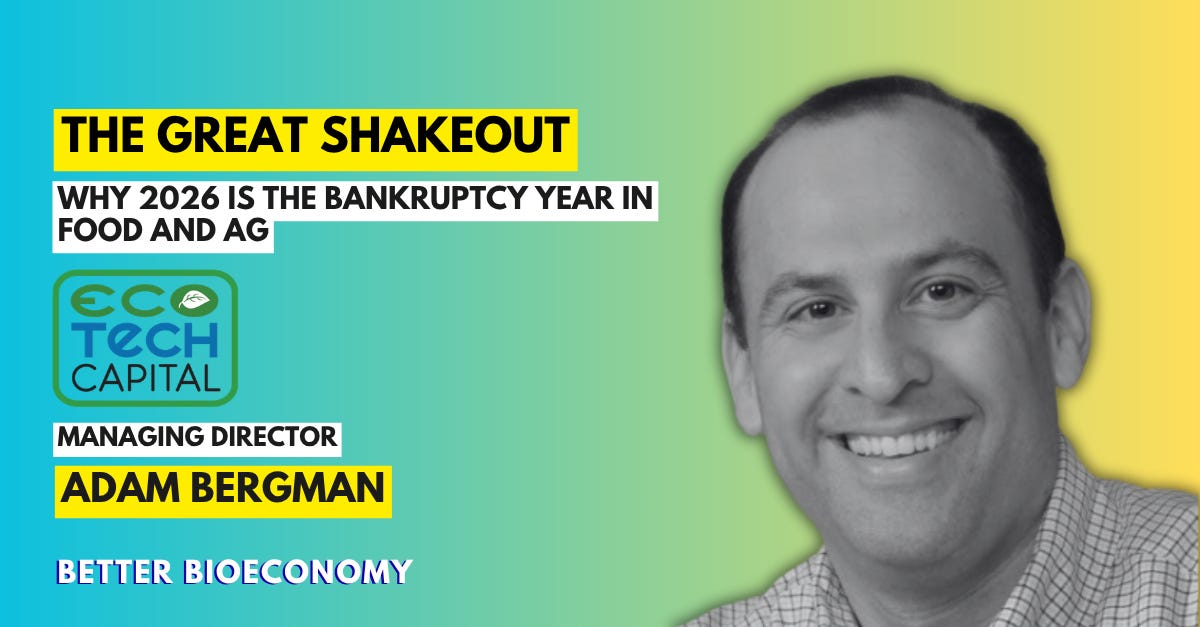
For Issue #145 of Better Bioeconomy, I sat down with Adam Bergman, Founder and Managing Director of EcoTech Capital.
EcoTech Capital is a strategic advisory firm working with food and agriculture companies on capital raising, strategic partnerships, and M&A. Unlike a venture fund, Adam is not writing cheques. He sits alongside founders as they navigate one of the toughest fundraising markets the sector has seen, and he has done so across roughly 15 years of ag tech deals, starting with one of the first of them in 2012.
Adam has spent more than twenty-five years in CleanTech investment banking. Before starting EcoTech Capital, he built and led ag tech and food tech banking practices at Citi and Wells Fargo, and set up Wells Fargo’s ag tech cohort inside its St. Louis innovation incubator. Along the way, he has worked on financings and M&A across Citi, Deutsche Bank, Jefferies, JPMorgan, UBS, and Wells Fargo, covering ag tech, food tech, biomaterials, energy, water, and mobility.
The formative thing to know about Adam is what he saw before he ever looked at a farm. As he put it, his first ten years in finance were a crash course in downturns. The Asian financial crisis, the bursting of the internet bubble, and the great recession all landed within one decade. Three of the largest implosions of the last fifty years, all before he got to ag tech. That matters because a lot of the investors and founders active in food and ag today started their careers after 2010 and have never really seen a market reset up close.
In our chat, we spoke about what happens on the other side of the coming wave of food and ag bankruptcies, the trust gap that has opened up between founders and investors, why this sector will never scale like software, and where he is bullish despite all of it.
Let’s jump in!
2026 is the great shakeout year, and only one version of it ends well
Adam expects 2026 to bring the largest wave of bankruptcies food and ag tech has ever seen. A meaningful number of companies are going to shut down, and the sector will split into one of two scenarios on the other side.
The hopeful version looks like this. A handful of companies emerge with viable business models and a real path to profitability. The capital that is still in the sector consolidates around them as clear category leaders. A few reach EBITDA positive, some exit, and private equity money starts flowing in behind the specialists.
That re-opens the sector to new LP commitments and puts food and ag back on the steady growth path it was briefly on in 2018 and 2019, before the 2020 capital flood pushed valuations to levels no financial model could justify.
The unhopeful version is that no clear winners emerge. Exits stay thin. LPs look at the numbers and walk away. “It is going to be very difficult to justify to LPs why they should come into a sector that raised $40 billion between 2018 and 2024 and returned probably less than $5 billion,” Adam said. That is not a pitch many allocators are lining up to hear.
Which path the sector takes is not really about how many companies fail. It is about whether the ones that survive can prove that disciplined, profitable growth in food and ag is achievable. If a small group does, the capital comes back.
An advisor can tell founders what an investor cannot
Adam’s day job looks different from most of the people I speak to. He is compensated on capital raised, not on the valuation he raises at, and he is not sitting on a board defending a mark. That changes what he can say out loud to a founder.
Founders and investors, he argues, are wired to be optimistic. They have to be. But that optimism makes it hard for either side to sit with risk for long. An advisor has room to take a more holistic view, walk through the risks in detail, and push back on decisions that look good on a pitch deck, but cost the company later. He does not have skin in the game the way an investor does, and he is the first to say so, but the distance is part of what makes the advice useful.
Nowhere is that clearer than on valuation. “Maximising valuation is an exercise you should be doing on an M&A sale,” Adam said. “It is not always your best outcome when raising capital, because you might be raising too much of it at too high a valuation.” Raise at a price the business cannot grow into, and the only way the investor gets their money back is by pushing the founder to run at a pace the company was never built for. Many companies chase a short-term win on price and run out of road eighteen months later.
Investor FOMO is dead, and trust has to be rebuilt one milestone at a time
One of the most structural problems in food and ag right now, according to Adam, is trust. Over the last decade, too many companies told investors they would hit milestones they never hit, and the market is still paying for it. “FOMO is dead,” Adam said. Investors are happy to open diligence, sit in it for months, and watch founders prove out what they said they would do before committing a dollar.
His advice to founders raising today is to create monthly or bi-monthly milestones. Tell the investor exactly what you will deliver and by when. Then go and do it, come back, and do the next one. Raising in this market is not about selling the vision any more. It is about building a small, public track record of hitting commitments so that the big one becomes believable.
He also warned against the old pitch muscle memory. In 2020-2022, investment decks were built around upside cases and “investment highlights”. In the current market, what matters is risk factors and how you plan to mitigate them. A founder who can walk an investor through their top three risks and name a strategic partner mitigating each one is in a different conversation from one still pitching hockey stick charts.
Founders should also brace for tighter runway expectations. Eighteen to twenty-four months timelines for use of proceeds are no longer the default. A lot of rounds today are sized for twelve months, with the promise of more capital if the milestones land.
Founders keep building what farmers never asked for
There is a second trust gap that gets talked about more often, but is acted on far less. It is the gap between what founders think farmers want and what farmers actually want.
Adam’s favourite illustration comes from a farmer and co-op operator he used to work with, who told him the same thing every time they spoke. What he really wanted was an ag tech company that could pull rocks out of his field. That was his biggest operational headache, and he had told plenty of founders about it. No one ever built it, because no one found the problem sexy enough.
The point is not really about rocks. It is that a lot of products in this sector get built on the founder’s assumption of what a farmer needs, not on what a farmer has actually said they will pay for. Adam told me he used to ask early-stage founders a simple question whenever they pitched him. “Is it a big problem for them, or is it something that’s a nice to have, not a need to have?” In a lot of cases, the founder did not know, because they had not asked. They were confident the problem existed. They had not confirmed it was worth solving.
The second piece of the farmer story is risk. A farmer’s field is their livelihood. If a new technology kills a crop or knocks down yield, that is a direct hit to their income for the year, with no rerun until the next season. No other industry asks an operator to stake a full year of revenue on an unproven product from a startup. Proving anything out in a field takes time, and it takes more time than most investors and founders have been willing to wait.
Calling it tech does not make it scale like tech
The word “tech” is doing a lot of work in how this industry talks about itself. In practice, what is really being built is industrial ag and industrial food. The buyer, whether a farmer or a food manufacturer, moves slowly. Farmers buy on an annual cycle tied to planting season. Miss it, and you wait twelve months for another shot. Enterprise software does not work that way, and valuing a company as if it does is how companies run into issues.
Adoption inside a single farm also takes years, not quarters. A typical winning product might land on 1 to 2% of the farm in year one, 5 to 10% in year two, 20% by year three, and full penetration by year seven or eight if everything goes right. “Its ability to scale is going to be predicated on getting a farmer to purchase it, or getting a consumer to buy a new product. That is not easy.” A SaaS rollout inside an enterprise is more binary. An ag rollout is a multi-year crawl through field trials, weather, and the farmer’s own risk tolerance.
The exit math matches the adoption math. There are no big IPOs coming in ag tech. The last real one, Adam pointed out, was probably Monsanto, about thirty years ago. Most exits happen through M&A, usually under $500 million and often under $250 million. Strategics, like the major input and equipment companies, are not lining up to pay premium prices for unproven technology. They will buy the tech when it is ready, bring the team along, and budget another $50 million of R&D on top to get it to scale.
The bullish case starts with what makes the farmer more money
For all the caution, Adam is bullish on a handful of areas, and the logic underneath all of them is the same. Each one has a clear path to providing farmers with a positive ROI in one season or less.
The first is automation & robotics and digitisation, with one important caveat. The winners in the short term will be additive automation, tools that make an existing picker or farmer more productive, not systems trying to replace farm labour entirely. Humanoid robots in the field are a long way off.
But the structural pressure from shrinking labour supply and rising labour costs is a real challenge in every developed country, and it is not going away. “Automation & robotics needs to be there to replace farm labour,” Adam said, and not just in the US. Picking crops in the heat is not going to win the recruiting war against a fast food chain paying the same wage with better working conditions.
The second is AI in the field. He has watched computer vision tools cut pre-harvest crop loss roughly in half at client operations, from 25 to 30% down to 10 to 15%, which on a thin-margin farm can move the business from breakeven to a 20% EBITDA margin. The only catch is psychological.
As Adam puts it, “a grower is going to see the data that shows them that they’re not doing a great job farming. That’s the only way they’re going to be able to improve performance.” Nobody loves being told they could be doing their job better, but the economics are hard to argue with.
The third bullish bet is advanced irrigation, from an unusual angle. Adam thinks the hyperscalers building new data centres could end up funding farmers to switch from flood to drip irrigation, because the water savings can be redirected to cooling data centers at scale. That is a capital source the sector has not really priced in, and it could move advanced irrigation faster than another round of climate funds ever did.
The fourth is alternative proteins, but not where most of the capital has gone so far. Cultivated meat, in his view, is at least a decade away from solving its scaling and cost problems. He is more interested in what he calls “future proteins” more broadly, where global demand for animal protein is outrunning supply, and the gap has to be filled by something. The technology is still early, and the taste is not there yet, but the midterm direction is real.
The bear case starts where the ROI story falls apart
On the other side of the ledger, Adam has concerns about parts of ag biotech, especially biologicals. The issue is not the science, but the challenge of showing a grower a short-term positive ROI. A great biological product in a bad weather year will look mediocre, and a mediocre product in a great year will look fine. When the signal from your own product is that noisy, farmers have no structural reason to adopt.
He is also watching the traditional CPG sector brace for the GLP-1 wave. People on GLP-1 eat roughly 80% less dessert, and the knock-on effects for the companies filling the middle of the grocery store are significant. The legacy CPG names either reinvent themselves around healthier, GLP-1 compatible products, or they watch a meaningful chunk of revenue disappear. Adam is bullish on the health outcomes overall. He is also honest that he does not yet know which specific businesses will emerge as winners.
Underneath both calls sits the deeper point Adam kept coming back to across our conversation. Food and ag are held to a higher standard than almost any other startup industry. The “move fast and break things” playbook does not apply, because the cost of breaking things is paid by a farmer’s harvest or a shopper’s plate. “If it is a break it, you’re probably sidelined for a decade,” Adam said. Companies in this sector need to launch when they are ready, not when the pitch deck says they are.
Want to connect with Adam?
Adam is open to hearing from founders and investors navigating this market. You can reach him at adam@ecotechcap.com
If you found value in this newsletter, consider sharing it with a friend who might benefit from it!
Or, if someone forwarded this to you, consider subscribing.
Disclaimer: The views and opinions expressed in this newsletter are my own and do not reflect those of my employer, affiliates, or any organisations I am associated with.