

Hey, it’s Eshan. Welcome to Issue #163 of Better Bioeconomy. Thanks for being here!
Several weeks ago, I looked at who is capturing the healthspan shift. I wanted to understand how an early-stage investor turns it into an investable food and biomanufacturing thesis.
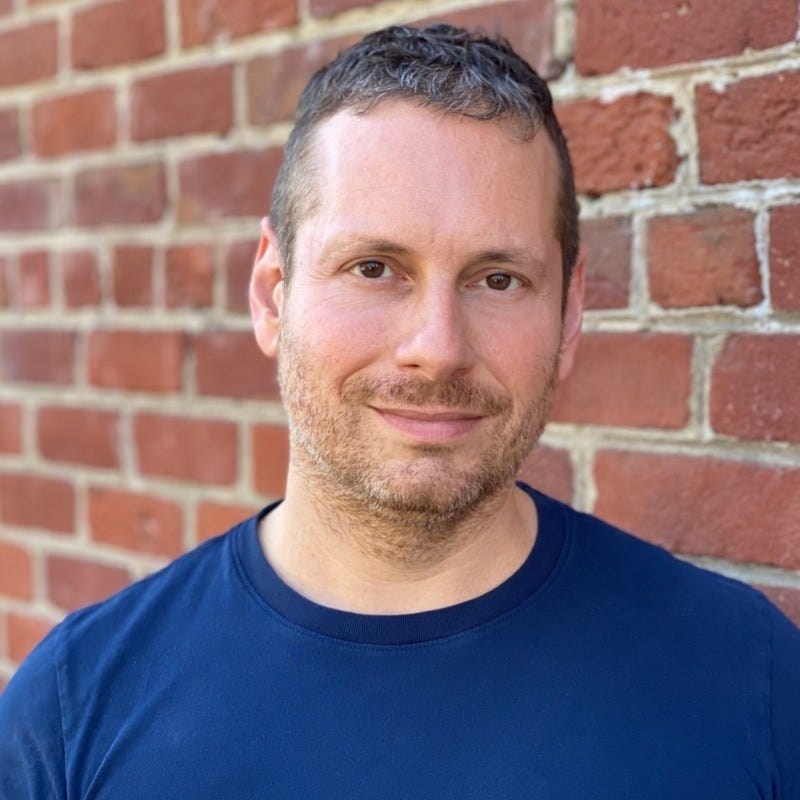
So, I spoke to Steve Simitzis, Founder and Managing Partner at Replicator VC.
Replicator VC is a San Francisco fund investing at pre-seed and seed across cellular agriculture, biomanufacturing and longevity. It is Steve’s debut fund and held its first close in December.
Steve has been vegan for close to 30 years. Animal welfare and biodiversity were where he first started noticing problems. “Once you start seeing problems in the food system, you start to see them everywhere,” he said.
His career has followed that widening. He started as a software engineer and has founded and exited three companies. Pets were how he got into food, first at Mars Petcare and then at Wild Earth, a plant-based pet nutrition company.
Cell Valley Labs came next, an early Berkeley incubator he co-founded to give alternative protein and biotech startups lab and office space. He picked up an Investor-in-Residence seat at Tufts’ Center for Cellular Agriculture, working with spin-outs on their commercial and fundraising strategy. Replicator is what he built out of all of it.
In our chat, Steve shared:
Which half of longevity food can reach
What programmable nutrition makes possible
Why he backs molecules whose biology is already understood
Who he wants a longevity product to be affordable for
Where the gap between the science and the shelf is today
What he tells founders to build, with the exit market still unformed
Let’s jump in!
Healthspan is the half of longevity that food can reach
Longevity splits into two projects, and Steve invests in one of them. Lifespan is how long you live. Healthspan is how long you live in good health. A 2024 JAMA Network Open analysis of all 183 WHO member states put the average gap between them at almost 10 years.
Lifespan is the half that captures the imagination. Can we get ourselves to 120, or 150 years? Underneath it are next-generation therapeutics for diseases like cancer, and a research community trying to understand the fundamental mechanisms of ageing and turn them around. None of that is addressable with food, at least not yet.
Healthspan is the half food can reach. “We want to have 99 great years, and then maybe the last year is when you get to check out,” he said. “You get 99 good years instead of spending your last 20 or 30 in and out of hospitals.”
Staying healthy also buys you time, so that the next wave of therapeutics has a chance to become both available and relevant to you.
So when Steve puts food and longevity together, healthspan is the whole of what he means.
Programmable nutrition is where food tech starts doing something farming cannot
Steve breaks food tech’s contribution to healthspan into three jobs.
The first is the longevity of the food system itself. The pressure is already visible in prices, with beef and whey climbing and products going missing from shelves in the US. If we are going to live much longer, the food system has to keep up with us. You want a long life, so the systems that feed you have to keep working for that long too.
The second job is control of the inputs. Cultivated meat and cultivated seafood let you decide what is in the food, in a way you cannot with a wild catch. “We’re going to have fish without microplastics, without mercury,” he said.
“A lot of what people do in longevity is eliminate things that can kill you,” Steve said. A food system built without those inputs does that work for people who are not running a protocol, and it does it at population scale.
The third job is what he calls programmable nutrition. Once you are making food through biomanufacturing, you can specify what goes into it.
Factory-farmed beef, Steve said, carries generally lower omega-3 concentration than grass-fed. Demand keeps rising as populations get richer, and conventional production cannot scale to meet it. So the default answer is more intensive farming, and that path takes nutrient density down.
But cultivated production inverts the constraint. The same volume pressure that strips omega-3 out in a feedlot becomes a dial you could turn up in a bioreactor. From there the list opens to meat with dietary fibre in it, or meat carrying custom peptides.
Then there are compounds where the biology is understood, and the supply is the bottleneck. Saffron has data behind it for ocular and cognitive health, and there is nowhere near enough saffron grown. Flavonoids in cocoa have been studied for their effect on inflammation, and cocoa has become expensive. Plant cell culture can make more of both without planting anything.
The molecule stays the same as the one the literature already studied. What changes is how much of it exists, and what it costs.
Healthspan has to reach beyond the Bryan Johnsons of the world
Someone has to back all of that before it exists. At the pre-seed stage, you often have to invest before there’s definitive evidence of long-term health outcomes. And there will not be any for years. So what gives him confidence the science holds up?
A higher protein diet curbs hunger and shows up in a workout, so you see the results within weeks. A molecule meant to add healthy years takes far longer to show anything. “Sometimes you never see them,” Steve said.
In skincare, where he also invests, someone buys a product, and their face does not change for months, and the market is enormous anyway. “Selling hope also works,” he said. The consumer half of this is unsolved. “I don’t know that we’re going to crack that on this call, because that is a really big problem.”
Steve tries not to take that risk on the science. He looks for companies whose molecule is already understood, where the novelty is in how it gets made.
Totality Biosciences is the portfolio company he pointed to. The company makes human milk oligosaccharides, or HMOs, through molecular farming. HMOs are the sugars in breast milk that help an infant build a healthy gut and an immune system from the earliest age. In adults, Steve said, they also work as a skincare molecule.
The industry makes HMOs by microbial fermentation in bioreactors. Totality is engineering plants to make them instead. CEO Leila Strickland and CSO Patrick Shih built the company on Shih’s plant molecular biology work at UC Berkeley. The first product is 2’FL, typically the most abundant HMO in breast milk, expressed in soybean. “When you move from expensive bioreactors to plants, the cost structure changes completely,” Strickland told NutraIngredients.
More than 200 HMO structures exist, and fermentation makes only five or six of them at scale. Plants are a route to the ones microbes struggle with, so the platform is about capability as well as cost.
The biological case for HMOs was made long before Totality existed. “That work has already been kind of done for us,” Steve said. Steve’s investment case starts with the economics, and what molecular farming adds is a cheaper route to a molecule with known effects.
“What I like to fund is something where there is existing data already out there,” he said, “not something they’ve invented entirely new that we now have to go test and do clinicals on.”
Price is what decides who gets the benefit. HMOs are a critical component of infant formula, in Steve’s words, and the manufactured versions are expensive to produce. That expense decides which babies get them.
“Can we take something that we know is healthy and good for the human body and democratise access to it,” he said, “rather than have it just be for the very rich?”
He means globally rich, not rich in America. “I’m not just thinking about the Bryan Johnsons of the world leading a 3% better life,” he said. “I’m talking about lifting outcomes globally across population demographics.”
Production and scale-up are what stand between the science and the shelf
Across food, nutrition and longevity, where is the biggest gap between what the science makes possible and what consumers can access?
On the therapeutics side, he thinks the gaps are probably the largest. Replicator does not invest there today, though he is looking at it for the future.
On the food side, in Steve’s view, the core science works. Better cell lines for cultivated meat, better chassis for precision fermentation and better downstream processing for molecular farming would all help, and none of them is the blocker. “I don’t think there’s much of a gap in science,” he said. “Where there is a gap is in production and scale-up.”
Same story for the molecules. HMOs, flavonoids, saffron compounds, all studied, all with known effects on the body, none of them widely available.
Take Replicator’s portfolio company Deco Labs. The Tufts spinout makes a plant-derived replacement for albumin, the single most expensive ingredient in cell culture media. Conventional albumin adds close to $100 to the cost of every kilogram of cultivated meat. Media is one of several things standing between cultivated meat and a workable cost.
And the financing is its own bottleneck. If a peptide with a real effect on skin takes off, someone has to fund the capacity to meet the demand. The financing around that scale-up is the piece he thinks is missing.
Running an incubator inside Wild Earth around 2019 and 2020 gave him a close view of the Bay Area near the top of the cycle. Companies raised as much as they could and spent it on facilities, offices and oversized teams before demand existed. Steve had run a startup out of money before and had watched the dot-com cycle do the same thing. The demand has to be visible before the capacity gets built.
Solve a burning problem with good economics, and the exit takes care of itself
Exits are the other end of that same capital question. There have not yet been enough exits at the intersection of food and longevity to model against. “I would be making up an answer, because there hasn’t been a lot of that activity.”
Given that M&A is the more likely route, what would a corporate be looking for? He named four things:
A capability they lack
A cost structure they cannot reach
Consistency or availability missing from their supply chain
A consumer trend that is not going away
High protein is his example of the last one. A whey manufacturer that delivers on cost and availability, he thinks, becomes an acquisition target.
What he tells founders starts with the customer. He has been a founder and has run customer service teams, so he gives more weight to founders who understand their buyer than to founders imagining scenarios.
Find a burning problem a customer is not getting solved, business or consumer, and grow revenue on it with superior economics.
“Driving toward a good exit strategy is just building a really great growing business that is meeting the needs of some important valuable customer segment,” he said. “And then the exits will follow from that naturally.”
Want to connect with Steve?
Steve is looking to hear from other investors looking at the bioeconomy through a longevity lens, whether to compare notes or share what they are seeing.
He also enjoys talking to people at the earliest stage of starting something. Scientists holding IP with no obvious commercial application, or a team that works well together and has not settled on what to build yet. If that is you, you can reach him at steve@replicator.vc.
I’m Eshan. An operator-turned investor, backing companies in food, agri, nutrition, and health. I’ve been writing Better Bioeconomy since 2023, as a way to share my learnings and to connect with cool people like you. Thanks for reading!
If you found value in this newsletter, consider sharing it with a friend who might like it.
Or, if someone shared this with you, consider subscribing (it’s free!).
Unlock Asia’s trillion-dollar opportunity
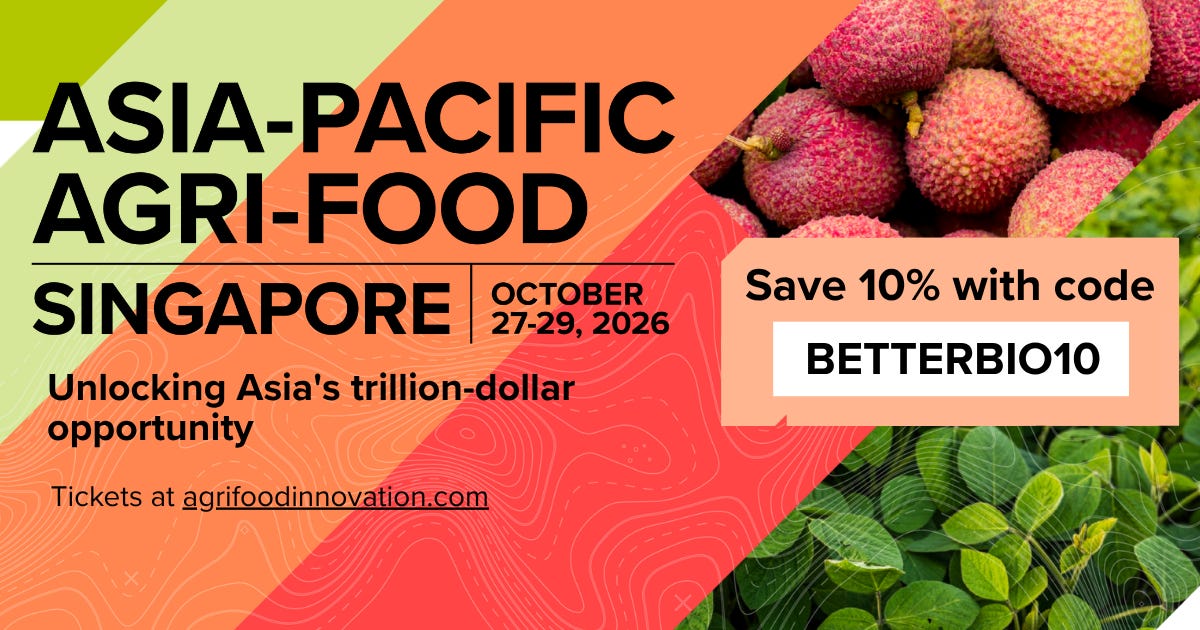
Don’t miss your chance to attend the Asia-Pacific Agri-Food Innovation Summit and get 10% OFF with my network code. Use my exclusive partner code for 10% OFF your pass: BETTERBIO10. See you there!
Disclaimer: The views and opinions expressed in this newsletter are my own and do not reflect those of my employer, affiliates, or any organisations I am associated with.