

Hey, it’s Eshan. Welcome to Issue #156 of Better Bioeconomy, insights on companies and capital using biology to shape how we eat, grow food, and nourish ourselves. Thanks for being here!
Today, I want to pick up where the last one left off. Last week I mapped the seven positions companies are taking in healthspan and spent one section on what the incumbents were buying. I was midway through drafting this one, on how those incumbents are playing it, and a few days ago that section became a priced fact.
Procter & Gamble (P&G) agreed to acquire Thorne for $3.8B in cash, with closing expected in the fourth quarter. L Catterton took the same company private in October 2023 at $680M. That is 5.6x in under three years.
While the number is the headline, I found the list of interested parties more interesting. Reuters reported in late June that Haleon had bid. The Financial Times reported around the same time that Unilever was considering a bid at up to $4B, though how far that went is not clear from the public record and Unilever has not commented. Shailesh Jejurikar, P&G’s chief executive, declined when asked to confirm that P&G had come through a competitive process at all.
Even on that thinner record, three companies from three different industries were circling the same asset: a consumer health business spun out of GSK, a household products giant, and a food and personal care conglomerate midway through divesting its food. They were not looking at the same thing.
What follows is my attempt to work out what each of them saw. The short version is that every company in this story wants something it cannot grow on its own. They are short of different things, and the thing most of them are short of has got twice as expensive in nine years.
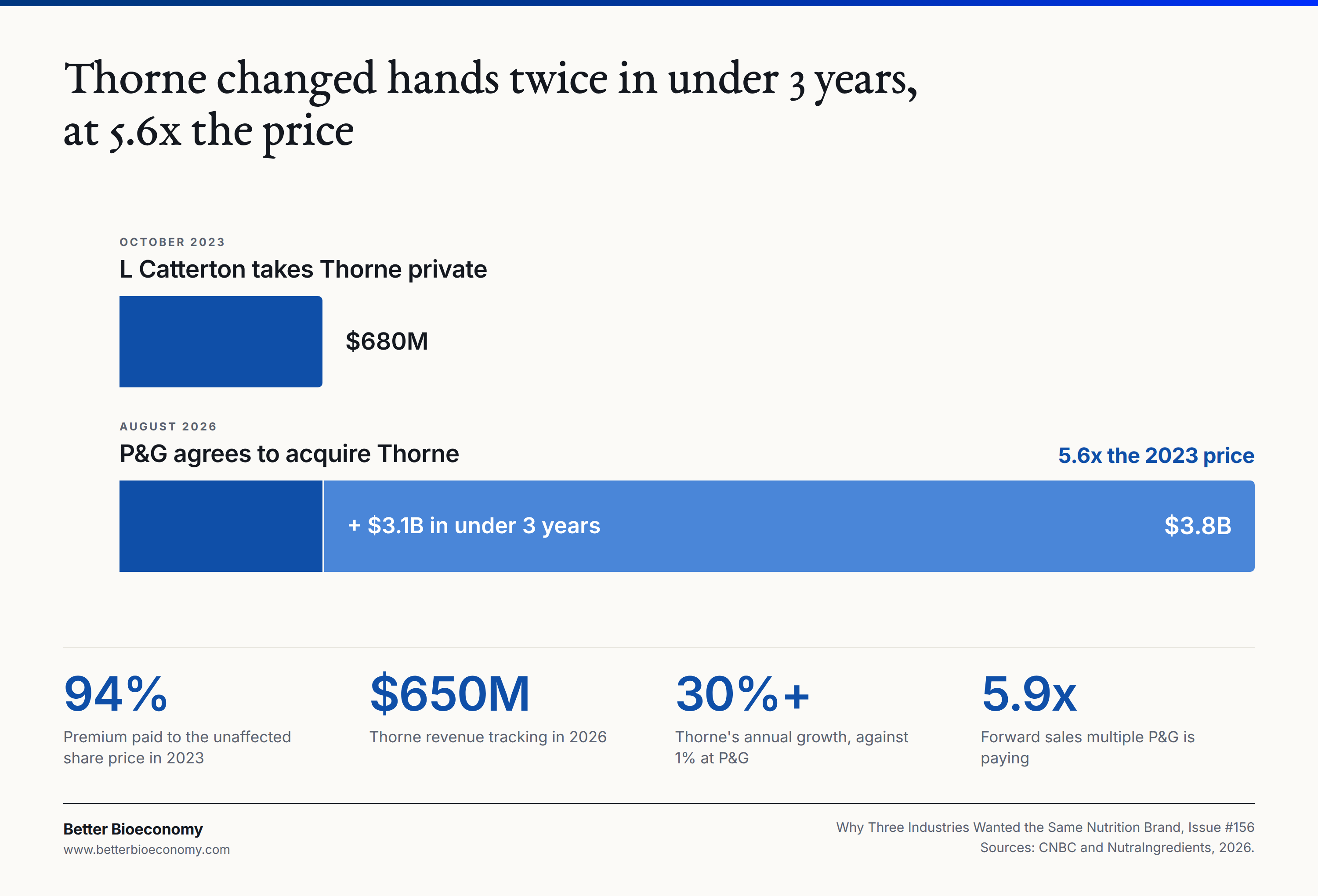
P&G reported 1% growth six days before agreeing to pay for 30%
On 29 July, P&G reported fiscal 2026 results: net sales of $87.0B, organic sales growth of 1%, and volume flat for the year. Fourth-quarter organic sales were zero. Health Care took the steepest volume decline of any segment at 3%, with organic sales down 1% in the quarter, on full-year net sales of $12.5B and full-year organic growth of 1%.
Guidance for fiscal 2027 is 1% to 3%. Six days later, the company committed $3.8B to a business compounding above 30% a year and tracking ~$650M of 2026 revenue. That is close to 5.9x forward sales, paid by a company that, based on recent data, could not generate volume growth in its own health business last year.
Haleon had the same problem but, in my view, in a more uncomfortable place. Its FY2025 organic revenue grew 3.0% to £11.0bn. Its VMS division grew 1.9% to £1.69bn, behind the group, and the weakness was specifically in North America, where the company pointed to a soft multivitamin market, heavier competitor promotions and distribution losses it says it has since addressed. Thorne is a US premium brand sitting on a US practitioner base, which is the hole in Haleon's map. It bid and did not win.
Unilever, reported to be considering the same asset, was looking at it from a seemingly different position. Its first-half 2026 underlying sales grew 4.8% on underlying volume growth of 4.2%, with second-quarter volume at 5.5%, its strongest since 2010.
So the same asset was being weighed from different starting positions. The two companies documented as pursuing it are the two whose own numbers say they cannot produce that growth internally. Unilever’s numbers look nothing like either of theirs, and what it did with that is not on the public record.
Evidence can be bought, credibility has to be inherited
Three assets sit behind these deals, and each behaves differently. Evidence is a clinical file: trials, endpoints, a safety dossier, a novel food authorisation. Credibility is what exists once somebody qualified has read that file and is willing to attach their name to it in front of a patient. Permission is the right to make a claim in public without a regulator or a retail buyer objecting.
Evidence can be bought outright, and it usually is. Permission can be assembled in a few years with clean manufacturing, third-party certification and good lawyers. But credibility is the slow one.
Thorne is not worth $3.8B because its trials are better than everybody else’s. It is worth that because tens of thousands of practitioners have already turned those trials into trust, and trust is the part that does not come attached to the file.
What each buyer already owns decides what it has to buy
Underneath the deal announcements, the acquirers in this story fall into four groups, and they differ in which of those three they are shortest of.
These are tendencies rather than rules. The largest companies span more than one group, and the exceptions are real. Nestlé sits squarely in the first group and has owned a leading practitioner brand since 2017, which I come back to. What holds across all four is the pattern in what each has been paying for.
Food and nutrition majors
They hold shelf space, manufacturing scale and a brand-building machine. What most of them are shortest of is clinical credibility and a relationship with the people who recommend products for a living.
Their largest cheques have gone to businesses people consume on a schedule. Unilever paid $1.2B for Grüns in April, a company founded in 2023 that had passed a $300M annualised run rate by October 2025, which is ~4x sales. Danone agreed to buy Huel at around €1B, a deal still working through a CMA phase 1 inquiry with a decision due 11 September.
Danone also bought The Akkermansia Company, a strain with a decade of academic work behind it, for a sum neither party disclosed.
Personal care and household groups
They own something the food majors do not, which is a defended slot in the daily routine and the retail leverage to hold it. What is hardest for them to manufacture is credibility with anyone who reads a label closely.
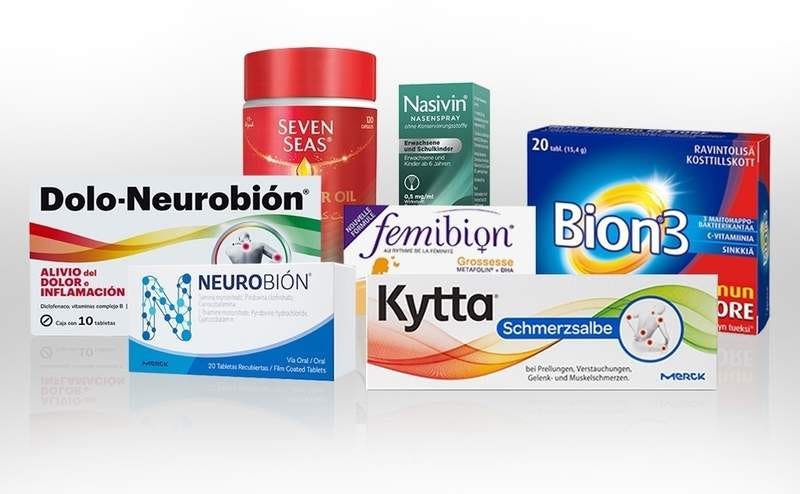
P&G is not new to this aisle. It bought New Chapter in 2012 for an undisclosed sum, and paid €3.4bn for Merck KGaA’s consumer health business in 2018, picking up vitamin brands including Seven Seas and Bion3. What eight years and two acquisitions did not buy was a practitioner base, which is the specific thing Thorne has but Seven Seas does not.
Kimberly-Clark is running the same logic at a different scale with its $48.7B acquisition of Kenvue, a tissue company buying the maker of Tylenol and Band-Aid.
Consumer health companies
They hold the pharmacy shelf, the regulatory apparatus and the pharmacist relationship. What they are short of, based on recent trends, is growth.
Alongside Haleon’s 1.9%, which I mentioned earlier, Bayer’s Nutritionals sales fell 3.9% in 2025 on a currency- and portfolio-adjusted basis. This is the class with the deepest category credibility and the weakest momentum, which puts its members on both sides of the table. T
They need to buy growth, and their own credibility makes them worth buying. Haleon bid for Thorne, and Kenvue is being acquired, inside the same twelve months.
Ingredient houses
They hold the thing everyone else is trying to rent, which is the dossier: the trials, the novel food files, the manufacturing know-how. What they are furthest from is the consumer. Their moves have been to buy evidence and shed commodity volume.
dsm-firmenich paid €275M for the postbiotics producer Adare Biome, which brought with it Lactéol and the postbiotic Lactobacillus LB. Over the same period it agreed to divest animal nutrition at a €2.2B enterprise value. Buy the file, sell the tonnage.
All four groups already have factories, formulation scientists and shelf space. What separates them is which of the three assets they cannot make for themselves, and that is what sets the price they end up paying.
A dossier has a knowable cost. Any of these buyers can work out roughly what it would take to run the trials in-house, and most of them could afford to, so nobody pays far above that number. That is why dsm-firmenich got Adare Biome for €275M. A practitioner network has no equivalent figure, because no budget shortens it. Thorne has been building its clinician base since 1984, and a buyer who wants one either buys Thorne or starts in 1984.
So the question that sets the price is whether a competitor could get what you have by hiring for it. If they could, you are worth what your growth is worth. If they could not, you are worth whatever a buyer will pay to avoid waiting. Grüns went at 4x sales. Thorne went at nearly 6x. The same question decides who will lend against you, which I will come back to.
The clinician network survived the last time a giant bought one
One thing I wanted to know when the news broke was whether P&G can scale Thorne without destroying the clinical credibility that built it. The answer turns on what that credibility is for.
Thorne is used by tens of thousands of healthcare practitioners, and ~60% of its revenue now comes from consumers under 40. Colin Watts, Thorne’s chief executive, described a market that has moved from boomer-driven prevention to a Gen Z and millennial base buying for energy, sleep, anxiety and workout performance. The clinicians are not the customer. They are what makes the brand credible enough to charge a premium to people who will never sit in a clinic.
Which is the point I made in the last issue, before the price was known: a network of clinicians who vouch for you takes years to assemble and does not transfer with an acquisition, and the channel moat reaches a large outcome when it sits underneath a consumer business.
Thorne at $3.8B is that sentence being priced. The clinician base and the consumer business were both necessary. A practitioner brand without a consumer business has not fetched anything close to this, and a consumer greens brand without the practitioners fetched 4x sales instead of nearly 6x.
That reframes the dilution risk, and it turns out this experiment has already been run once. In December 2017, Nestlé paid $2.3B for Atrium Innovations, a business doing close to $700M of sales, whose portfolio included Pure Encapsulations. Nestlé’s own announcement called it the number one recommended brand in the US practitioner market.
Eight years on, Nestlé’s 2025 results name Pure Encapsulations as one of the premium brands driving growth in its supplement business, against sales declines in its mainstream and value brands. When Nestlé decided this year which of those assets to keep and which to sell, the practitioner brand was on the keep list, and the supermarket brands were not.
So the network does transfer. What I had wrong in the last issue was the condition attached to it. A clinician base survives acquisition by a company that has never held one, provided the buyer does not try to run it as a mass brand, and in Nestlé’s case, it did not.
Whether P&G runs Thorne as a mass brand is a question about distribution strategy rather than about whether clinician trust is portable, and it is something I will be watching between now and the close.
What buyers pay tracks what they cannot build
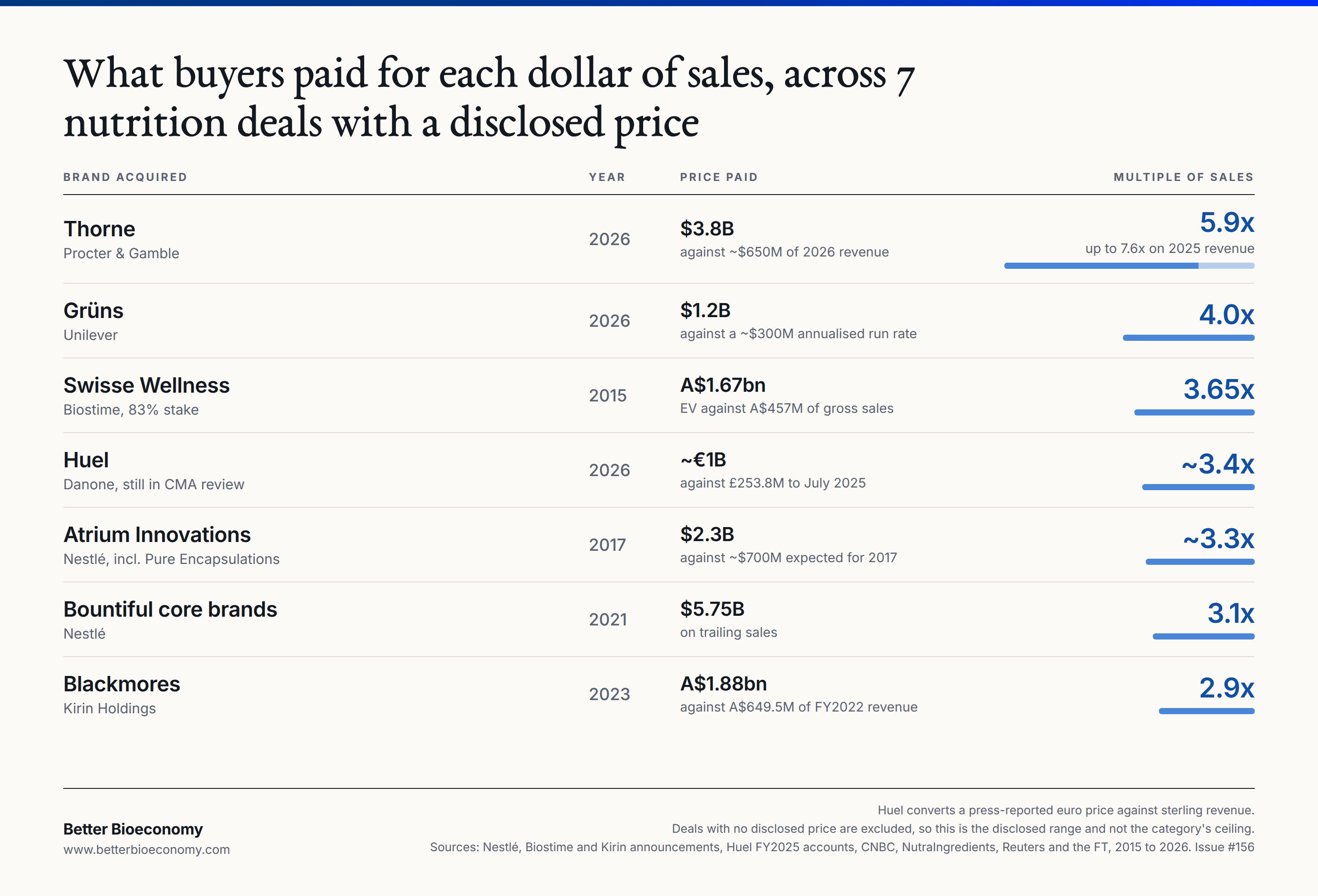
If credibility is the asset that cannot be built to a deadline, that should show up in what people pay for it. Deal activity supports that, and the gap has been widening for nine years.
Thorne went at ~5.9x forward sales. Grüns went at ~4x, and Huel at closer to 3.5x. On the valuation, Jejurikar told CNBC that the price “is a good price for the growth rates they have” and “kind of in line with the industry benchmarks we’ve seen.” A chief executive describing nearly 6x forward sales as a benchmark tells me the repricing is no longer an exception.
The closest comparable transaction is eight years old. Nestlé’s $2.3B for Atrium against close to $700M of sales is a shade over 3x. It is not a clean like-for-like, since Thorne is one brand and Atrium was eleven, and Garden of Life rather than Pure Encapsulations was the largest of them. It is still the nearest benchmark in this category, in my view.
Two more numbers sit in the same place. Nestlé paid $5.75B for the Bountiful core brands in 2021 at 3.1x trailing sales. The mainstream part of that portfolio, now classified as assets held for sale, carries ~CHF 1bn of annual revenue and has been put by market sources, not by Nestlé, at a potential value of EUR 3bn to 4bn. Around 3x again.
Atrium in 2017, Bountiful in 2021, the Nestlé mass tail today. Three points across nine years, all at ~3x sales, against Thorne at nearly 6x. The mass end has not got cheaper. The premium end has got twice as expensive.
This is not just a European or North American thing. Kirin paid A$1.88bn for Blackmores in 2023, Australia’s largest vitamin company, against A$649.5M of FY2022 revenue. That is 2.9x, and the buyer was a Japanese brewer looking to reduce its dependence on beer.
The floor under the mass end is private label, and it is rising. Private label reached 21.3% of US sales in 2025 and grew 3.3% against 1.2% for national brands, nearly triple the rate. Costco told its 2026 annual meeting that Kirkland Signature sold $90B in 2025. A commodity multivitamin has no answer to that, which is why I doubt anybody will pay more than 3x sales for one.
Nestlé is a good illustration because it holds both ends. Nature’s Bounty, Osteo Bi-Flex and Puritan’s Pride are going. Garden of Life, Solgar and Pure Encapsulations are staying, on Nestlé’s stated grounds that its capabilities in science and brand-building give it a competitive edge in premium. One company, two multiples, and it has decided which one it wants to own.
Kirin was not an outlier in its region. Asian buyers have been acquiring Australian and New Zealand supplement brands for a decade. Biostime took 83% of Swisse at an A$1.67bn enterprise value in 2015, Shanghai Pharmaceuticals took Vitaco in 2016, and By-Health took Life-Space at A$690M in 2018.
What they were buying is the same category of asset P&G bought, in a different form. Australian provenance and TGA oversight work as a trust signal in Chinese and Southeast Asian markets in a way domestic brands have not been able to replicate. It is credibility that comes from elsewhere and cannot be assembled at home on a schedule.
The difference is who owns it. Australian provenance belongs to every Australian brand, so a buyer who wants it can have it by acquiring any of them. That is a category attribute, and it prices like one, which is why Blackmores went at 2.9x. A clinician network belongs to one company. That is the whole reason Thorne went at twice the multiple.
Which leaves every incumbent in this article chasing the same short list. The mass shelf trades at a multiple that makes it a poor use of an acquisition budget, and the number of brands with a real clinical base is small. That is how a single supplement brand ends up drawing interest from three industries at once.
Capital is pricing predictability
Three pools of money are active in this category, and they are buying three different things.
Strategic acquirers pay for credibility attached to a habit, which is most of this article so far. Private equity pays for growth it can engineer, which is what L Catterton did at Thorne, entering at a 94% premium to the unaffected share price and exiting at 5.6x the entry valuation under three years later.
It is not an isolated trade. Bain Capital agreed to acquire Vitabiotics, the UK’s largest vitamin company, at a reported £900M on 25 July, ten days before the Thorne announcement. Two supplement deals above a billion dollars landed inside a fortnight, and a sponsor was on one side of both.
The third pool buys something the other two do not, and it gave me a different way of looking at which positions in this category can raise money.
On 14 July, direct-to-consumer wellness brand IM8, co-founded by David Beckham and owned by Prenetics, secured $1B in non-dilutive growth financing from General Catalyst’s Customer Value Fund. The structure funds up to 70% of the company’s marketing spend in exchange for a capped share of income from the customer cohorts that spending acquires. Once the fund recovers its investment and its capped return on a given cohort, everything after that belongs to IM8. The company reported around $17M of revenue in June and projects a $300M annualised run rate by year-end.
In the last issue, I put IM8 in two of the seven positions at once, the narrative play and the format play, because as far as public records show, it markets on the literature behind its ingredients rather than trials of its own formulations, and sells the result as a daily routine. What is hard to replicate and what is easy to finance are close to inversely related here.
A clinical trial has no cohort payback curve and no repayment profile, so there is very little for a lender to underwrite. A customer on a monthly reorder has both. A company that owns a molecule and the trials behind it holds the asset that is hardest to replicate and hardest to borrow against. A brand built on licensed ingredients and a daily habit holds the one that is easiest to copy and easiest to fund.
Closing thoughts
The three assets this category runs on are not priced the same way, and the gap between them is the thing I did not see last week. Evidence changes hands for a few hundred million because any serious buyer can work out what it would cost to produce the same file. Credibility went for $3.8B because none of them can work out how to produce it faster than Thorne did.
What I also did not have was the shape of the buyer set. A household products company, a consumer health business spun out of a pharma group and a food conglomerate midway through divesting its food were all circling the same asset.
The industry boundaries that sort these companies no longer sort the assets they are chasing, and the ones that moved hardest are the ones whose own numbers leave them the least room to wait.
What sits underneath that is harder to square. Credibility is manufactured out of evidence. Practitioners recommend Thorne because somebody ran the trials, and kept running them for forty years. So the market has decided that credibility is the expensive asset and evidence is the cheap one, while evidence is the raw material credibility is made from. The category has repriced the finished product of a process it is not paying to run.
The obvious reading is that the premium corrects. High prices pull in supply, and supply brings the price back down. I do not think that happens here, because supply is the one thing this asset class cannot produce to order. A clinician network cannot be accelerated by spending more on it, and if nobody funds the evidence that new practitioner brands would have to be built on, the ones that already exist get scarcer.
As always, my understanding keeps evolving here. This piece corrects something I wrote last week, and the deal at the centre of it has not even closed yet. If you spot something I have missed or got wrong, let me know.
And if you are someone investing in this space, I would love to connect. Thanks for reading!
Unlock Asia’s trillion-dollar opportunity

Don’t miss your chance to attend the Asia-Pacific Agri-Food Innovation Summit and get 10% OFF with my network code. Use my exclusive partner code for 10% OFF your pass: BETTERBIO10
Learn more
See you there!
If you found value in this newsletter, consider sharing it with a friend who might benefit from it!
Or, if someone forwarded this to you, consider subscribing.
Disclaimer: The views and opinions expressed in this newsletter are my own and do not reflect those of my employer, affiliates, or any organisations I am associated with.