

Hey, it’s Eshan. Welcome to Issue #157 of Better Bioeconomy. Thanks for being here!
Last week, I sat down with Siddharth Jadhav, founder and CEO of Polybee.
Polybee is a National University of Singapore (NUS) spin-off that puts small autonomous drones to work inside greenhouses and over open fields. They do two jobs: pollinating crops, and scanning them so the platform behind them can forecast yield and time the harvest.
In February, the company raised a $4.3 million seed round led by Paspalis Capital and elev8.vc, with SEEDS Capital and Blue River Technology founder Jorge Heraud participating. More recently, the company signed a channel partnership with Vegetables by Bayer to take the platform to Australian vegetable growers.
Siddharth started the company in 2019 as a side project while working as an aerial robotics researcher at NUS. He had admission offers for a PhD in the US and turned them down. Polybee now runs drone fleets across seven to eight countries, and its customers include Perfection Fresh, Fruitist, PMFresh and Comfresh.
Back in Issue #140, I mentioned that the ag robotics categories reaching commercial scale share a structure. A narrow decision, a measurable outcome, and a task that repeats across growing conditions. I named harvest timing as one of the next candidates. Polybee is that company, so I wanted to see how it looks from inside it.
In our chat, we spoke about the two things every produce grower is missing, how a drone company earns the right to run across a whole farm, what “physical AI agents” means when the term is being used loosely, and why the same product has a different customer in every market.
Let’s jump in!
Most harvest decision in produce today is made by eyeballing a few plants
A grower walks the field, samples a handful of plants by eye, forms a view of how the crop is coming along, and sets the harvest date on it. Accuracy is not a metric anyone can quote, because there is nothing objective to measure it against.
As Siddharth put it in his AgFunder interview, growers would be the first to admit this is not how they would choose to run the business. Produce makes it worse by being stubbornly non-uniform. Even in a greenhouse, with a controlled environment and advanced genetics, plants develop at visibly different rates.
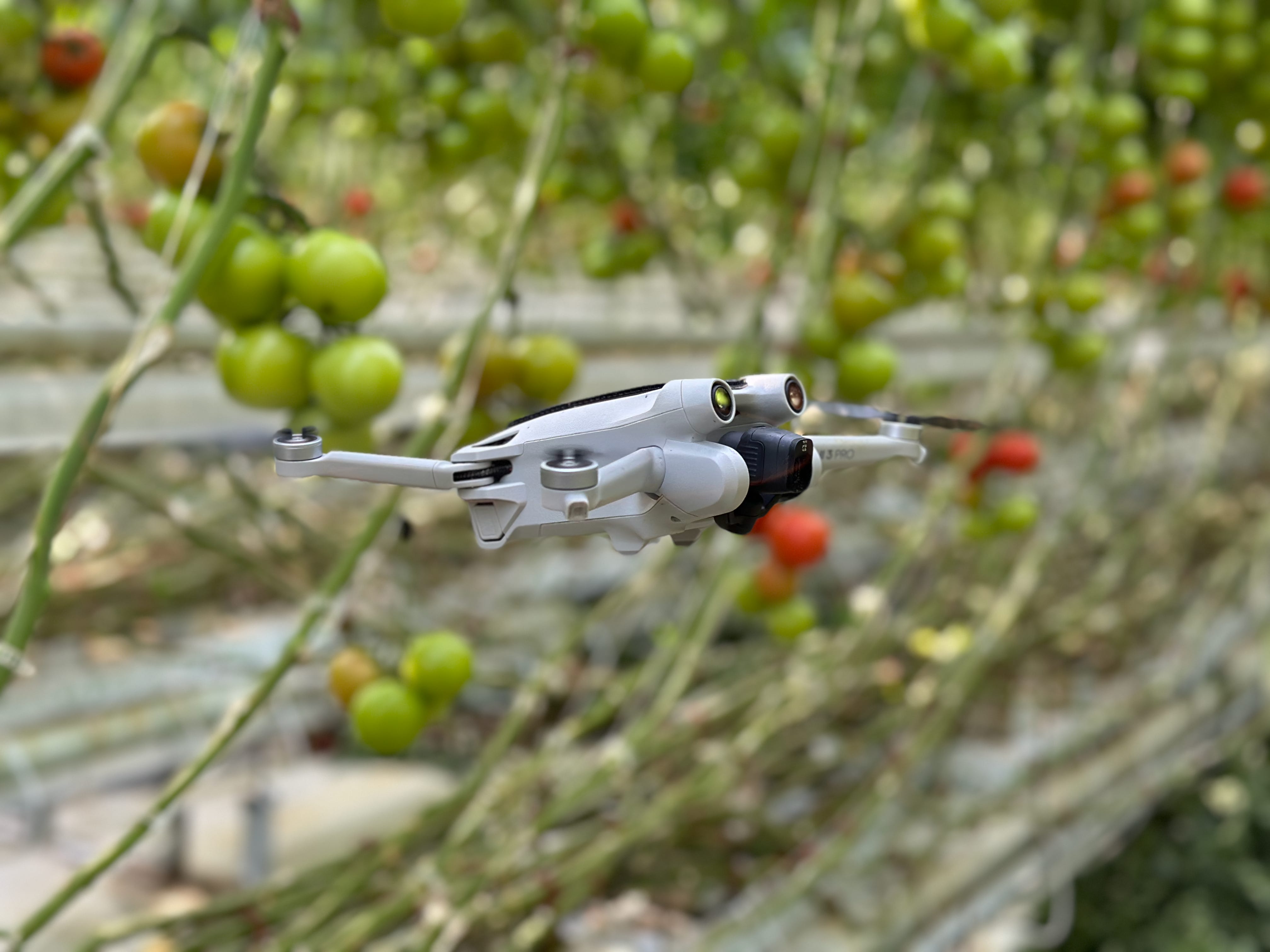
Polybee attacks both halves of that: the accuracy and the sample size. A fleet of off-the-shelf drones flies pre-programmed routes and scouts every plant rather than a handful. They launch themselves, recharge themselves, and need no user touchpoints at any stage.
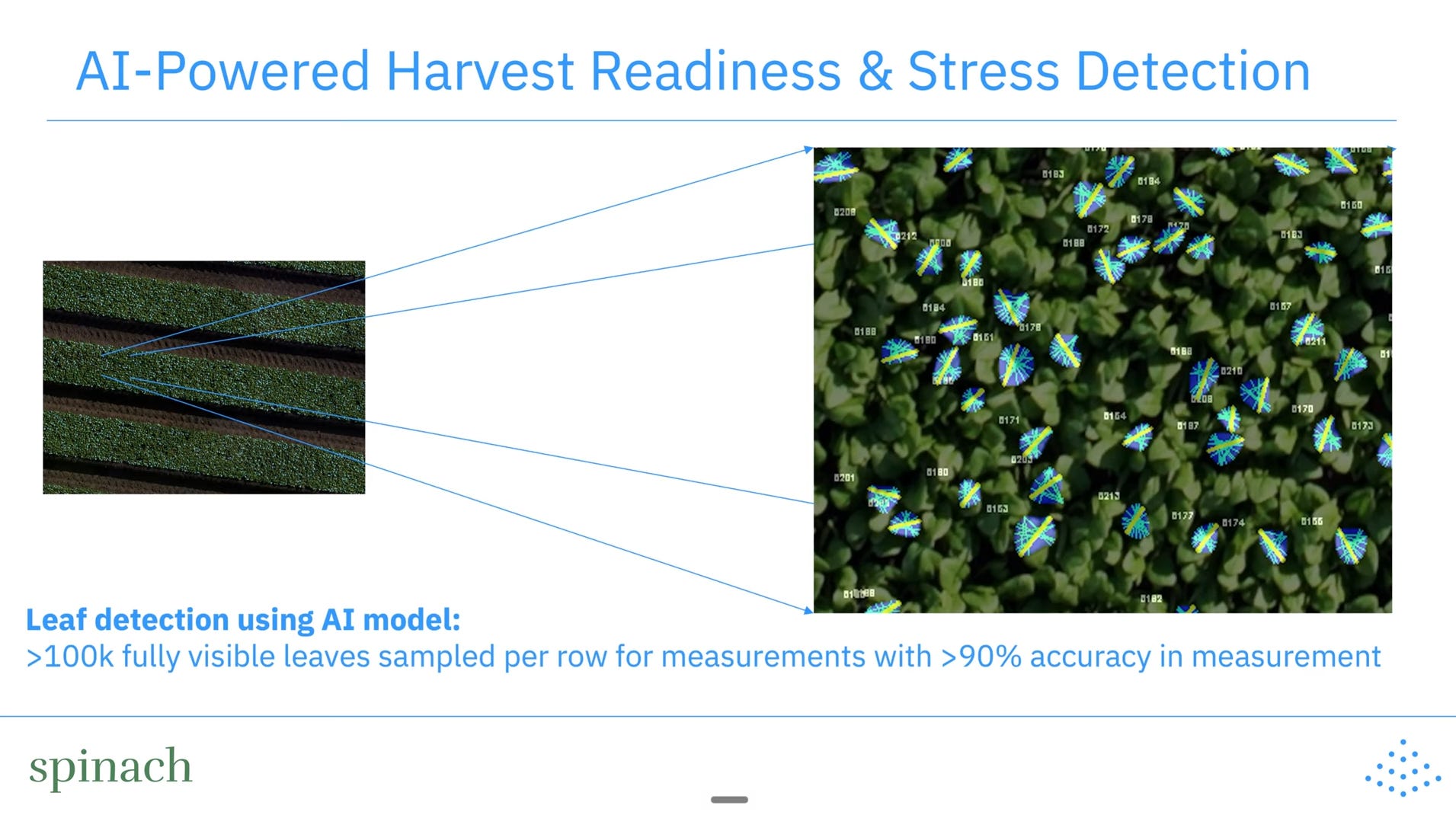
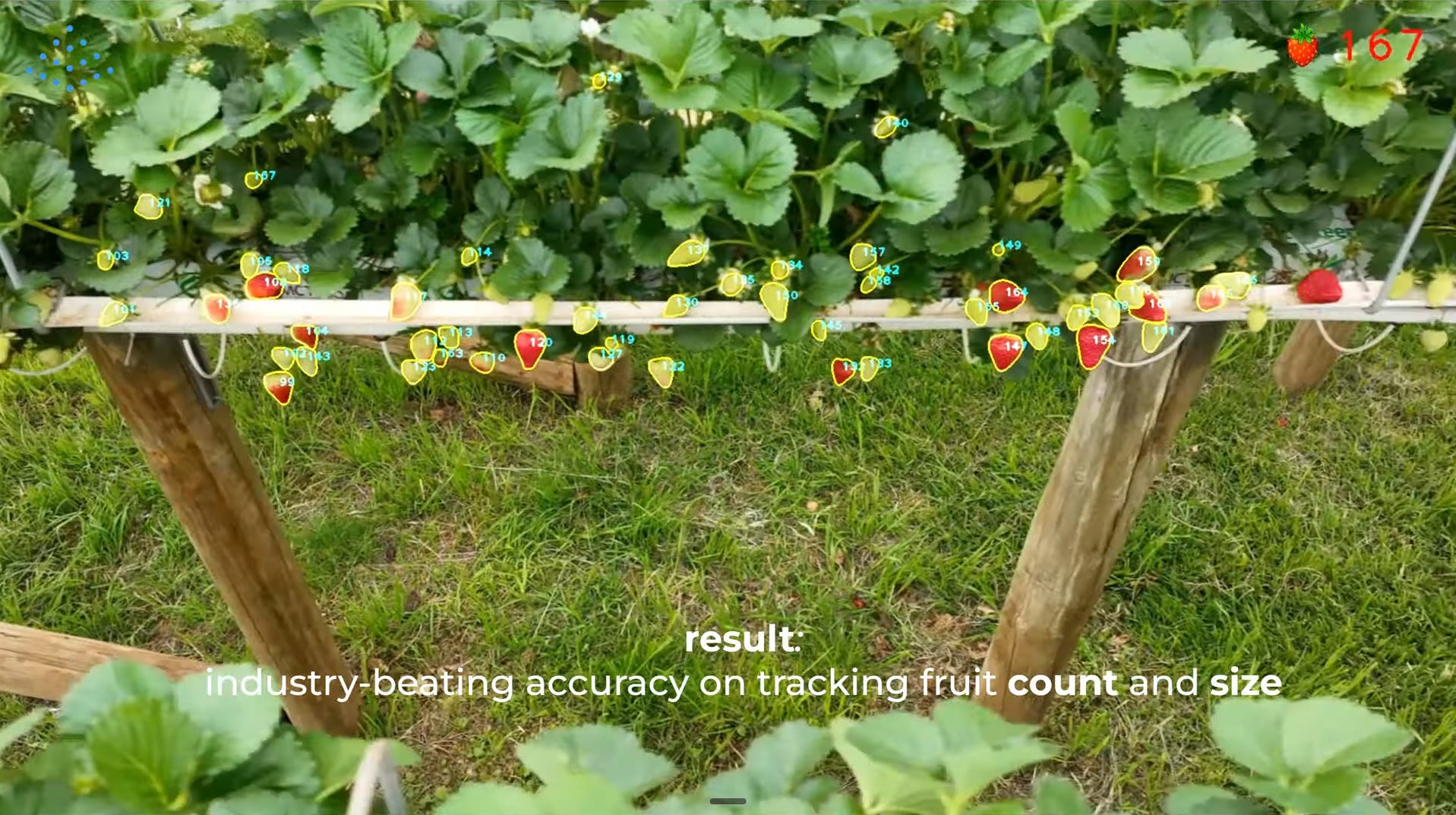
What they capture depends on the crop. On a fruiting crop, the system reads the fruit load, how much has ripened, and how fast ripening is tracking against the weather. On a vegetable crop, it reads growth rate and whether the plants are inside the buyer’s quality spec.
Cameras scan at millimetre precision, and the models count every plant, size every unit, and project a growth curve per block with confidence intervals. Polybee puts stand counts above 95% accuracy, measurement error under 3mm, and yield and sizing forecasts above 90% accuracy a week out.
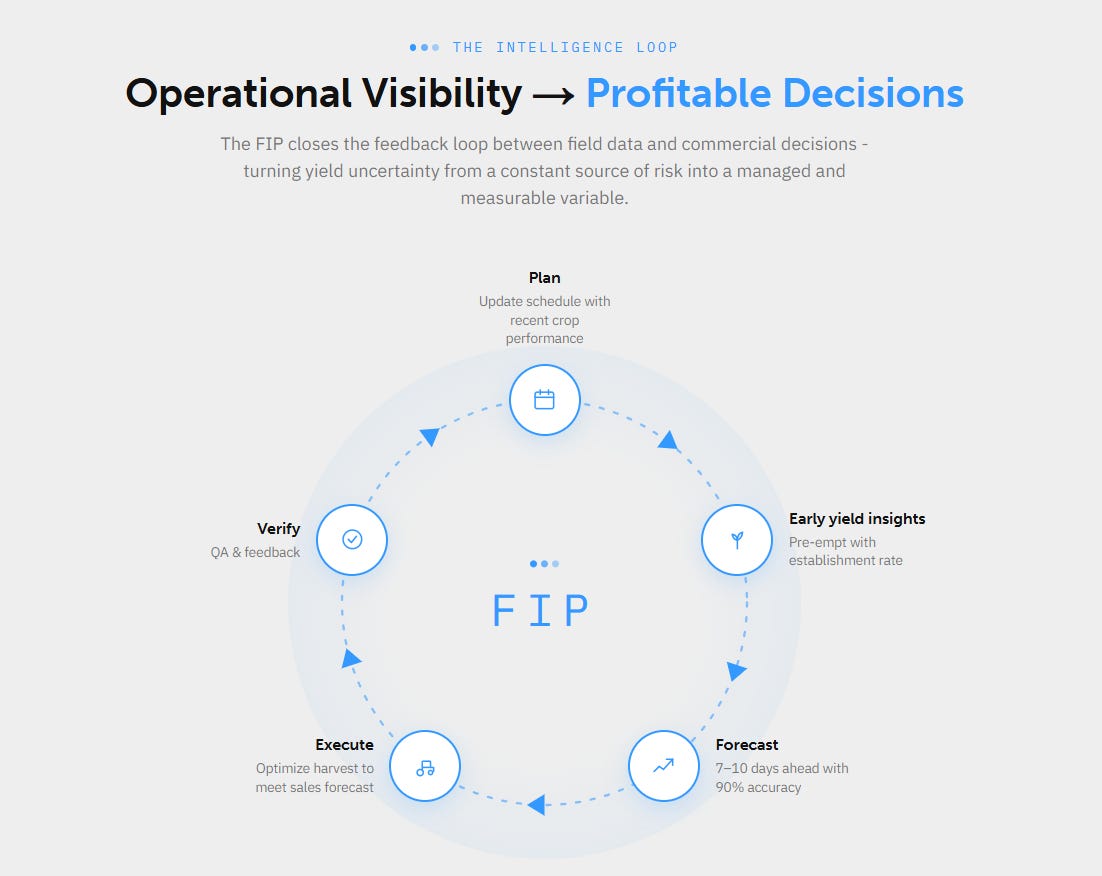
Everything the fleet collects lands in Polybee’s Farm Intelligence Platform, which is where a scan turns into a decision. It runs as three modules:
Forecaster maps plant establishment, yield and harvest readiness down to the row, for every planting and every block, every week.
Harvest Optimiser turns that into a weekly cutting schedule, balancing expected yield against packhouse capacity, weather, and what has already been sold.
Planner feeds the same signal back into production planning through the season rather than only at the start of it.
The loop those three describe is plan, forecast, execute, verify. Scan to insight runs about 12 hours, the forecast horizon is seven to ten days, and since the Bayer partnership, the same scan carries disease detection through near-infrared cameras.
Forecasting is live on spinach, broccoli, blueberries and lettuce, with tomatoes and strawberries in development. Polybee says growers save 30 to 50 hours a crop cycle and lift pack-out, the share of the crop that meets spec and gets sold, by 15%.
Pollination happens either without bees or without hands
Pollination runs on the same airframe and a different trick. The drone uses the downwash off its own propellers to vibrate a flower at the right frequency, roughly what a bumblebee does when it buzzes one. The vibration shakes the pollen loose, and nothing touches the plant.
The drones launch when the micro-climate is right rather than on a fixed clock, treat every row repeatedly, and log a timestamp and pass count for each plant. When the battery runs low, they dock, recharge, and resume where they stopped. Coverage runs one to three drones per hectare. Because no insect moves between crops, there is no disease transmission risk, which matters in a sealed greenhouse. It is live on tomatoes and strawberries, with blueberries and peppers in development.
Where bumblebees are available, Polybee complements them rather than replacing them, picking up the shoulder seasons when hives are hardest to manage. Where they are not, which includes Australia and much of South America, the job is done by hand. People walk the rows with leaf blowers, or whack the plants with sticks and hope. That is the incumbent Polybee is displacing.
“What initially seemed like a pond of opportunity is a sea of opportunity”
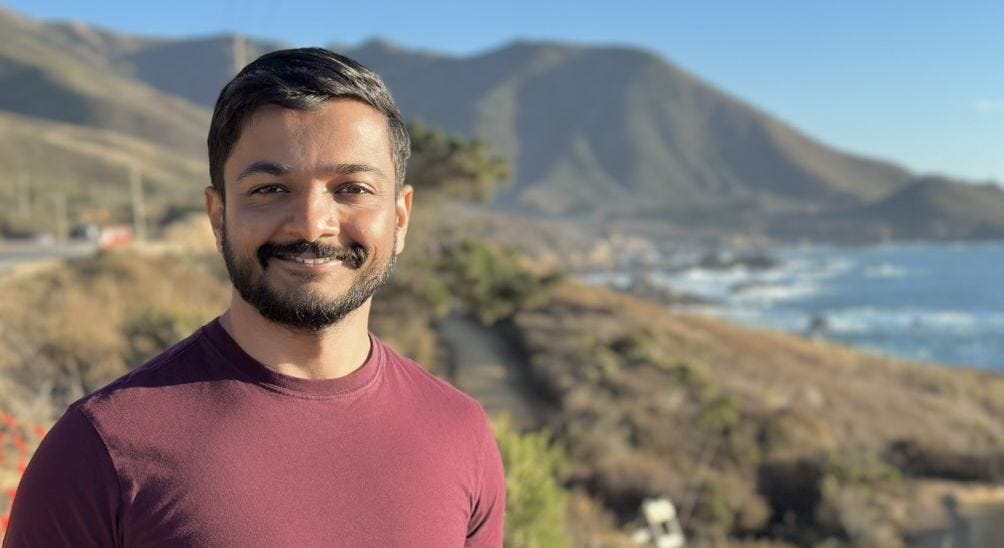
In 2018, Siddharth was three years into a research career at NUS and stuck on a decision. He had the PhD offers, and a clear enough picture of academic life to wonder whether he wanted five more years of it. Around the same time, he had started reading about agriculture, and what struck him was how little had changed since industrialisation and the breakthroughs in genetics and breeding.
Then his advisor roped him into NUS Enterprise’s Lean LaunchPad programme, a Singapore run of the Stanford course, wanting a hand with the market research. It carried no obligation. You went through it, you came out with a business plan, and what you did with it was your business.
Singapore in 2018 was talking about vertical farming, because indoors was the only way to grow much of anything on the island. That is the slice Siddharth went at, and he went at it as an engineer. Nobody in the industry had an obvious answer to the pollination problem, so he framed it as a technical question. Could you automate the job with drones?
So he built prototypes, called growers, showed up at events, and kept pulling. The signs were promising, and the adjacent problems kept appearing. “What initially seemed like a pond of opportunity is a sea of opportunity,” he said. That is when he spun the company out.
Visibility and control are the two things produce growers lack
Polybee did not stay indoors for long, and the customers are what moved it. Greenhouse growers came into the picture early, then open-field operations, and each of them kept putting the same question back to him. You are going to fly an autonomous platform around my whole farm with good cameras on it. What else can you tell me?
So Polybee went back and asked those growers what information they wanted and did not have. Across every crop and every growing environment, the answers converged on two things: visibility and control.
Produce farming has been unpredictable for centuries, and his thesis is that the root cause is the missing visibility and control. “We are building physical AI agents that turn unpredictable produce farms into data-driven factories,” is how he puts it.
Forecasting is the visibility product, because a grower who cannot see what is coming cannot plan against it. Pollination is the control product, because it lets a grower act on fruit set rather than hope for it. Both were picked for the same reason. They shift a grower’s numbers soonest, and the ROI is clear.
A working product is not enough. It has to work on the grower’s farm under their circumstances
Polybee now has a repeatable sales motion, built on case studies from early partners who let the company take their results to market. Their work proved three things. That the technology functions, delivers value, and has a real ROI.
“You still want to see it work on your farms under your circumstances,” he said, and he thinks agriculture is right to insist on it. Even a seed from an established breeder gets trialled before anyone buys at scale.
So the motion runs in two stages, and stage one is proof of value. Polybee’s advice to a new customer is to put the product on 20% to 30% of their production area and run it across three or four adjacent production weeks.
In developed markets, a grower is harvesting almost every week of the year, at close to the same volumes. That is what makes three or four consecutive weeks a workable test window. Follow the forecasts, follow the harvest timing, then compare those blocks against the status quo blocks next door.
The target Polybee sets itself is at least a 10% yield uplift, and it is charging against that number. Pricing is a fixed fee per hectare, with no drones to buy, and the promise of a 3x to 5x return inside the same crop cycle.
Commercially, the company reports 10% to 15% higher yields in spinach and broccoli when its harvest timing is followed, and up to 15% from pollination in strawberries and tomatoes. Its baby leaf spinach and broccoli case studies claim a 3x profit improvement.
Siddharth knows how that lands in a sector where input companies fight for single percentage points. Salad and leafy vegetables are extremely sensitive to when they are cut, and their spec moves with the crop stage. A couple of days either way moves yield by that much. That sensitivity is why Polybee started here rather than with easier crops.
The pollination number has a second layer. Those gains concentrate in the shoulder seasons, when bees are hardest to manage, and prices are at their highest. A 15% uplift on the most valuable fruit of the year is worth more than the percentage suggests.
Stage two is the whole farm, and that is where the money is. A grower moving from one kilogram per square metre to 1.05 or 1.1 is not just selling more product. They are spreading the same fixed costs over more of it. “That’s where my biggest margin uplift will come from,” he shared.
“Physical AI agents” means the job gets done end to end with nobody lifting a finger
Everyone is calling themselves an AI company right now, and the term has stretched far enough to mean very little. So what does Polybee mean when it says it builds “physical AI agents”?
Siddharth is aware the vocabulary is being used loosely. Polybee uses AI to get jobs done on the farm end to end. Right now, that is two jobs, pollination and forecasting, and the list grows as the company goes deeper into an account.
What that looks like in practice is fleets in seven to eight countries flying dozens of drones a day. Flights are pre-programmed, the drones recharge themselves, and they synchronise their own data. The only time a person walks into the field is to set the drone up and configure it the first time. After that, the system runs itself, and Siddharth describes what it becomes once it does: the central nervous system of the farming operation.
Farms are among the most unforgiving environments to automate, so the industry gets some grace for how hard scaling has been. But what he does not excuse is the design habit underneath it. Too many products have asked farmers to reorganise around the product.
That trade is fine for a trial and fatal for a rollout. “If you want to really scale a product, you have to fit into a farm’s operations and not the other way around,” he said. Some of the failure was immature technology. In 2026, he does not think that excuse holds.
The moat is the stack that keeps the fleet flying, and the data
Polybee combines high technical defensibility with immediate bankable ROI, as one of its investors described it, and that is a strong pair to hold in ag tech. Where does the company’s durable advantage come from? It starts with the unglamorous half of it.
Building this took autonomous navigation software that can orchestrate fleets. It also took data pipelines with the throughput to process what those fleets collect, reliably and at an economics that works for Polybee. Growers get results back within about a few hours, and that turnaround is itself an engineering achievement.
Three more moats sit on top of that stack. First, Polybee is close to patent grants across several regions on its pollination method. It uses turbulent airflow from the drone propellers to self-pollinate crops like strawberries and tomatoes, with blueberries coming.
Second, he believes Polybee is among the top few companies globally for produce crop data. That trove was built over years across a wide spread of environments, crops and varieties, which is what makes the models transfer.
Third, the partnerships. Polybee works with DJI Enterprise for priority stock, equipment discounts and a direct line to their R&D team. The stack is hardware agnostic, so in regions where it may not be as straightforward to use DJI products, another off-the-shelf drone does the job.
The problem is the same everywhere, but market structure decides who you sell to
Polybee is running in Australia, the US and the UK, on crops from spinach to strawberries. Across that spread, what travels and what has to be relearned?
The common denominator everywhere is the missing visibility and control. Polybee walks into a new region or a new crop, starts talking about forecasting, and hears a version of the same line every time. “Where has this been all this time? We have been looking for something like this for years.” Siddharth still finds the uniformity of that response surprising.
What differs is market structure, and it changes who you sell to. In the US, grower-shipper-packers hold much of the share. They run some of their own production, contract out the rest, process it, and deal directly with retailers.
That makes the shipper-packer the customer, not the contracted farmer. Polybee’s rule is to find whoever suffers from a bad forecast and can also act on a good one. A shipper-packer influences harvest timing across its contracted growers, so it can pull the lever. The contracted farmer is paid a fixed price per hectare and carries the production risk, so an accurate forecast leaves him nothing to do with it.
Elsewhere the answer inverts. A vertically integrated grower selling direct to a retailer holds the harvest decision and the retail relationship in the same hands, and that grower is the target. The product does not change. The ideal customer profile does, region by region, and getting it wrong means selling an accurate forecast to someone who cannot use it.
Advice for first-time founders: “If it’s not a resounding yes, it’s a no”
Siddharth is a first-time founder and had to learn fundraising, hiring, strategy and customer discovery at the same time. Two lessons came out of it that he thinks travel beyond agriculture to any B2B business.
The first is to sketch the customer’s ROI early, before you have earned the right to be precise about it. What does someone walk away with if they adopt this? Get it right to an order of magnitude at the start, then spend the pilot proving it.
That work becomes the proof-of-value stage and, later, the case study sales runs on. One condition: do it with development partners willing to walk the hard part of the road with you, and reward them fairly when the product commercialises.
Australia is where that played out. Polybee went there first for the proximity to Singapore, the R&D infrastructure and the tech workforce, and treated it as a sandbox. Growers including Perfection Fresh, Flavorite and Boratto Farms let the team onto their farms to test an unfinished product and work it out together.
The sandbox became the company’s second home. Polybee opened its ANZ headquarters in Melbourne in 2025, and Australian vegetable growers are the first market for the Bayer partnership. “Our early adopters are equal innovators alongside us,” he has said of them. “We wouldn’t have been able to build this product without their feedback and their involvement.”
The second is hiring, learned the way most founders learn it. “If it’s not a resounding yes, it’s a no,” he said. Do not talk yourself into an 80% yes with a 20% reservation, and do not hire because the opening is open and the candidate looks decent. Delaying is the cheaper mistake.
Want to connect with Siddharth?
Both products are commercially launched, early customers are scaling, and the channel partnerships are there to keep the pipeline fed. Polybee knows what the product is, what it is worth, and who makes a good customer. What comes next, in Siddharth’s own words, is growth.
Siddharth is open to hearing from growers, channel partners, and talent looking to join Polybee’s next stage. You can reach the team at info@polybee.co and Siddharth on LinkedIn.
Made in APAC 🌏
This is part of a series of conversations with founders and operators across the APAC region doing industry-leading work that shapes how we eat, grow food, and nourish ourselves.
Check out my first conversation with New Zealand ag tech unicorn Halter.
Stay tuned. More to come!
Unlock Asia’s trillion-dollar opportunity
Don’t miss your chance to attend the Asia-Pacific Agri-Food Innovation Summit and get 10% OFF with my network code. Use my exclusive partner code for 10% OFF your pass: BETTERBIO10. See you there!
If you found value in this newsletter, consider sharing it with a friend who might benefit from it!
Or, if someone forwarded this to you, consider subscribing.
Disclaimer: The views and opinions expressed in this newsletter are my own and do not reflect those of my employer, affiliates, or any organisations I am associated with.