

Hey, it’s Eshan. Welcome to Issue #160 of Better Bioeconomy. Thanks for being here!
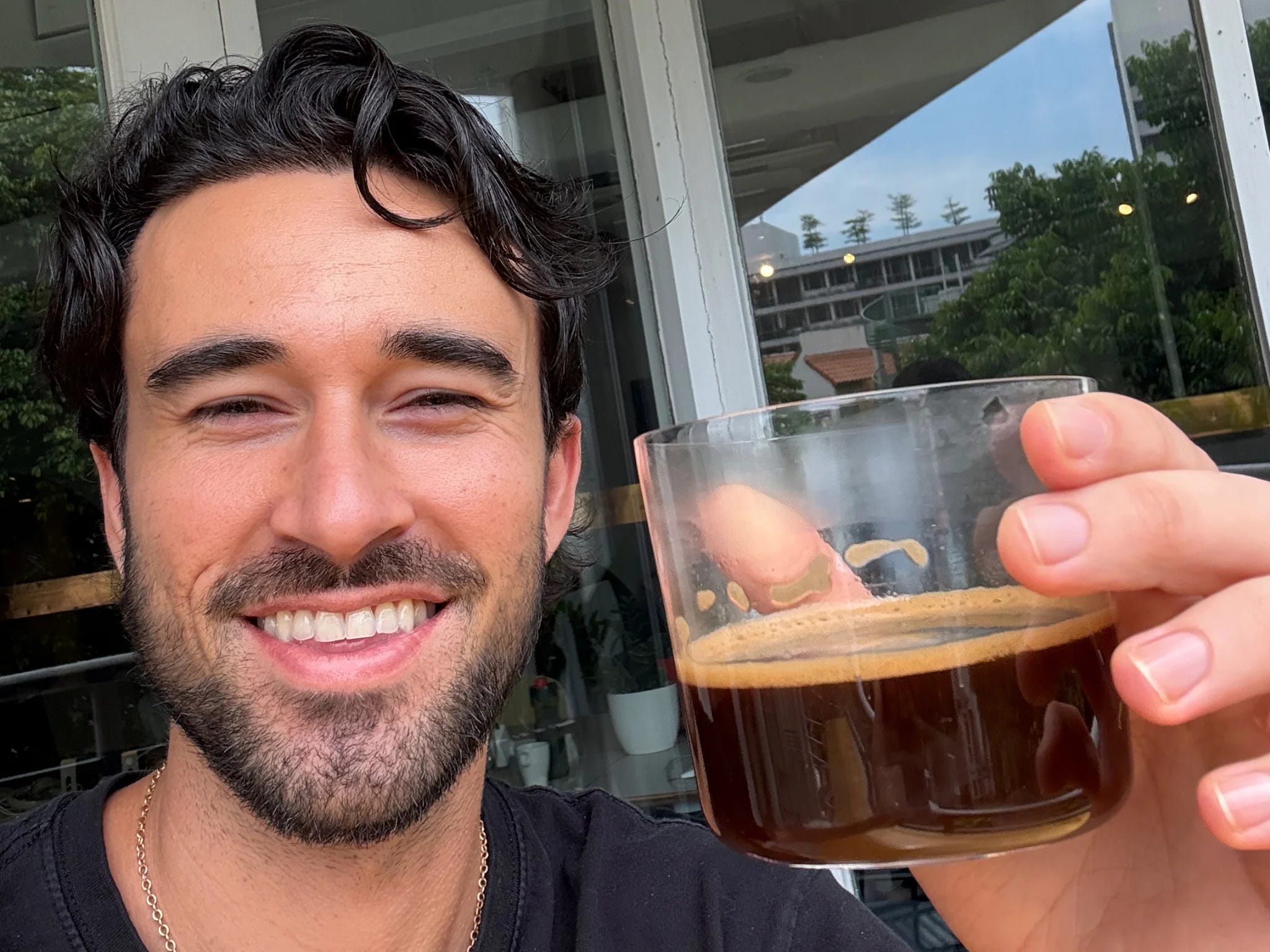
Last week, I sat down with Jake Berber, Co-founder and CEO of Prefer.
Disclosure before we start: Prefer is a portfolio company of Better Bite Ventures, where, at the time of publishing, I work. Nothing here comes from that relationship (other than the easy WhatsApp access). Everything below is what Jake told me, plus public reporting.
Arabica broke US$4 a pound for the first time in February 2025, after drought and heat cut supply out of Brazil. It spent the rest of the year setting fresh records. Cocoa went through a bigger shock, running to around US$12,900 a tonne in December 2024 as disease and bad weather squeezed West African production.
For the companies that buy those crops, a commodity problem becomes a P&L problem. Pay more, raise the shelf price, absorb the margin hit, or find a way to use less of it.
Prefer helps them do the last one while maintaining high quality. The Singapore company makes coffee and cocoa flavours by fermenting low-cost inputs, with no coffee or cacao in the supply chain. The output goes to large food manufacturers as an extender. Blended into conventional coffee and chocolate, their customers - coffee and cocoa brands and manufacturers - use less of the commodity without changing what the consumer tastes.
Prefer was founded in November 2022 out of Entrepreneur First’s Singapore cohort by Jake and Ding Jie (DJ) Tan. DJ is a former A*STAR scientist who moved from organic chemistry into fermentation. Prefer has raised US$7 million, most recently an oversubscribed US$4.2 million pre-Series A in August 2025.
Before starting the company, Jake studied neuroscience, worked in biotech, started and failed two startups, then took a venture analyst role while getting his MBA.
In our chat, Jake shared:
Why coffee and cocoa came first
Why the product moved from replacement to extension
What a manufacturer is really paying for
Why a B2B company runs a consumer brand
What it takes to close deals with big food companies
How Prefer plans to scale without owning the factories
Grab your coffee and let’s jump in!
Coffee and cocoa are supply problems before they are flavour problems
Prefer’s mission is to recreate the flavour and functional properties of ingredients through fermentation. Why did they start with coffee and cocoa?
“Coffee and cocoa share the same problem. Supply chains are volatile, and prices are rising,” Jake said. “They both grow on a weather-sensitive band of land near the equator, and demand keeps going up. Prices have reached all-time highs, and consumers are sick of the hikes.”
Fermentation was the tool that made it addressable. Coffee went first on commodity prices and market size. Cocoa was pulled in by the customer base. “Our customers who buy coffee often have chocolate too, and they asked if we could make chocolate flavours as well,” Jake said.
Making coffee without coffee means working backwards from the roast
A green coffee bean does not smell like a cup of coffee. The aromas we recognise appear when heat hits the compounds inside the bean. Sugars and amino acids react with one another and throw off hundreds of new browned, roasted flavour compounds. That is the Maillard reaction, and a roaster spends a career learning to control it.
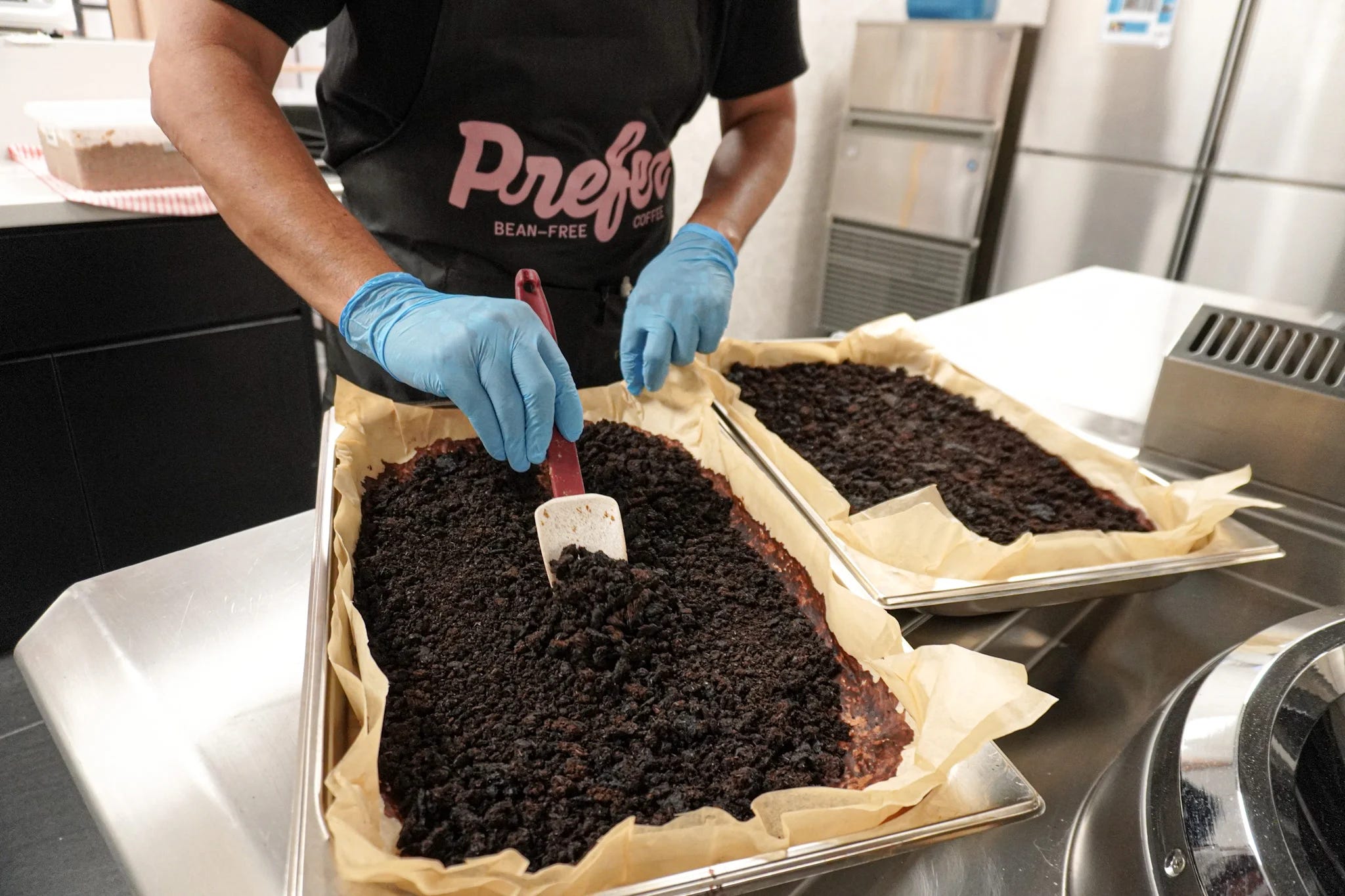
Prefer works that sequence backwards. Rather than growing a plant to produce those precursor compounds, it builds them with microbes, then roasts the result so the same chemistry runs. The company describes it in three steps:
Ferment food byproducts into flavour precursors
Roast the precursors to induce Maillard compounds
Process the material into whatever format a manufacturer needs
The technical half of that came from DJ, Prefer’s co-founder and CTO. Prefer’s first six months of R&D happened in his kitchen.
The feedstocks have changed as the process matured. The early Singapore batches ran on local manufacturing byproducts, including okara from tofu production, day-old bread and spent barley grain from breweries. The current PreferRoast formulation runs on broken rice and chickpeas, chosen for cost, allergens, consistency and industrial supply.
Fermentation is also what makes the output adjustable in ways a farmer cannot match. Prefer can change the microbes, the substrate, the fermentation conditions and the roast profile to steer where the flavour lands. The base product carries no caffeine, so caffeine gets added separately, which is why the range runs from decaf to double strength.
Two formats are in market. PreferRoast, launched in 2024, is the ground product. A soluble powder followed, which goes into instant sachets, ready-to-drink cans and concentrates. PreferChoc is the cocoa line off the same platform, and manufacturers have been testing it at 30% to 50% inclusion in place of regular cocoa powder.
Prefer stopped trying to replace coffee, and set out to complement it instead
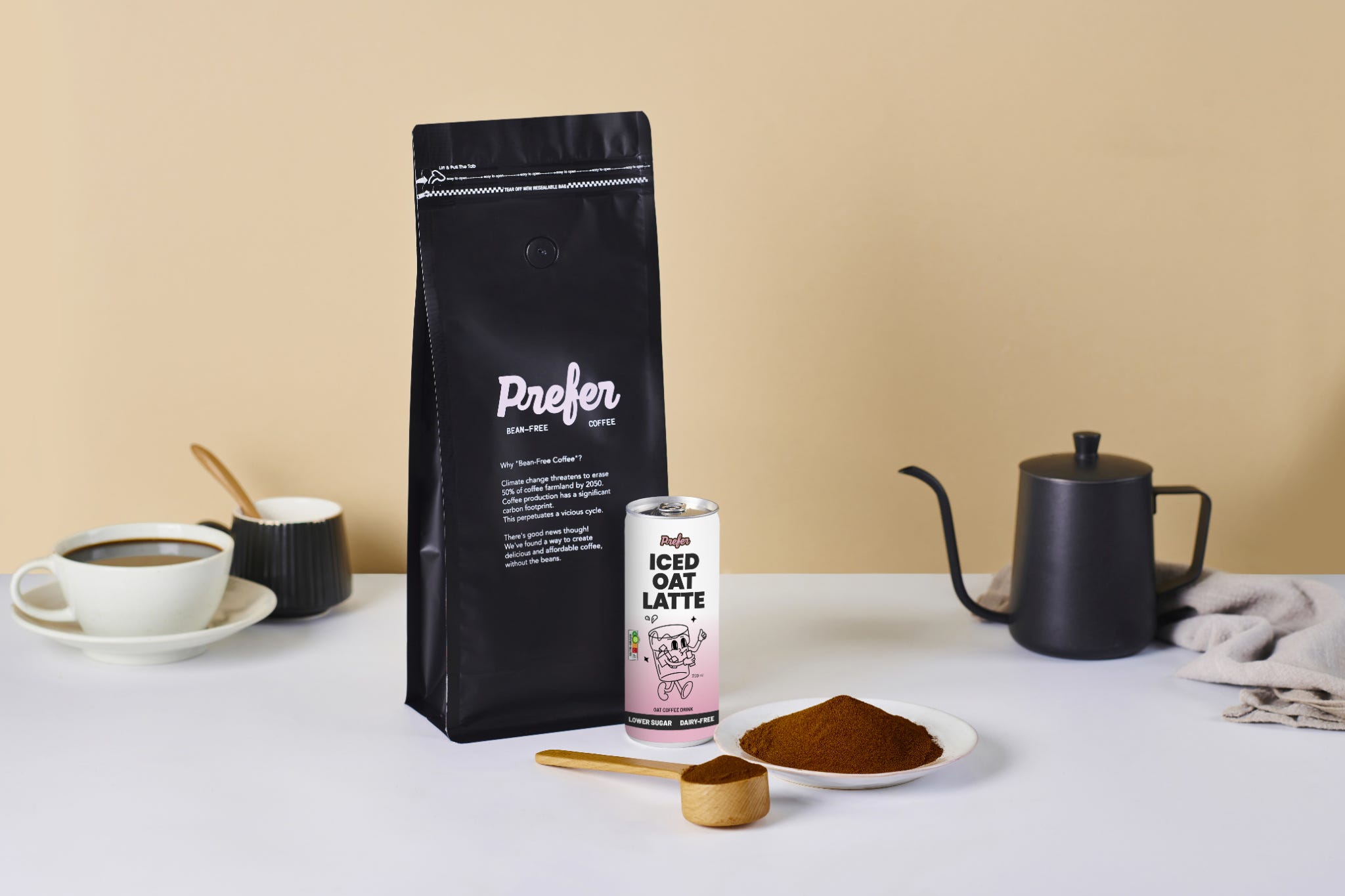
The company that first reached consumers was selling bean-free coffee, which sat on the shelf as an alternative to conventional coffee. The company selling today is offering a coffee extender, designed to be added to conventional coffee at up to 40% without a change to the flavour profile.
The repositioning came from the market. Nobody was shopping for an alternative. As Jake told The Spoon, “People wake up in the morning and say, ‘Dang, my coffee is a dollar more expensive today than it was a month ago.’” They want the cup they already like at the price it used to be.
“Customers asked for it; it solves the consumer problem of rising prices. They want the same product, but at the price they used to be able to afford. So by using our ingredients, coffee and chocolate companies are creating products that taste the same and cost less,” Jake said.
A full replacement asks a consumer to give up something they like for something unfamiliar. An extender lets the brand keep selling the same experience and change what sits underneath it. Green Queen has described the move as the blended-meat playbook applied to a commodity, and Jake uses the comparison himself. “We want coffee and chocolate to last, not end,” he told PEAK.
Prefer changed its own products too. The Iced Oat Latte was its debut consumer launch and a full replacement. It now uses PreferRoast as an extender blended with conventional coffee.
The company also changed which argument leads the sale. Its early pitch leaned on the climate case. “We worked out early that sustainability on its own wasn’t going to get a big food company to buy,” Jake said. “Taste and cost are what matter most, so that’s what we focused on.”
Prefer still quotes carbon, with a life cycle assessment putting PreferRoast at 8 times lower carbon intensity than grown coffee. But that number does not do the selling. The cost and consistency advantage opens the door, and the emissions figure becomes a supporting fact once the buyer is already in the room.
Price certainty is the product
So what is a large food manufacturer paying Prefer for? Cost and supply chain stability.
A coffee buyer sits between the commodity market and the consumer. Jake described the position as caught between a rock and a hard place, between what they pay for raw material and what consumers will pay. Absorb the increase for a while, then pass it through, reformulate, shrink the pack, or take the margin hit.
“We run a factory, not a harvest, so we can quote a price and sign long-term contracts on it,” he said.
A harvest is exposed to rainfall, disease, growing cycles and a global trading market, and it sets its own price and tells you afterwards. Sure, a fermentation process still carries input and energy costs, but far more of them can be engineered, forecast and written into a contract.
Prefer’s soluble powder comes in at a lower price than soluble coffee today. For a procurement team, the more valuable part of that is knowing the number will still be there next year.
Price certainty is the product. It is also why the applications skew to formats where the ingredient blends into a formulation such as instant coffee, canned lattes, chocolate drinks, brownies and confectionery.
The consumer brand is a sales tool for the ingredient business
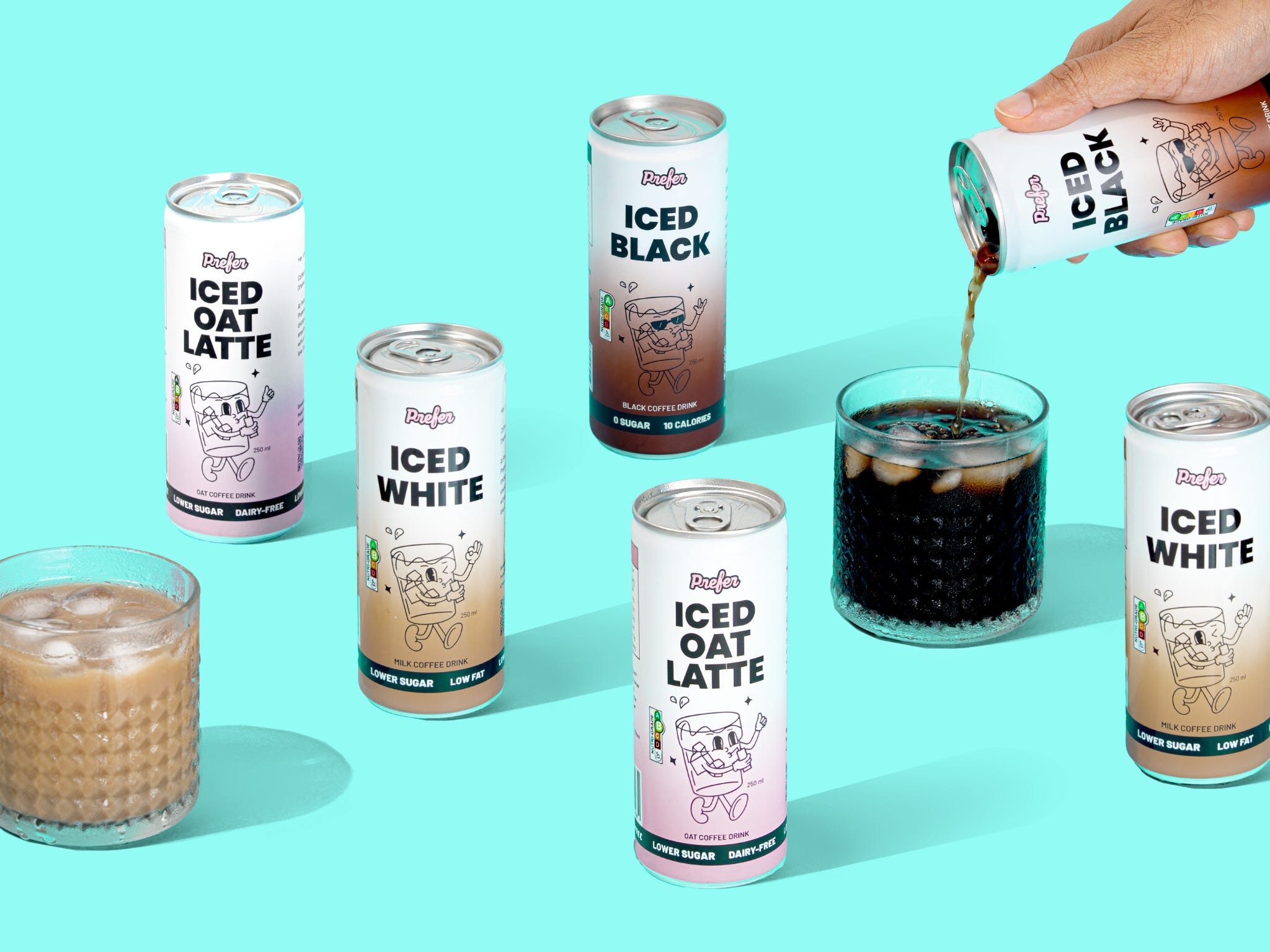
Prefer has built a real consumer footprint at home. “For our range of RTD (ready-to-drink) cans, we’re now in 250+ locations across vending, retail and corporate pantries, all in Singapore,” Jake shared this month. More recently, the cans landed in all 56 Shell forecourt shops and 90 Sheng Siong stores in Singapore.
While that may look like a company that started at the consumer and worked its way upstream, the direction never changed. “We started the business as a B2B company, and we’re still a B2B company,” Jake said. “It’s just taken a few steps and a few years to get where we are today, but the core assumptions for why we started Prefer remain.”
The consumer line is part of how they sell B2B. When Prefer is in a room with an FMCG buyer, the question on the table is whether consumers will buy this. “We can answer that with sales instead of a tasting panel,” Jake said, “which seems to be more effective at taking the risk out for them.”
A panel score says people liked the flavour, but a sell-through rate says they paid for it. Prefer’s canned coffee sales grew tenfold between February and July 2026, and the Shell listing followed that data.
Supply is the other reason. Prefer is sold out of its coffee production every month, so where each kilo goes is a real decision. A can of ready-to-drink uses a small amount of the ingredient compared with a bag of ground coffee, and it still puts the product in front of a consumer. Consumer formats buy more distribution per kilo than the same material sold any other way.
How a big manufacturer decides to adopt a new ingredient
Prefer is now working with larger food companies. What does it take to get a new ingredient adopted inside one?
“One thing that has been surprising is how much of the work they do happens in a black box,” Jake said. Once you win their interest and send application recipes and samples, the work moves to their R&D team to formulate, and the visibility drops away.
The team shows up in person and guides the customer’s R&D with its own suggestions, as far as the customer will allow. The timelines stay long, and the decision stays collective, which in Jake’s view is rational given what a formulation change costs a brand at scale.
“Volume only comes once you get the nod from R&D, QA, procurement and marketing,” he said. Each of the four is solving a different problem. R&D needs the ingredient to work in the formulation. QA needs it to behave the same way every batch. Procurement needs the economics and the supply to hold. Marketing needs to believe the finished product will sell. An enthusiastic innovation team is a long way from a repeat order.
And Prefer seems to have strong demand from those companies. “To date we’ve signed US$26 million in offtake MOUs (Memorandum of Understanding), and the focus now is turning those into recurring orders,” Jake said. The ingredient is already selling into Singapore, Japan and the Philippines, with Thailand next.
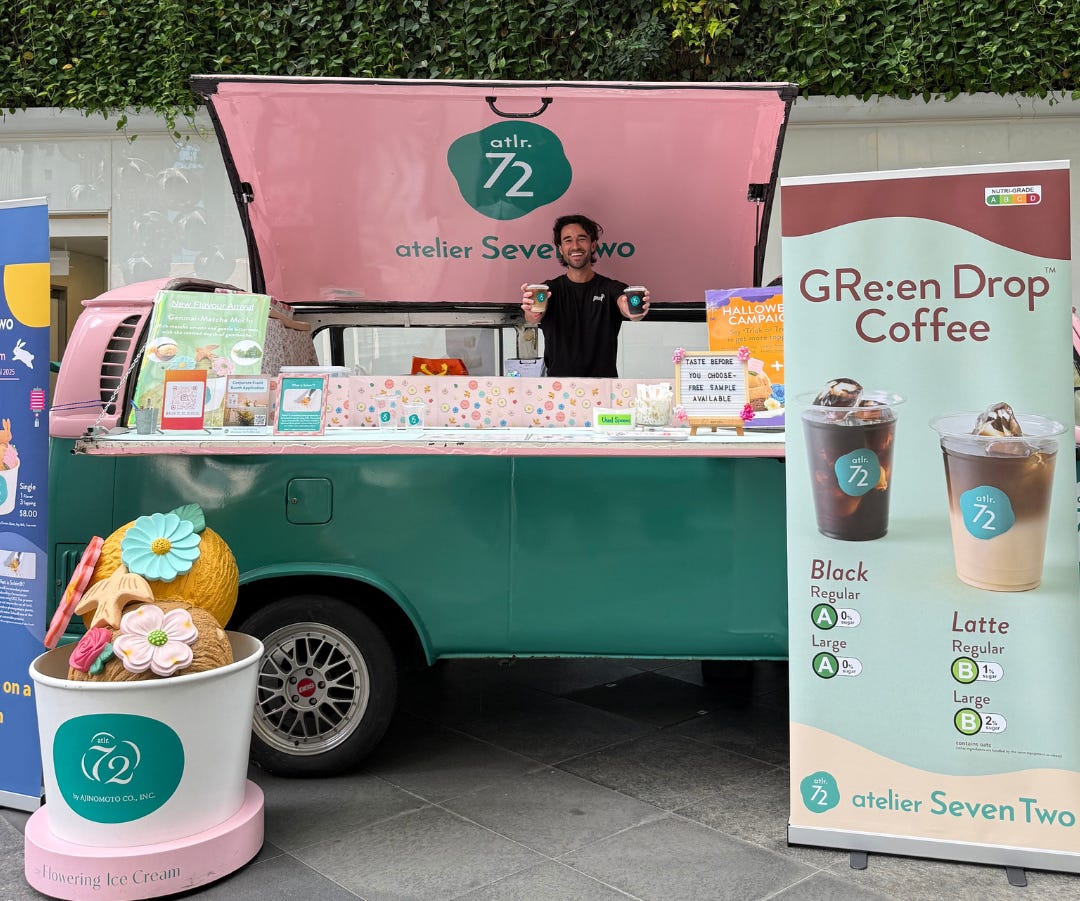
In October last year, Ajinomoto launched GRe:en Drop Coffee in Singapore under its Atlr.72 brand, a dairy-free iced latte built on 70% conventional coffee and 30% PreferRoast. More should follow as Prefer works the MOUs toward recurring orders.
The scaling up plan must match what the product promises
Every fermentation company reaches the point where the process has to leave the lab and run at commercial volume.
Prefer is at that point now. “Our pilot plant with 500 tonnes a year of annual capacity for PreferRoast and PreferChoc is commissioning this quarter,” Jake said. The company produces about 10 tonnes a year today, so the new plant is a 50-fold step up, and its first major equipment shipment landed in August.
Jake wants Prefer to own very little of the eventual manufacturing footprint. “In this space we pay per batch and own the process and some of the equipment,” he said. “That’s how we plan to scale, to keep CAPEX low and the potential for diversified manufacturing high.”
Prefer keeps the microbes, the process parameters and the IP. Somebody else keeps the building. For a company whose goal is a lower and more predictable cost per kilo, a capital-heavy factory network would work against the thing it sells.
Building for the mass market makes Asia-Pacific the obvious place to build
Several companies are rethinking coffee through technology, and most of them are building outside Asia, in the US and Europe.
Jake thinks Prefer is playing its own game. “In coffee, most of the others are building for a different customer,” he said. “We’re building for the mass market, with some of the biggest food companies in the world as our customers.”
“Our job is to make the lowest cost per kilo at the highest quality possible.” That single choice explains the extender model, the soluble format, and why cost leads the pitch while sustainability follows behind it.
It also explains the geography. “For manufacturing, APAC helps because CAPEX and OPEX here are lower, and when cost is one of two main value propositions, that’s super important,” Jake said.
Demand fits the same shape. “Asia has famously price-sensitive consumers, which is exactly who we’re building for,” he said, “and a lot of the coffee here is instant and ready-to-drink rather than specialty pour-over.”
Those are the formats a soluble extender was built for, which is why the early commercial work has concentrated in the region, from Ajinomoto in Thailand to 250 locations in Singapore.
The region matches the business model the company picked. If you sell premium coffee at premium margins, manufacturing cost matters differently. If you sell a mass-market brand, a way to take cents out of every serving, the cost of making each kilo is the competitive position.
That is what the next raise is for. Jake has said it would let Prefer “increase production another 10x, bring costs down further to reach profitability, and service customers globally.”
Want to connect with Jake?
Jake is looking for introductions to coffee and cocoa FMCGs, co-packers, flavour houses and private-label manufacturers. If that is you, or you know someone there, he would like to hear from you. You can reach him at jake@prefer.bio.
I’m Eshan. An operator-turned investor, backing companies in food, agri, nutrition, and health. I’ve been writing Better Bioeconomy since 2023, as a way to share my learnings and to connect with cool people like you. Thanks for reading!
If you found value in this newsletter, consider sharing it with a friend who might like it.
Or, if someone shared this to you, consider subscribing (it’s free!).
Made in APAC 🌏
This is part of a series of conversations with founders and operators across the APAC region doing industry-leading work that shapes how we produce food, nourish ourselves, and improve our health.
Check out my previous conversations:
Stay tuned. More to come!
Unlock Asia’s trillion-dollar opportunity

Don’t miss your chance to attend the Asia-Pacific Agri-Food Innovation Summit and get 10% OFF with my network code. Use my exclusive partner code for 10% OFF your pass: BETTERBIO10. See you there!
If you found value in this newsletter, consider sharing it with a friend who might benefit from it!
Or, if someone forwarded this to you, consider subscribing.
Disclaimer: The views and opinions expressed in this newsletter are my own and do not reflect those of my employer, affiliates, or any organisations I am associated with.