

Hey, it’s Eshan. Welcome to Issue #166 of Better Bioeconomy.
Insights on the companies and capital shaping how we produce food, nourish ourselves, and improve our health. Thanks for being here!
Quick personal note:
With Better Bite Ventures’ investment period wrapping up, I’m opening up some time for project-based work with investors and companies across agrifood, biotech, health and climate.
This could include assessing emerging technologies and commercial opportunities, scouting startups or conducting investment diligence, but I’m open to other stuff too.
If you have something in mind, reply (or drop me a note on LinkedIn) with a little about what you’re working on. Happy to chat about where I could help.
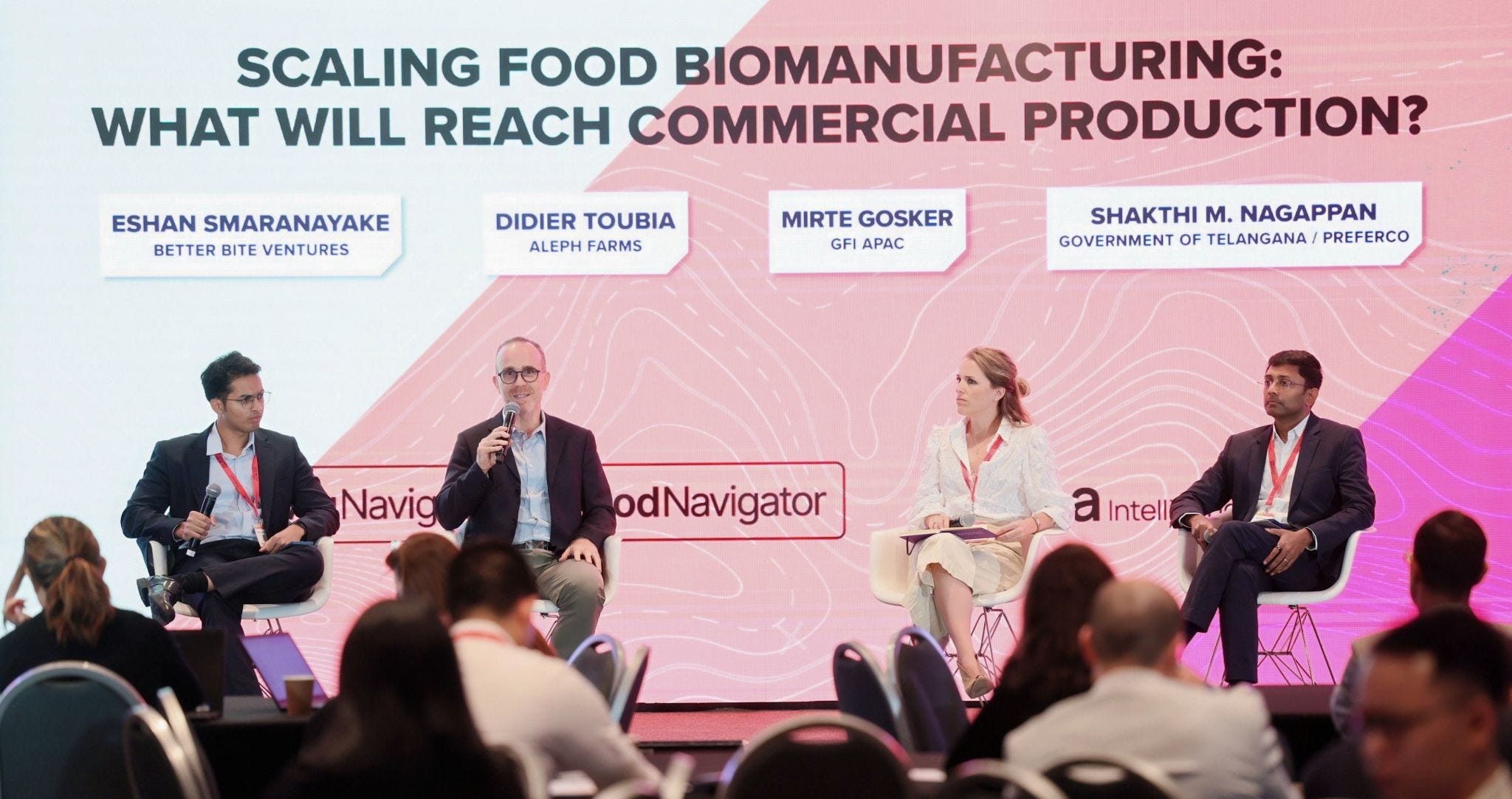
On 28 October, I moderated a panel on scaling food biomanufacturing at Asia-Pacific Agri-Food in Singapore. The question was what it will take to reach commercial production, and most of the answers came back to money and where it comes from.
I asked Didier Toubia, co-founder and CEO of Aleph Farms, how the funding environment had changed. He described letting production partners own and run plants. Shakthi M. Nagappan, PreferCo’s chairman and an adviser to the Telangana government, described providing shared utilities at industrial-park level so each company does not build its own. Mirte Gosker, CEO of GFI APAC, wanted governments and large buyers to commit to demand.
Each answer brought someone else’s balance sheet, or a different kind of money, into scale-up. It got me thinking about a broader question. Which kind of capital fits each stage, and what does each stage have to prove to unlock the next?
Each stage should be funded by the capital that prices its risk
Venture capital is largely built on software, where a few large winners pay for many small losses, and the money mostly buys people and code. A factory needs large, slow money, and most of it is lost if the technology underdelivers.
Each kind of funder is pricing a different risk. A venture investor backs the chance that a company becomes much more valuable. A lender needs a credible route to getting its money back, so it wants predictable cash and something to secure. A strategic partner may care more about supply or technology than about a financial return. A government wants jobs and an industry, and will accept lower returns to get them.
That is why funding gaps open between pilot and demonstration plants, and again before the first commercial facility. Returns and timelines there disappoint venture investors, while technical and market risks put off lenders. In both places, the company’s risks and timelines can fall outside what either investor is willing to accept.
Venture money is harder to come by. GFI’s 2026 fermentation industry report records $357 million raised by companies operating primarily in fermentation in 2025, down from $632 million in 2024. So a plan cannot expect venture investors to fund every facility that follows.
Steven Finn, co-founder of Siddhi Capital, put the funding question to me this way: “How many dollars do you need before you don’t need any more dollars?” Working backwards from positive cash flow shows how many handovers a plan depends on. Each round should buy the evidence that brings the next kind of capital in.
The first financing decision is what to make
The product decides how much scale, and so how much capital, a company will need.
TurtleTree learned that early. When I interviewed founder Fengru Lin in September, she told me the company started out trying to make milk from cultivated cells. People at Fonterra and Abbott both told the team that milk is a commodity, and the value is in the scarce proteins inside it.
Lactoferrin, which TurtleTree now makes, trades at several hundred to a few thousand dollars a kilogram. Whey and casein trade at a much lower price point.
TurtleTree is not alone. Several precision fermentation companies that started with bulk dairy proteins have added or switched to ones harder to obtain used in small amounts.
Better Dairy moved its near-term focus from casein to human osteopontin for infant formula. Vivici, set up by DSM and Fonterra, started with beta-lactoglobulin, a whey protein, and launched lactoferrin in the US in February on the same manufacturing platform.
More startups that started in bulk proteins are now pivoting into low-inclusion, high-value products. The pivot is pragmatic because the margins work at a smaller scale. A protein worth hundreds of dollars a kilogram can be profitable in rented tanks, while one worth a few dollars needs a very large plant to get there. That changes how much capital a company has to raise before its sales cover its costs.
At this stage, the risk is whether the science and the product work at all. There is no revenue to lend against and no asset worth securing, so debt does not fit. The money that fits can accept losing everything.
Grants and philanthropy fund the knowledge as much as the company. Pre-seed/Seed equity accepts high odds of failure for a small chance of a large outcome. And because scaling a biological process tends to reveal new scientific problems, this money should allow for more research than the plan assumes.
At pilot scale, rented capacity can be a cheaper way to prove the process
The next stage proves the process holds up as it gets bigger. For fermentation, the useful measures are titer, yield and productivity. They describe how concentrated the product is, how efficiently inputs become product, and how quickly it is made.
Results at 1,000 litres do not always hold at 100,000. A techno-economic analysis turns those measures into production cost and capital needs, but it is only as useful as its split between what has been demonstrated and what is still a target.
In an earlier diligence review, I questioned a cost model that assumed commercial uptime before continuous operation had been demonstrated. Short runs were useful for learning. I wanted the next tests to show whether the process could sustain the performance behind the projected unit cost.
Fixed costs make that gap expensive. Take a plant designed for 1,000 tonnes a year, with $1 million in annual fixed operating costs. At full output, those costs add $1.00 to each kilogram. At 800 tonnes, they add $1.25, and at 400 tonnes $2.50.
BCG’s 2024 analysis modelled large cost reductions from facilities needing $300 million to $400 million. It put design and construction at three to five years for the first facilities. A lower cost at full capacity is little comfort if the ramp towards it uses up the cash.
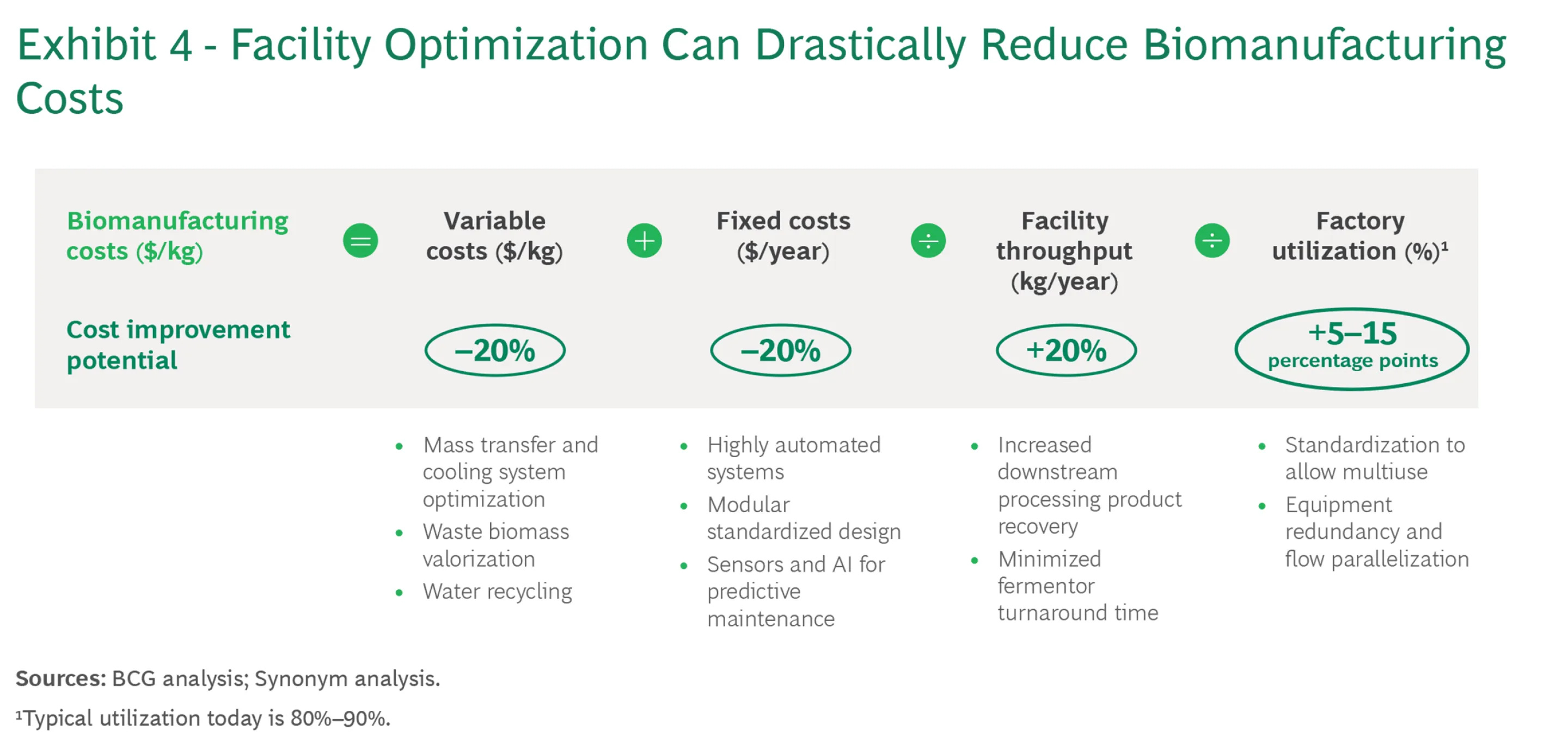
Venture equity can fund the technical uncertainty at this stage. A good result can re-rate the company before a larger capital commitment. Before buying pilot equipment, I’d compare ownership with suitable rented capacity, including fees, scheduling and process-transfer costs. Bespoke kit may be necessary to generate the evidence, but that decision should follow the testing plan.
Renting turns that capital spending into a fee. At the open-access Bio Base Europe Pilot Plant in Ghent, Cemvita completed a 75,000-litre fermentation campaign this year, and Cellugy ran its first 15,000-litre demonstration. In Singapore, ScaleUp Bio offers startups pilot- and industrial-scale fermentation. I’d agree in advance which data the next customer or funder will accept, so the fee buys evidence someone will act on.
Grants fit pilot work too, because governments get something back even if the company fails: skills, infrastructure and a domestic industry. That is also why they come with obligations. Horizon Europe’s grant guidance ties funding to agreed activities, budgets and reporting. Some carry equity.
The 2026 Sustainable Protein Grant Call from the Bezos Centre for Sustainable Protein at NUS and Enterprise Singapore offered up to S$1 million per startup. To accept, a startup had to give Enterprise Singapore rights to shares worth 50% of its S$500,000 portion. I’d check terms like that before counting an award as non-dilutive.
First commercial supply can run through someone else’s plant
At first commercial supply, the risk moves from the science to manufacturing and sales. The parties best placed to carry it are the ones who already run plants or need the product.
A contract manufacturer wants its capacity filled. A strategic partner values supply security or technology access, so it can accept terms a financial investor would not. A customer that wants the product can prepay for it. Owning a plant at this stage means raising equity for an asset before the company knows how much it will sell.
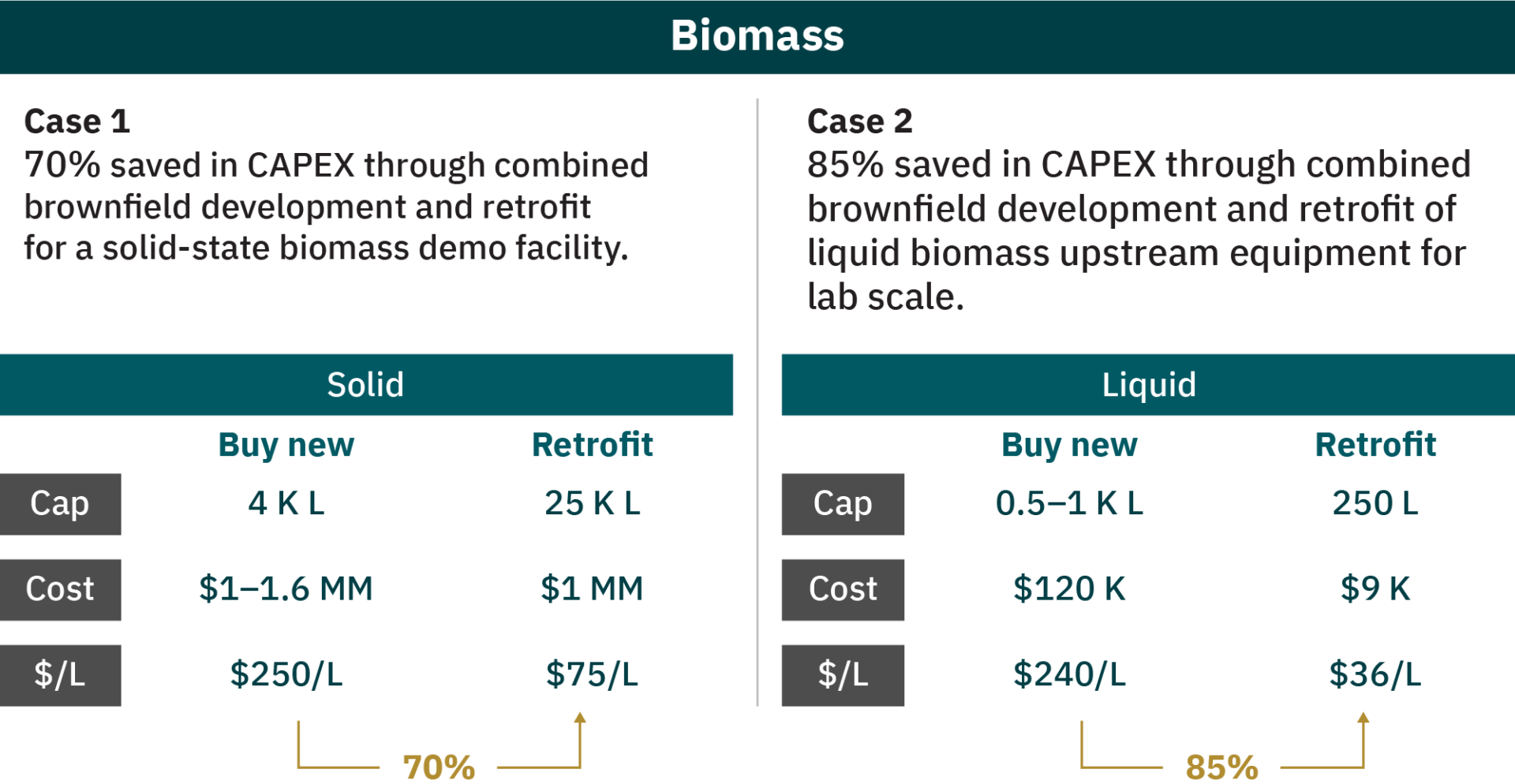
GFI and Integration Consulting’s 2023 manufacturing capacity analysis compares contract manufacturing, new builds and retrofits, and each creates a different funding need.
The EVERY Company has made its egg white protein with Bulgarian manufacturer Huvepharma for three years. In July, ADM agreed to produce it at commercial scale at Clinton, Iowa, with the operation expected online in 2027.
CEO Arturo Elizondo told Green Queen that wholly owned facilities often cost more than $200 million and take years to build. He said partners let EVERY scale "much faster and much more capital efficiently". The deal gives EVERY a route to more volume through a partner's plant.
TurtleTree took a similar route. Fengru told me it had interviewed about 30 contract manufacturers by 2023 and picked three, keeping its strain, process and regulatory file in-house. Aleph Farms is doing it in cultivated beef. On our panel, Didier described using production partners for biomass and starting in smaller markets such as Singapore and Switzerland to limit upfront investment. In June, Aleph extended that asset-light approach.
A partner’s plant still leaves things to fund. Lance Kizer, who led Huue’s bio-indigo manufacturing turnaround, described 18 months of preparation before its first multi-batch campaign at 50,000 litres, including capital upgrades and technology transfer. I’d ask who pays to reserve capacity, who covers a failed batch, who owns process-specific upgrades and whether the startup can recover that spending if the relationship ends.
However, not everyone thinks outsourcing gets costs low enough. Planetary CEO David Brandes told AgFunderNews that viable bulk-fermentation costs require owned, co-owned or exclusively accessible infrastructure. He sells an infrastructure and licensing model. His argument is more relevant for bulk ingredients with tight margins.
A strategic partner can go further and take on the scale-up itself. In July, Novonesis agreed to exclusively undertake efforts to scale, manufacture and commercialise TurtleTree’s lactoferrin for early-life nutrition. Fengru told me Novonesis wanted to see an advanced titer and a process already run beyond the pilot plant. TurtleTree had paid for that evidence on contracted capacity.
Buyers gain too. Fengru said they valued Novonesis’ ability to “underwrite the quality, the volumes that a big customer would need”, which a startup cannot easily promise. The price was exclusivity in early-life nutrition, the main market for conventional lactoferrin. That trade, and what each side contributes, belongs in the funding plan, so an investor can see what the partnership adds and what the startup keeps.
Once revenue or strong strategic backing exists, venture debt starts to fit. Venture debt can extend runway when a lender is comfortable with the company’s backing, liquidity and repayment plan. It often carries warrants. Revenue alone does not establish cash available for debt service, and repayment may still depend on another equity round. That dependence belongs in the cash forecast.
Customer commitments have to land between a letter of intent and take-or-pay
The evidence that opens up lending is a customer commitment. At the strong end, a take-or-pay contract obliges the buyer to pay for agreed volumes whether or not it takes them. At the weaker end, a letter of intent (LOI) records interest without a binding commitment.
Liberation Bioindustries, which is building a 600,000-litre contract fermentation site in Indiana, shows how hard the middle ground is. CEO Etan Bendheim said this summer that the site had qualified interest for well over 200% of its capacity. But he also described a LOI as offering little assurance, and a take-or-pay contract as hard to get before the plant operates.
Customers want an operating date before they sign, lenders want signed customers, and the plant needs that money before it can operate.
Founders can work through the loop with a sequence of commitments: paid development work, agreed qualification criteria, initial purchases and then longer supply arrangements. Each step should say what changes once the agreed evidence is delivered.
Established owners can get there earlier; e.g., BASF committed to Qore’s bio-based BDO almost two years before the Cargill and HELM joint venture’s plant started production.
For a startup negotiating its own agreement, I’d look at five things:
Volume: What must the buyer purchase or pay for, and when does that obligation begin?
Price: How does the selling price respond to feedstock, energy and other input costs?
Acceptance: Which specifications and qualification tests decide whether output must be accepted?
Duration: Does the commitment last long enough to support the proposed financing?
Counterparty: Can the buyer meet its obligations, and what happens if it terminates or defaults?
On our panel, Mirte suggested buyer coalitions, potentially supported by government incentives, and public procurement to build demand. The same five tests would apply to any agreements they produced. Bringing prospective lenders into these talks early shows which terms they can rely on.
A first owned plant needs contracts lenders can lend against
An owned plant becomes a candidate for debt when lenders can underwrite its performance, contracts and repayment cash flows.
Technical uncertainty can remain after pilot work, while construction and ramp-up add risks of their own. A lender accepts a capped return and security over assets and contracts, which could make debt less expensive than equity.
EXIM’s guidance asks for reliable future cash flows, creditworthy buyers, substantial sponsor equity and technical due diligence. Offtake terms help determine borrowing capacity, together with the process, project costs and other commitments.
Equity still has a job. Helen Lin, a partner at At One Ventures, argues that infrastructure financing depends on allocating risks across counterparties, through equipment warranties, construction contracts, customer commitments and insurance. Whatever risk nobody else will take falls to equity.
In my interview with Veronica Breckenridge, founder of First Bight Ventures, she argued for standard, financeable hardware, because it is easier to lease, refinance or resell. That widens the share of the plant a lender will fund.
Public loans and guarantees fit here because governments will carry part of the risk for jobs and a domestic industry, and accept terms a commercial lender would not. The USDA Business and Industry programme guarantees loans to eligible rural businesses after credit review.
In June 2026, Finland’s Solar Foods received decisions for a €39.6 million grant and a €38.1 million R&D loan for its second factory. The loan runs for ten years at 1%, with five years of grace. That gives the project more time before principal repayments begin.
Public money brings conditions, though. Solar Foods’ grant and loan both depend on the investment decision and on securing total financing. The grant is also paid against approved expenditure, so the company has to spend before the cash arrives. In its August half-year report, it still intended to take that decision in 2026, and listed binding offtake with large consumer goods companies as a priority. The grant waits for the full package, and lenders wait for customers.
Liberation shows what happens when the pieces do not arrive together. In January 2025, under its old name Liberation Labs, it reported $71.5 million in private capital, $30 million in equipment financing and a $25 million USDA loan guarantee.
By June 2026, construction had paused again at about 75% complete. On 29 September, shareholder Agronomics disclosed that about $25 million more was needed to complete, commission and reach first production, after expected financing failed to arrive and costs rose.
A four-month review found no acceptable offer for a sale or joint venture, so Liberation planned to finish with its shareholders. Each source in a funding plan needs a commitment date, payment conditions and a fallback.
AFYREN opened its plant in 2022 and is still ramping
The last stage can fall between funders. Lenders want stable cash flow, which a new plant does not yet have, and the construction equity has been spent.
AFYREN inaugurated its French biorefinery in September 2022, targeting 16,000 tonnes a year by 2024. Its September 2026 results reported 40% of capacity for 48 hours in July, a level it still had to sustain.
So the ramp needs equity reserved from the start. A $100 million plant funded with $15 million of grants, $40 million of debt and $45 million of equity balances on paper. Add $15 million for ramp losses and working capital and a $10 million contingency, and the equity requirement becomes $70 million.
Once there are receivables and inventory, working-capital lines can carry part of it, and dependable output can open up refinancing.
What each stage needs, and why
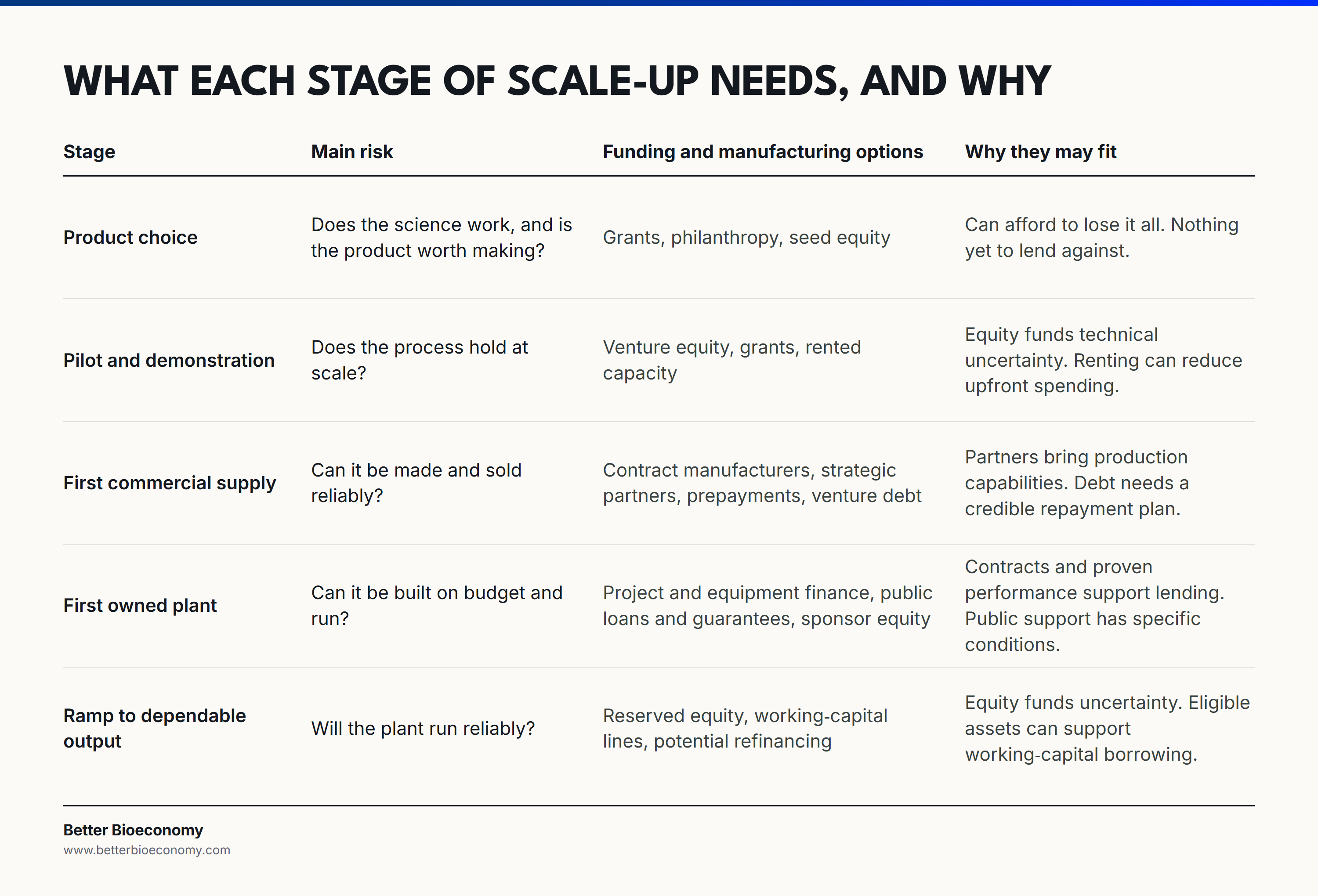
Before a first commercial plant is built, I’d want four questions answered:
Evidence before capacity: Which result would change the next funder’s decision, and can rented capacity or a partner produce it first?
Responsibilities and rights: Who pays for commissioning, failed batches and a slower ramp, and what rights or margin does the startup give up?
Commitments a lender can use: Which commitments are signed, which are conditional, and when does each one pay?
Cash through the ramp: Does the plan hold if a late start, slower output and delayed payments arrive together, and who covers a shortfall?
Some projects will not work, however the capital is arranged. Costs stay too high, demand falls short, or the right funders are not there. Sometimes the sensible call is to narrow the first application, use a contract manufacturer or postpone construction.
Our panel kept coming back to the same idea from different directions. I expect the companies that reach dependable production to be the ones that decide which money pays for each stage before they need it.
I’m Eshan. An operator-turned investor, backing companies in food, agri, nutrition, and health. I’ve been writing Better Bioeconomy since 2023, as a way to share my learnings and to connect with cool people like you. Thanks for reading!
If you found value in this newsletter, consider sharing it with a friend who might like it.
Or, if someone shared this with you, consider subscribing (it’s free!).
Disclaimer: The views and opinions expressed in this newsletter are my own and do not reflect those of my employer, affiliates, or any organisations I am associated with.