

Hey folks!
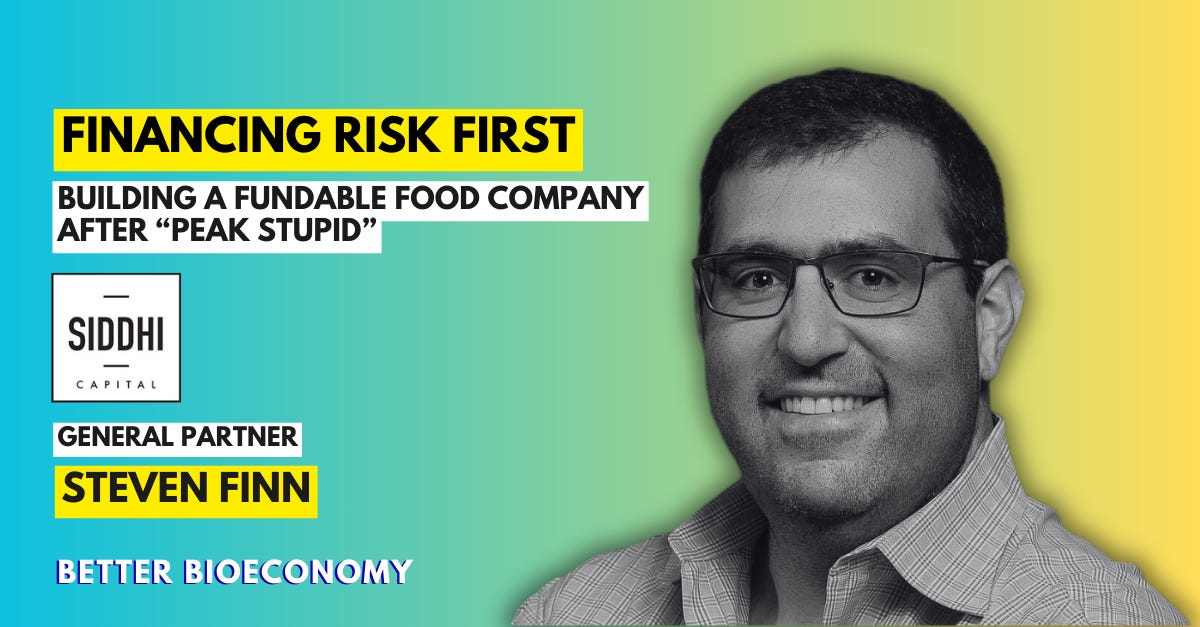
Thanks for being here. For Issue #141 of Better Bioeconomy, I sat down with Steven Finn, Co‑Founder and General Partner at Siddhi Capital.
Siddhi is an investment firm operating across two distinct verticals: consumer packaged goods brands and food technology. What makes the fund structurally interesting is that more than half the team aren’t investment professionals. They’re operators, inherited from a food systems consulting firm co-founded by Steven’s partner Melissa.
In 2022, that firm was folded as a standalone business, and its people were brought into Siddhi’s management company to work directly with the portfolio. The result is a fund that can, as Steven puts it, build your food facility and write you a check.
Steven leads the food tech side of the house. He came to it as an engineer first and an investor second, which shapes how he thinks about B2B businesses: always global in scope, always grounded in commercialisation mechanics. He’s refreshingly outspoken about the mistakes that got the sector into its current mess, and equally clear about where he sees the path out.
In our chat, we spoke about why the food tech investing climate is bad (and why that’s not the whole story), the structural trap of trying to do CPG and deep tech under one roof, how to think about cap tables in a sector still recovering from its own “peak stupid”, and where GLP-1 and AI are creating real opportunity versus just noise.
Let’s jump in!
The investing climate is bad, but drivers for innovation didn’t go away
The food tech investing climate is bad. Steven won’t sugarcoat it. But he draws a line between the sector’s PR problem and the underlying quality of companies being built right now.
The issue is structural to private markets. When a public market sector crashes, it crashes together, a shared bad moment that the market can process, price in, and move on from. Private markets don’t work that way. The companies that raised too much money at wrong valuations during what Steven calls “peak stupid,” roughly 2019-2022, didn’t fail at the same time. They’ve been dropping one by one over the years. That creates a bad news cycle that persists long after the underlying cause has passed.
The consequence: generalist money, which flooded the sector during peak stupid and then got burned, has stayed away. Access to capital has dried up. Valuations have compressed. And the slow drip of high-profile failures makes it look like the whole space is broken, even when companies founded later are doing compelling work on more disciplined capital structures.
“Dumb generalist money went to the wrong places in the first place,” he said. “That’s not because the companies aren’t doing great, amazing things. It’s because they raised the wrong amount of money at the wrong time.”
What he thinks people are missing is that the drivers for food tech didn’t go anywhere. Supply shocks are still coming. Wars, fertiliser disruptions and geopolitical fractures keep reminding the world how fragile food supply chains are, and each new crisis pushes eggs, cocoa, oils, and other categories back into the spotlight.
The difference this time, he argues, is that the biotech and ingredient infrastructure is “many steps closer” to being able to respond than it was during Covid. The tools are better, the playbooks are clearer, and there are more teams building around real price and taste rather than purely around narratives.
Siddhi’s answer is to keep writing checks, but not into companies that require a US$100M generalist-led round in 12 months to survive. Instead, they back businesses that can raise smaller, staged amounts from industry insiders while the market heals and can extend runway without dropping two-thirds of a round into CAPEX on day one.
The bet is that by the time these companies are ready for bigger capital, a couple of visible wins will have done the work of bringing generalist money back in. Not on 2021 terms, but on terms that reflect what the sector has learned.
Don’t try to do ‘tech and brand’ under one roof
Siddhi invests in both pure CPG brands and deep tech ingredient platforms, but Steven is adamant about one line they won’t cross: they do “zero companies that are trying to do both.” The two tracks run separately, collaborate closely, and don’t merge.
That conviction is shaped by scars from the consumer side. After years of getting “persistently and occasionally beaten” in CPG and watching brilliant scientific founders treat the consumer brand as the “easy part,” he has come to see tech and brand as two separate zero-to-one problems.
Putting both zero-to-one journeys under one roof does not double complexity. It turns it into an order-of-magnitude problem. The teams are different, the skill sets are different, and, crucially, the investor universes and valuation logics are different. For a tech platform, the early valuation may be anchored on IP, platform potential and B2B unit economics. But for a consumer brand, valuations are often anchored to revenue multiples and gross margins.
When a deep tech company bolts on a small brand because “the industry is moving too slow to adopt us,” it typically ends up being valued like a consumer business doing a few hundred thousand dollars in sales rather than like an ingredient platform with scalable upside.
“What was your last valuation?” he asks ingredient founders considering a consumer pivot. “Because the second you’re a consumer product, you’re valued as a consumer product, and you’re probably worth two to four times sales.” Go out and sell $100,000 of product in your first year, and you’ve just marked yourself down to $200,000 in enterprise value, regardless of what the underlying science is worth.
The bifurcated model Siddhi runs creates an edge on both sides. The CPG portfolio, growth-stage brands doing roughly $30-150 million in revenue, are big enough to be meaningfully distributed but small enough to move quickly and run ingredient pilots at small quantities. That gives the food tech side a real-world commercialisation channel and live feedback on what problems the CPG market needs solving. One side feeds the other. But only because they stay separate.
A great consumer brand is more defensible than a patent

Most investors in this space instinctively favour the patent. Steven doesn’t. His view is that both a brand and a patent are essentially zero-to-one exercises, rare, hard to build, and not as durable as they appear once achieved.
What undermines a patent in food specifically is that customers don’t care about the method. They care about the outcome. And in food systems, there is almost always more than one way to achieve the same outcome.
Take a cultivated meat bioreactor company, which builds a compelling case: there aren’t enough steel bioreactors in the world to feed people at scale, it’s a real constraint. That argument resonates until the day you receive a pitch on molecular farming, where plants become the bioreactors, and the capital intensity problem largely disappears.
Same consumer goal. Entirely different path. “We’re solving the same problem so many different ways,” Steven said, “that I think patents are great, but businesses are better.” The clearest implication: IP is a starting position, not a finish line.
What this means practically is that Siddhi evaluates defensibility less around IP and more around whether a company has a real business: customers, recurring revenue, and relationships that can’t easily be replicated.
A brand that has earned shelf space, consumer loyalty, and retailer trust is harder to dislodge than a patent that a well-funded competitor can design around by approaching the same problem from a different scientific angle.
The “financing risk first” mindset to underwrite startups
The phrase “financing risk first” is Steven’s shorthand for how Siddhi underwrites deals now versus four or five years ago. The key question he asks early is: “How many dollars do you need before you don’t need any more dollars?” From there, he works backwards into a multi-year fundraising plan tied to specific value inflection points and milestones that change the way a future investor can underwrite the business.
In the “peak stupid” years, founders could get away with a hand‑wavey “we’ll raise a big Series B from generalists in 12 months” as part of the story. Today, that is an immediate red flag. Siddhi wants to see rounds sized and timed around realistic timelines to tech de-risking and commercial proof.
That includes a path to strong EBITDA, not just the maximum cheque size the market might bear. And it includes practical questions: can this company extend runway if needed, or have they structured the business so that two-thirds of a round goes into irreversible CAPEX on day two, leaving no ability to slow burn or pivot if the next raise takes longer than expected.
This financing‑risk lens also shapes which stage Siddhi is solving for in which vehicle. Their earlier-stage capital is often aimed simply at getting a company to a credible Series A: proof that the tech works, first customers, a sense that there is a real market pull.
The main growth fund, which writes larger checks and leads Series A and B rounds, underwrites an exit case that looks more like private equity than IPO. That means baking in the assumption that the business will need to become highly profitable and will likely be sold on EBITDA multiples, with strategic acquisitions treated as upside rather than the default exit path.
In practice, for a growth-stage entry, they are aiming for a world where, if things go right, their base case looks like a 5-6x return on invested capital, which they then mentally haircut to a 3x to account for the fact that “anything that can go wrong will go wrong.” That math only works if the company is still alive at the exit. Which is why the conversation about unit economics, total capital required to reach cashflow positivity, starts on day one.
A cap table can kill a good company
Steven is almost evangelical about cap table engineering. He has written multi‑part LinkedIn posts breaking down how preference stacks and misaligned valuations quietly kill otherwise good food companies, and those posts are how I first came across his work.
For context, a cap table (short for capitalisation table) records who owns equity in a company and on what terms. In any fundraise or exit, it determines who gets paid first and how much.
His diagnosis of the last cycle is that many companies raised the wrong amount of money at the wrong time, at the wrong price, and then felt compelled to take only “huge swings” to try to justify it. As those swings missed, as most huge swings do, the cap tables that had once signalled ambition turned into anchors.
If a company raised US$100M at a US$300M pre‑money valuation, and now needs to raise at US$5M pre because the world moved on, a naïve approach might be to just stack the new round on top and hope for the best. In reality, that leaves US$100M of liquidation preference ahead of the new investor, which means most realistic exits go almost entirely to the old money and leave the new round with very limited upside.
That kind of structure kills deals: new investors cannot underwrite to a reasonable outcome, teams know they will never see meaningful upside, and everyone is trapped waiting for a fantasy exit that will never come.
Steven’s rule is that the cap table must reflect the moment the company is in and the path it is now on, not the frothiest part of the last cycle when a prior round was raised. If the business model, market, or financing reality has changed, the cap table has to change too. Otherwise, all the baggage of the past surfaces every time a round, extension, or exit comes up.
Getting there means figuring out who the insiders are that still have capital to support the company, whose signatures are required to authorise any restructuring, and who needs to receive something in exchange for cooperation. It’s messy work. But the alternative is a company that keeps getting blocked by its own history, deal after deal, even when the fundamentals are strong.
GLP-1 is the AI of food, for better and worse
When Steven said “GLP-1 is our AI,” he meant it both ways. On one hand, GLP-1 drugs represent a genuine platform shift. The percentage of the population on these drugs is rising fast, and the behavioural changes, smaller portions, reduced appetite for ultra-processed food, and a shift toward protein-dense options are already showing up in purchasing data.
Importantly, the effect radiates beyond the individual user. As households adjust, the ripple is larger than the headline number suggests. A lot of Siddhi’s CPG portfolio, protein-forward, better-for-you brands, are well-positioned. And as consumer purchasing shifts, ingredient adoption on the B2B side will follow faster.
But on the other hand, just as every company in the AI era is suddenly an “AI company,” every food startup now has always been a “GLP-1 companion.” The positioning is often reverse-engineered after the fact. There’s real bubble risk here, and Steven has seen the pattern before.
On AI itself, he understands the productivity case for AI-powered CPG salesforce tools, one human managing an army of agents doing prospect research, initial outreach, and pipeline filtering. What he doesn’t see is the investment case. “I struggle to see the investment case in that software company,” he said. “I don’t see a moat.” These tools are, in his view, “next-generation services businesses” that will live or die on sales execution rather than on proprietary technology.
And the platform risk is real. Because the underlying models are controlled by a few large players, he expects those LLM providers to watch which use cases take off and then “eat the lunch of their wrappers” by adding the most successful functions natively, in the same way Shopify absorbed some of its own app ecosystem into the core product.
That does not mean AI is irrelevant to food tech. Where he sees the genuine case is in tools that remove hardware from the loop in bioprocess development: running virtual bioreactor experiments in silico in seconds instead of in steel over weeks, with outputs reliable enough to drive real decisions.
For a cash-strapped sector, anything that compresses the iteration cycle and reduces the amount of physical experimentation needed changes the shape of budgets and timelines in fermentation, cell culture, and other process-heavy categories. Those tools are harder to commoditise because they are built on the actual physics and biology of the problem, not on a prompt. That is the difference between AI that creates a moat and AI that just borrows one.
If you enjoyed this article, you might also like


If you found value in this newsletter, consider sharing it with a friend who might benefit from it! Or, if someone forwarded this to you, consider subscribing.